

College of Education
Preparing Future Educators With Quality Education Programs
For over 70 years, GCU has proudly maintained its rich heritage as a teachers’ college, both on campus and online. Our College of Education continues to prepare educators, school administrators and policymakers who strive to deliver quality education and help enrich lives across a variety of academic and community settings.
While GCU's College of Education is committed to nurturing your development as an educator, our dedication to your education extends beyond the classroom. We teach the spirit of servant leadership, innovation and service into each program through One Foundation, our Christian worldview. Education and teaching degrees are offered online, on campus or in the evening for your convenience.
Loading Form
You may be able to offset tuition costs with a GCU scholarship.
View ScholarshipsChoosing one of GCU’s education programs can equip you with a firm foundation to shape tomorrow’s future. Implement strategies that can help you think more critically and potentially position yourself for a career with an undergraduate degree in education. Integrate philosophy with practical knowledge within one of our master’s in education degree programs. You can also enhance your knowledge in specific areas with a certificate program or individual education courses.
Loading Degree Programs

Multiple AAQEP Accredited Degrees
GCU maintains its standing as a participating member of the Association for Advancing Quality in Educator Preparation (AAQEP), an accrediting body acknowledged at the national level by the Council for Higher Education Accreditation. The College of Education also aligns its curriculum with the standards set by the Higher Learning Commission, national accreditors and professional affiliates. These standards help us produce credible, qualified teachers and professionals through our education degree programs online and on campus.
Education degree programs that lead to licensure in the College of Education are approved by the Arizona State Board of Education.
Why do future educators choose GCU?
- GCU’s College of Education offers initial teacher preparation options for bachelor’s and master’s education degrees.
- Field experience, exam preparation and student teaching are part of your learning journey.
- The curriculum for our education programs online and on campus align with national standards.
The Canyon Center for Character Education (CCCE) at GCU, supported by The Kern Family Foundation, aims to build a national movement around character education. The College of Education at GCU uses a vast network of students, faculty, alumni and partners to promote school cultures that encourage human and societal flourishing through virtue formation.
By embedding character education competencies in our college education programs, the CCCE hopes to cultivate future leaders and educators equipped to serve their students with character formation. Through partnerships with schools across the nation (pre-K-12 public, private, charter and faith-based schools), the CCCE aims to support educators in implementing character education initiatives. Visit the CCCE website to learn more.
To access resources created by the CCCE, you can also visit their page on the Student Success Center.

FAQs for College of Education Programs
Discover concise answers to common queries about our College of Education, offering insights into our programs, faculty and resources. This section is designed to comprehensively address your questions and hopefully provide a deeper understanding of education programs at GCU.
As a Christian university, Grand Canyon University and the College of Education take a proactive approach to developing students’ servant leadership skills and the growth of our alumni in educational settings. While the college’s accredited programs are designed to prepare and equip students for a career in the field of education, we (faculty, staff and college leaders) understand the unique opportunities and challenges a career in education might present. We strive to assist all College of Education graduates who need additional support or who are experiencing challenges in an educational setting; and since 1984, we have upheld this promise. Support might include content-area teaching materials, certification testing resources, course curriculum assistance or faculty mentoring. To honor this promise, the College of Education asks graduates to pledge to uphold a high level of excellence in their educational setting.
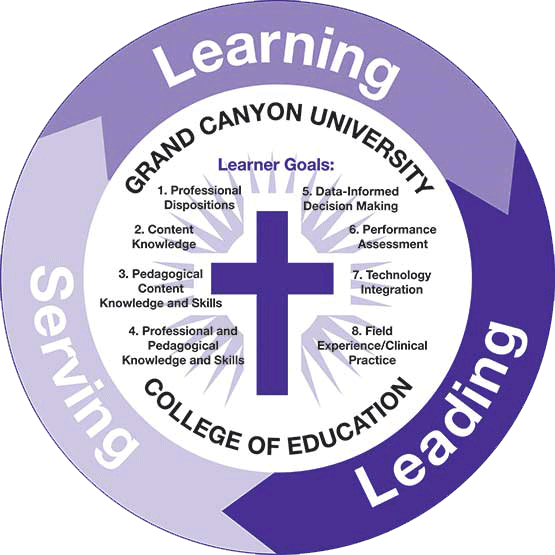
Learning
We believe that all students can learn and that educators who inspire excellence often engage in best practices and strive to maximize student learning achievements. Effective educators are typically experienced and skilled communicators who are dedicated and compassionate, to help ensure that all students are provided the tools needed to learn to the best of their ability.
Leading
We believe education can be a powerful tool to purposefully transform and uplift communities. As our candidates find their purpose and calling within education, the college aims to support candidates to reach their God-given potential and fulfill their passion in education by helping them lead with a keen focus on addressing the world’s deep needs.
Serving
We believe in the spirit of servant leadership and are committed to serving all candidates by empowering them to work toward becoming global contributors who strive to change their communities and the world. As faculty, staff and candidates, we believe in serving educational communities with an innovative and adaptive spirit. Leading with a strong dedication to professional conduct, ethics and respect for the diversity of others, excellence for all may be achieved.
Integration of GCU’s Christian Identity in Curriculum
GCU curriculum ensures that spiritual and ethical values are woven into the educational experience, fostering a holistic approach to learning. This initiative aims to nurture not only academic growth but also the development of character and values within students.
Through intentional communication and thoughtful actions, education faculty integrate the Christian identity and mission into the curriculum through dynamic engagement with students in the classroom. In turn, students can live out their faith in pre-K-12 practicum field experience and student teaching.
Students in an education program can directly benefit from GCU’s mission by becoming an educational innovator that can adapt and change to serve the deep needs of communities. This takes place through innovative, faith-integrated curriculum, instruction and engaging, hands-on learning opportunities such as practicum field experience and student teaching. Students can contribute to GCU’s mission by engaging in active learning through courses taught by knowledgeable education faculty and demonstrate their learning both in the classroom and out in the field.
Education students can experience GCU’s One Foundation principles through an integration of faith into the curriculum. This is demonstrated by the education faculty who strive to model virtuous behavior and the integration of virtues into the curriculum, which are found in the College of Education’s Professional Dispositions of Learners, as well as the nationally recognized Model Code of Ethics for Educators (MCEE).
The education program at GCU promotes the principles of human flourishing by equipping students to go into the field of education to serve the needs of their communities. This is accomplished through a wide variety of education-based program offerings that are innovative and adaptive to the current educational climate. These programs are taught by faculty who seek to help all students flourish in their chosen program and future profession.
If seeking licensure or certification, applicants to the program are responsible for contacting their state department of education for licensure requirements and program approval. In addition, fingerprint and background clearance is required.
1 Drexel University School of Education. (n.d.). What To Do With A Teaching Degree Besides Teach. Retrieved on Dec. 12, 2023.
2 Vilorio, D. (2016, June). Teaching for a Living. U.S. Bureau of Labor Statistics. Retrieved on Dec. 13, 2023.
3 Indeed. (2023, Jan. 26). How To Get a Teaching Certificate After Earning a Bachelor's Degree. Retrieved on Dec. 13, 2023.
4 U.S. Bureau of Labor Statistics. (2023, Sept. 6). How to Become a High School Teacher. Occupational Outlook Handbook. Retrieved on Dec. 13, 2023.
5 U.S. Bureau of Labor Statistics. (2023, Sept. 6). How to Become a Kindergarten or Elementary School Teacher. Occupational Outlook Handbook. Retrieved on Dec. 13, 2023.
6 U.S. Bureau of Labor Statistics. (2023, Sept. 6). How to Become a Postsecondary Teacher. Occupational Outlook Handbook. Retrieved on Dec. 13, 2023.
If you are ready to apply for GCU's College of Education or have additional questions about enrolling into a teaching degree program, contact us today!