

Undergraduate Environmental Science Degrees
Explore Sustainable Solutions for Global Challenges
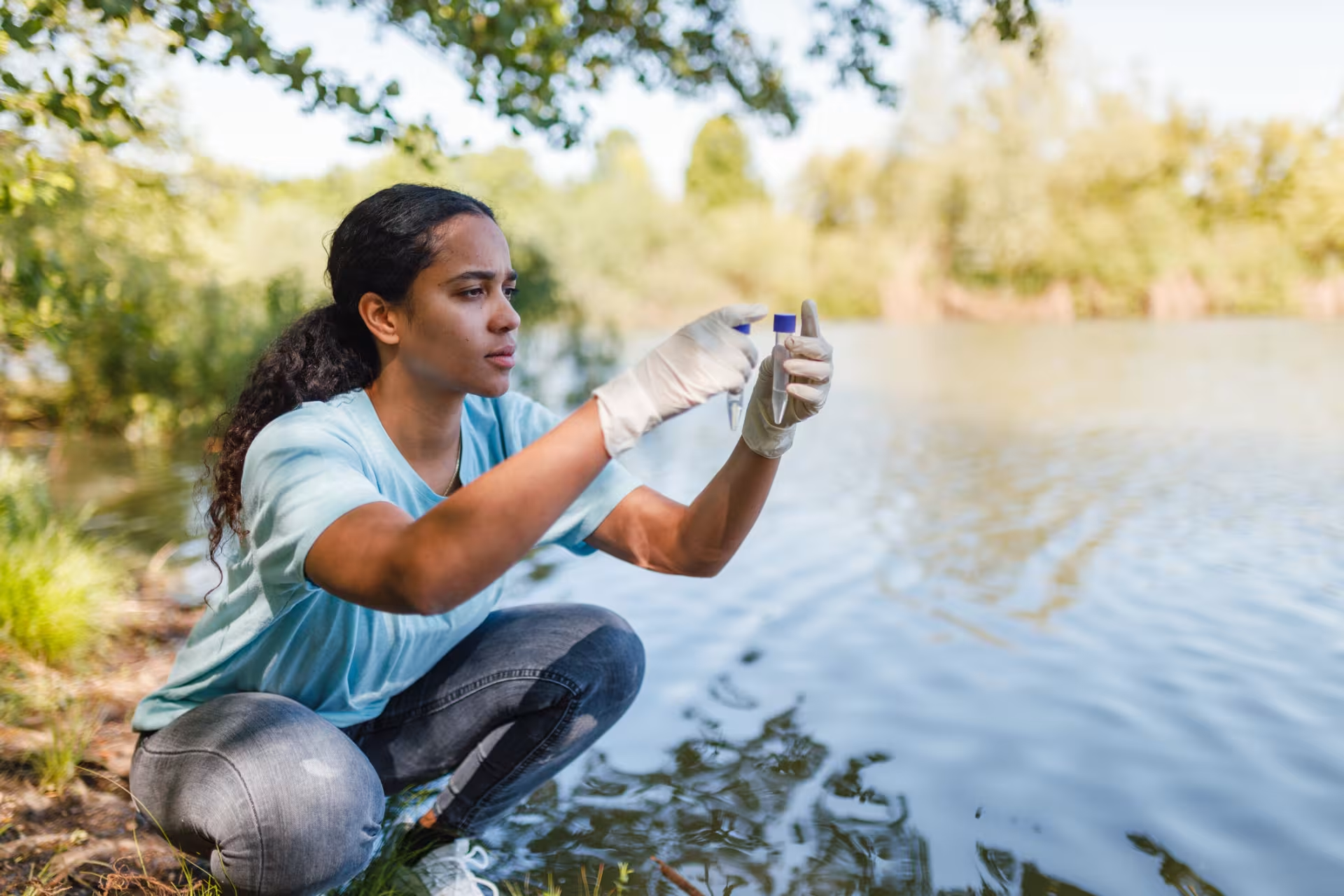
Studying environmental science at Grand Canyon University isn’t just about textbooks and lab reports; it’s about decoding the language of ecosystems, tracing the chemistry of clean water and modeling the future of ecological living.
With courses spanning biology, sustainability, ecology, geology, environmental law and ethics, undergraduate degrees in environmental science at GCU invite you to explore the planet’s most precious resources through a scientific lens.

Discover Undergraduate Environmental Science Programs
Our environmental science degrees aim to empower students to explore the natural world through faith-based learning while gaining the scientific skills needed to address today’s environmental challenges. These experiences can be found within GCU’s undergraduate environmental science degree options, including:
Hear From Our Faculty
"Our environmental science programs provide a strong foundation in ecological principles, environmental policy and applied science. We will teach students to critically assess data, design sustainable solutions and communicate across disciplines."
"Our environmental science programs provide a strong foundation in ecological principles, environmental policy and applied science. We will teach students to critically assess data, design sustainable solutions and communicate across disciplines."
Coursework for Degrees in Environmental Science

Through a curriculum grounded in scientific inquiry and ethical reflection, you will examine how environmental factors can influence both natural systems and communities. You might find yourself analyzing desert soils one week and simulating climate patterns the next.
Coursework emphasizes practical and analytical skills in:
Conservation biology
Ecology
Biodiversity
Renewable energy
Environmental contaminants
Data interpretation
Climate change studies
Environmental policy
Earth and marine sciences
Natural resource management
Career Opportunities for Environmental Science Majors
The environmental studies coursework taught in GCU degree programs encompasses scientific concepts that are relevant to future careers in conservation science. These skills can help you prepare for roles in the field of natural resources and sciences.
Environmental science degrees may lead to the following careers:
Wildlife biologist
Environmental scientist and specialist
Environmental engineer
Forest and conservation technicians
Marine biologist
Health and safety engineer
Median annual wage for environmental scientists and specialists as of May 2024(See disclaimer 1)
Estimated openings each year for environmental scientists and specialists from 2024 to 2034(See disclaimer 2)
Frequently Asked Questions
Browse through our list of frequently asked questions and answers to get all the information you need about becoming an environmental science major.
What is environmental science?
What do environmental scientists do?
What can you do with a degree in environmental science?
Pursue Environmental Science With Purpose at GCU
Choosing GCU for your undergraduate environmental science degree means joining a university where faith and science work hand in hand to shape thoughtful, purpose-driven leaders. Rooted in a Christian worldview, the program teaches students to approach environmental challenges with integrity, compassion and a deep sense of stewardship.
Beyond the classroom, GCU provides a range of academic support and career-focused resources, making it a place where your passion for the planet can grow into a thoughtful profession.
Our admission process is designed to be clear and supportive, so you can focus on what matters most: your passion for protecting the planet and serving others. Review our admission page or contact a university counselor through the form on this page for more personalized guidance.
GCU has maintained institutional accreditation from the Higher Learning Commission since 1968, reflecting a long-standing commitment to academic excellence. The College of Natural Sciences upholds these high standards, offering programs designed to align with GCU’s tradition of quality and integrity in higher education.
Located in the heart of Phoenix, Arizona, GCU offers more than just hands-on learning and access to diverse ecosystems — it provides a vibrant campus life rooted in Christian values. From labs and welcoming residence halls, the campus fosters connection, discovery and personal growth. It’s a place where you can build lasting friendships while preparing for a career in environmental science.
Student Resources
At GCU, you can benefit from knowledgeable faculty, rigorous programs, comprehensive resources, research groups, modern labs and dedicated support throughout your academic journey. Learn more about the campus and academic resources available to make the most of your GCU experience.

Explore the balance between understanding nature and protecting it within our undergraduate degrees in environmental science. Begin your impact-driven education with GCU today.
- The earnings referenced were reported by the U.S. Bureau of Labor Statistics (BLS), Environmental Scientists and Specialists as of May 2024, retrieved September 2025. Due to COVID-19, data from 2020 to 2023 may be atypical compared to prior years. BLS calculates the median using salaries of workers nationwide with varying levels of education and experience. It does not reflect the earnings of GCU graduates as environmental scientists and specialists, nor does it reflect the earnings of workers in one city or region of the country or a typical entry-level salary. Median income is the statistical midpoint for the range of salaries in a specific occupation. It is very unlikely that a median salary will reflect an entry-level salary. It represents what you would earn if you were paid more money than half the workers in an occupation, and less than half the workers in an occupation. It may give you a basis to estimate what you might earn at some point if you enter this career. Grand Canyon University can make no guarantees on individual graduates’ salaries. Your employability will be determined by numerous factors over which GCU has no control, such as the employer the graduate chooses to apply to, the graduate’s experience level, individual characteristics, skills, etc. against a pool of candidates.
- COVID-19 has adversely affected the global economy and data from 2020 to 2023 may be atypical compared to prior years. Accordingly, data shown is effective August 2025, which can be found here: U.S. Bureau of Labor Statistics, Occupational Outlook Handbook, Environmental Scientists and Specialists, retrieved September 2025.
- U.S. Bureau of Labor Statistics. (2025, Aug. 28). Environmental Scientists and Specialists: Work Environment. Retrieved Sept. 12, 2025.
- Indeed. (2025, March 3). What Is An Environmental Scientist? (And How To Become One). Retrieved Sept. 12, 2025.
- U.S. Bureau of Labor Statistics. (2025, Aug. 28). What Environmental Scientists and Specialists Do. Retrieved Sept. 12, 2025.