


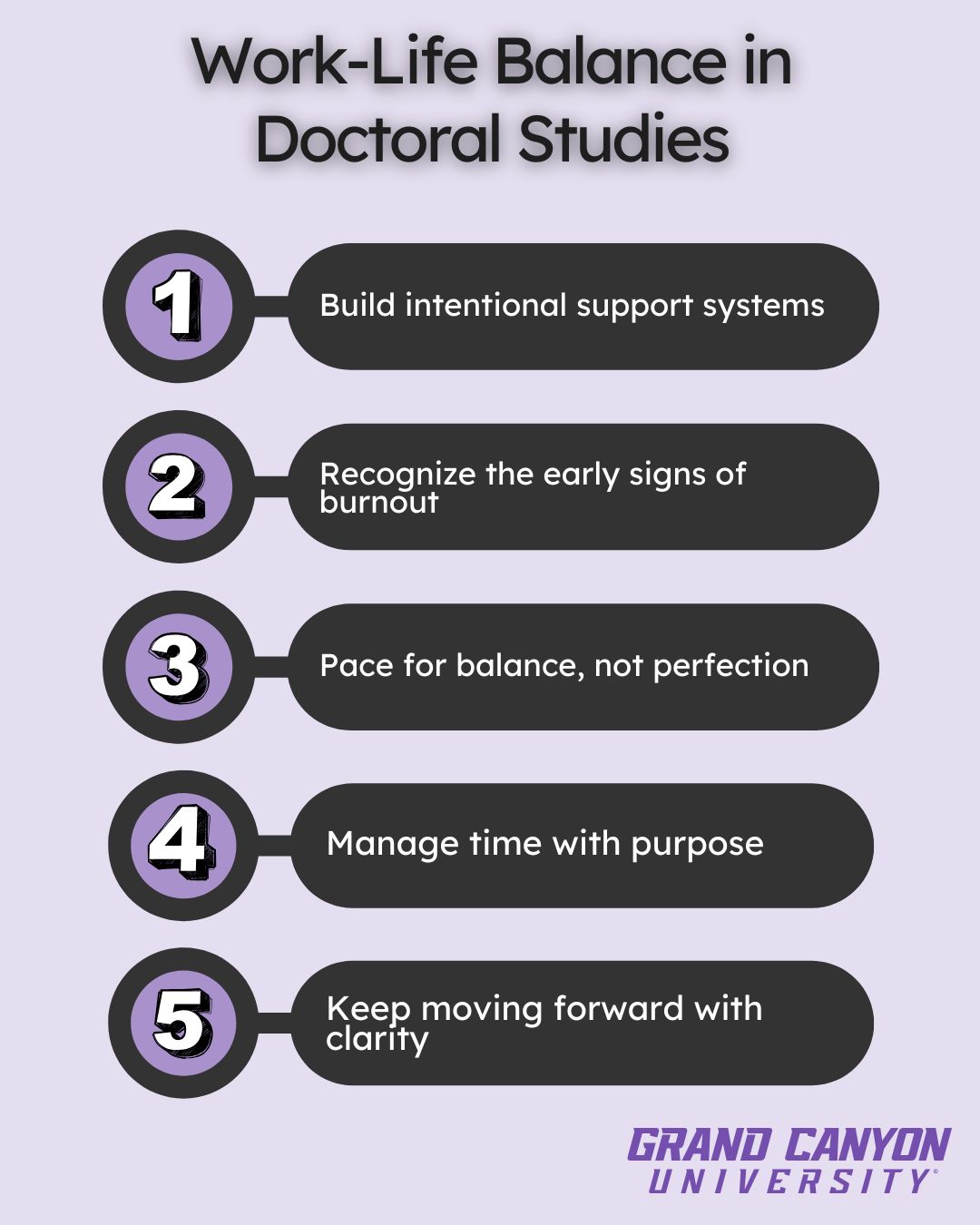
Many doctoral students perceive work-life balance as unattainable due to the demands of research, exams and other commitments. However, those who successfully navigate their degrees often view balance as a set of intentional choices. They stress the importance of setting boundaries and prioritizing meaningful activities.
This case study explores sustainable balance during a doctoral journey through insights from Dr. Kelly Maguire, EdD, and alums, Dr. Desiree Jackson, PhD and Dr. Lily Skots, PhD, who share their experiences managing coursework, teaching, research and personal commitments. Together, they reveal that achieving balance involves prioritizing tasks, building supportive networks and adapting to unexpected challenges.
Why Work–Life Balance Is Challenging at the Doctoral Level
Doctoral programs require a unique level of intellectual, emotional and logistical endurance, distinguishing them from undergraduate and master’s studies. Unlike earlier degrees that follow a clear structure, doctoral pursuits involve ongoing expectations beyond coursework.
Doctoral students often juggle:

Dr. Kelly Maguire, GCU adjunct faculty with the College of Doctoral Studies, explains that the challenge involves not just workload, but also the mental and emotional exhaustion that builds up from years of sustained academic effort. “It’s different because it’s not just about completing a task,” Dr. Maguire explains. “It’s about having that sustainability to go for the long run. A doctoral program takes a lot longer. That sustainability — intellectually and emotionally — over a long period of time can sometimes get the better of you.”
A doctorate involves ongoing cycles of reading and revision that can hinder students’ sense of completion. Milestones often depend on external factors, such as committee feedback and research approvals, making it challenging to gauge progress. Consequently, traditional time-management strategies often fall short, as the real challenge lies in managing cognitive capacity rather than just time.
Understanding Balance Beyond Time Management
A common misconception about doctoral work–life balance is that it’s just a matter of better scheduling. However, both graduates and faculty view balance as a much more complex issue.
During a doctorate, balance includes:
Because of these overlapping demands, balance during a doctorate rarely looks like a neat, daily equilibrium. Instead, it often looks uneven, and that’s normal. Graduates often think in seasons as different phases like coursework, comprehensive exams and the dissertation require distinct types of energy. Dr. Maguire notes that external pressures compound these academic demands, especially for adult learners who return to school mid‑career.
Unexpected course repeats, financial aid delays or extended dissertation timelines can create financial strain for doctoral learners who are often non-traditional students with established responsibilities and people who depend on them. Dr. Maguire adds that, “many doctoral learners have come back into education to pursue a terminal degree, so their family responsibilities are something they also have to juggle.”
Work responsibilities add another layer. Many students juggle full‑time jobs alongside their doctoral coursework and research, constantly shifting between professional, academic and personal roles. And then there are the unexpected life events that no one plans for. “We hear stories of doctoral learners who go through cancer or have a family member go through cancer. When COVID hit, people had family members passing away in the middle of their doctoral program.”
Balance in Practice: Case Study— Desiree Jackson, PhD, LPC
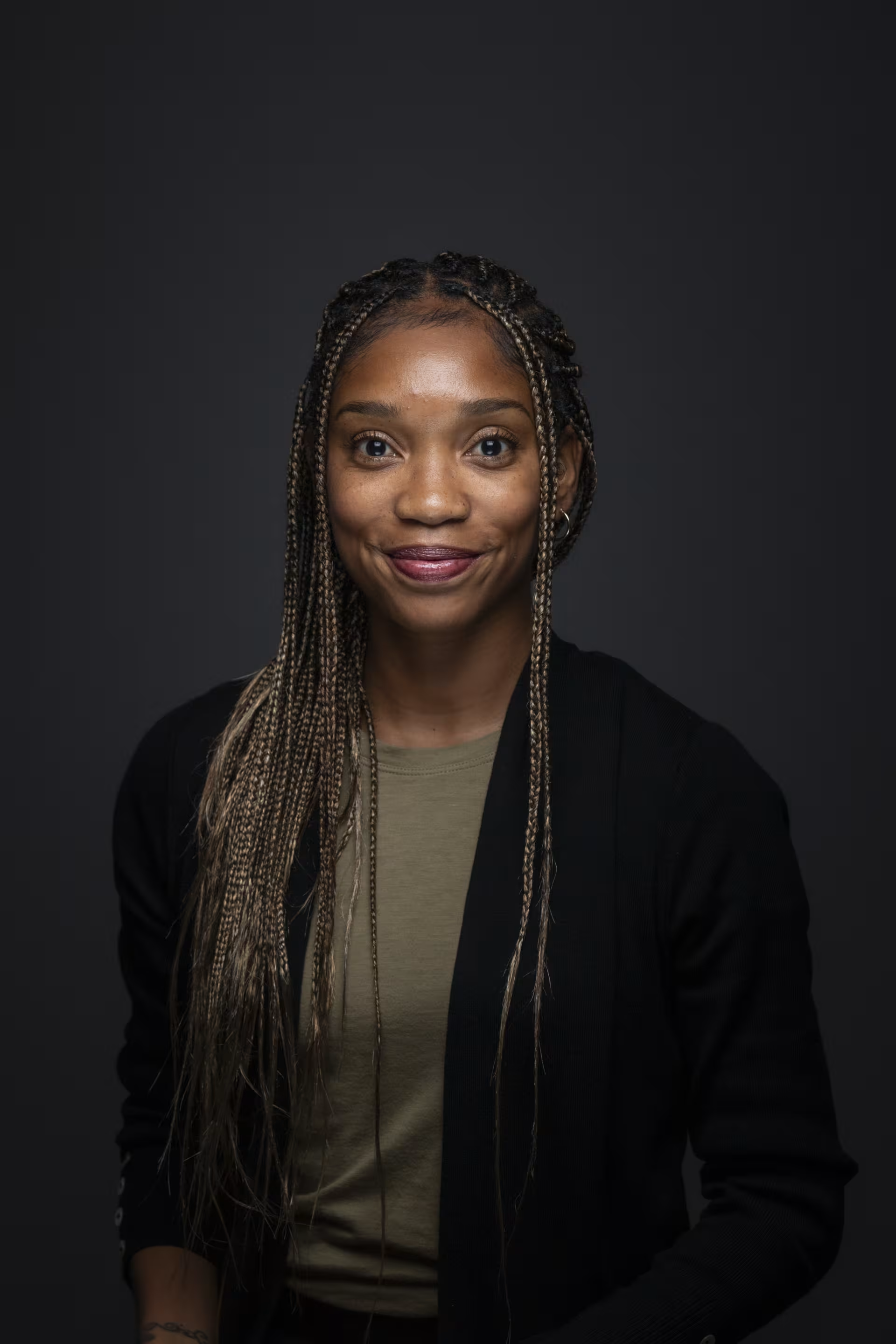
Alum Profile - Desiree Jackson, PhD in Counselor Education and Supervision (April 2026 graduate), MA in Clinical Mental Health Counseling, Licensed Professional Counselor, Faculty Member, Grand Canyon University
Program Context - Working full-time while completing doctoral coursework and serving in multiple professional roles.
A Doctoral Journey Built on Discipline and Control
When Dr. Desiree Jackson reflects on her doctoral journey, she describes it as both demanding and deeply formative. Completing her PhD in Counselor Education and Supervision took her just over four years, a timeline she attributes to planning and a commitment to controlling what she could.
“Four and a half years, a little over — and it was such a journey,” she says. “What I could control, I did, and I truly believe that’s why I finished at the time I did.”
For Dr. Jackson, the doctorate wasn’t something she pursued in isolation. She entered the program as an already established professional: a practicing clinician, a clinical supervisor and eventually a faculty member at GCU. Each role carried its own responsibilities, expectations and emotional weight.
Balancing Professional Identity With Doctoral Identity
Dr. Jackson’s experience reflects a reality many doctoral learners face: they are not just students, they are professionals developing into experts while simultaneously performing as experts.
“When you think about a doctoral learner, we are already professionals in some form,” she explains. “I was a practicing clinician, I was seeing clients, I was a clinical supervisor. Then I came to GCU and became the practicum and internship coordinator for the counseling programs.
Dr. Jackson describes the challenge not as simple time management, but as navigating multiple identities that all required her best. “In all these roles, as a doctoral learner, you’re developing as an expert,” she says. “And so at times we’re juggling, we’re trying to find harmony. I am passionate about what I do, and navigating and bringing harmony is difficult to do.”
Her experience underscores a key theme in doctoral balance: passion can fuel progress, but it can also blur boundaries. For Dr. Jackson, learning to manage that passion, rather than letting it consume every available hour, was essential.
Finding Structure and Support Through GCU’s Resources
Like many doctoral students, Dr. Jackson initially struggled with the complexity of managing coursework, research, committee communication and professional obligations. But she found that GCU’s centralized systems helped her create order in the chaos. “It was a struggle at first, I would say,” she recalls. “But then there was this phase where things got more organized, and it was good to have one portal.”
The single learner dissertation page became a cornerstone of her workflow. “It was the best way for me to communicate with all of my committee members and my research consultant,” she explains. “It’s that one community‑based system where we could all connect.” Having all resources — PowerPoints, templates, quantitative documents, committee feedback — in one place reduced friction and helped her stay focused on the work that mattered most.
What Jackson’s Story Reveals About Doctoral Balance
Desiree Jackson’s journey illustrates the realistic balance many doctoral learners navigate, emphasizing a deliberate alignment of priorities rather than perfect time distribution. While maintaining a full professional load, she completed her PhD by focusing on controllable aspects and building supportive systems. Doctoral education is not static; it requires continuous creation, protection and recalibration.
PhD Balance Through Support Systems and Boundaries
No one completes a doctorate alone; even the most disciplined students rely on supportive networks to navigate the challenges of doctoral study.
According to disciplined graduates, their effective support systems consistently included:
Support systems are essential for graduates, particularly during the isolating dissertation phase, helping them feel capable rather than overwhelmed. Setting boundaries around work, family and academic commitments, although uncomfortable, strengthened their professionalism. Support ranges from practical assistance, such as childcare, to emotional encouragement, which reinforces their belief in their ability to complete their degrees. Support ensures sustainability, while boundaries enable the journey.
One alum, Dr. Lily Skots, shares how essential her family was in helping her maintain balance while completing her doctorate. “My mom played a very important role in this journey,” she says. “She helped me balance everything — taking my son to soccer practice, helping with the day‑to‑day things that allowed me to keep going.”
Support also came from faculty who went beyond academic guidance to offer a genuine connection. Dr. Skots describes her relationship with her content expert, Dr. Kelly Maguire, as a pivotal part of her experience. “Dr. McGuire was my content expert. She was amazing,” she states. “When I requested her, she emailed me and said, ‘Lily, I want to come and meet you in person.’ I felt honored that someone was coming just to see me.”
That meeting happened during GCU's residency, and it left a lasting impression. “I talked to her and felt something — she reminded me of my mom. God placed people so strategically in my life, with different personalities and different fields of expertise.”
Preventing PhD Burnout While Maintaining Work–Life Balance
PhD burnout can develop gradually, with early warning signs often going unrecognized until students feel overwhelmed, even if they are still meeting deadlines and making progress.
Common early warning signs include:
Dr. Kelly Maguire, who has supported hundreds of doctoral learners, notes that burnout often begins with subtle disruptions to basic routines. “Not sleeping — that was probably one of mine,” she shares. “Going to bed, sleeping for only a couple of hours and getting back up.”
For many students, emotional shifts were just as telling. “Discouragement,” she says. “If you start to feel discouraged with what’s going on, that’s when you need to pay attention.” Recognizing these signs early is essential, but prevention requires intentional habits that protect both mental and emotional capacity.
Many graduates emphasize the importance of sustainable pacing, which often included:
Dr. Maguire stresses that reaching out for support is not a sign of weakness. It’s a strategy for longevity. “Prevention is probably finding people you can talk to,” she explains. “Who are those trusted individuals who aren’t going to tell you, ‘You should just quit,’ but will encourage you and support you through it?”
Her guidance reflects a core truth: PhD burnout is easier to prevent than to recover from; sustainable pacing, supportive relationships and early intervention can turn setbacks into manageable challenges.(See disclaimer 1)
Doctoral Balance in Practice: Case Study — Dr. Lily Skots
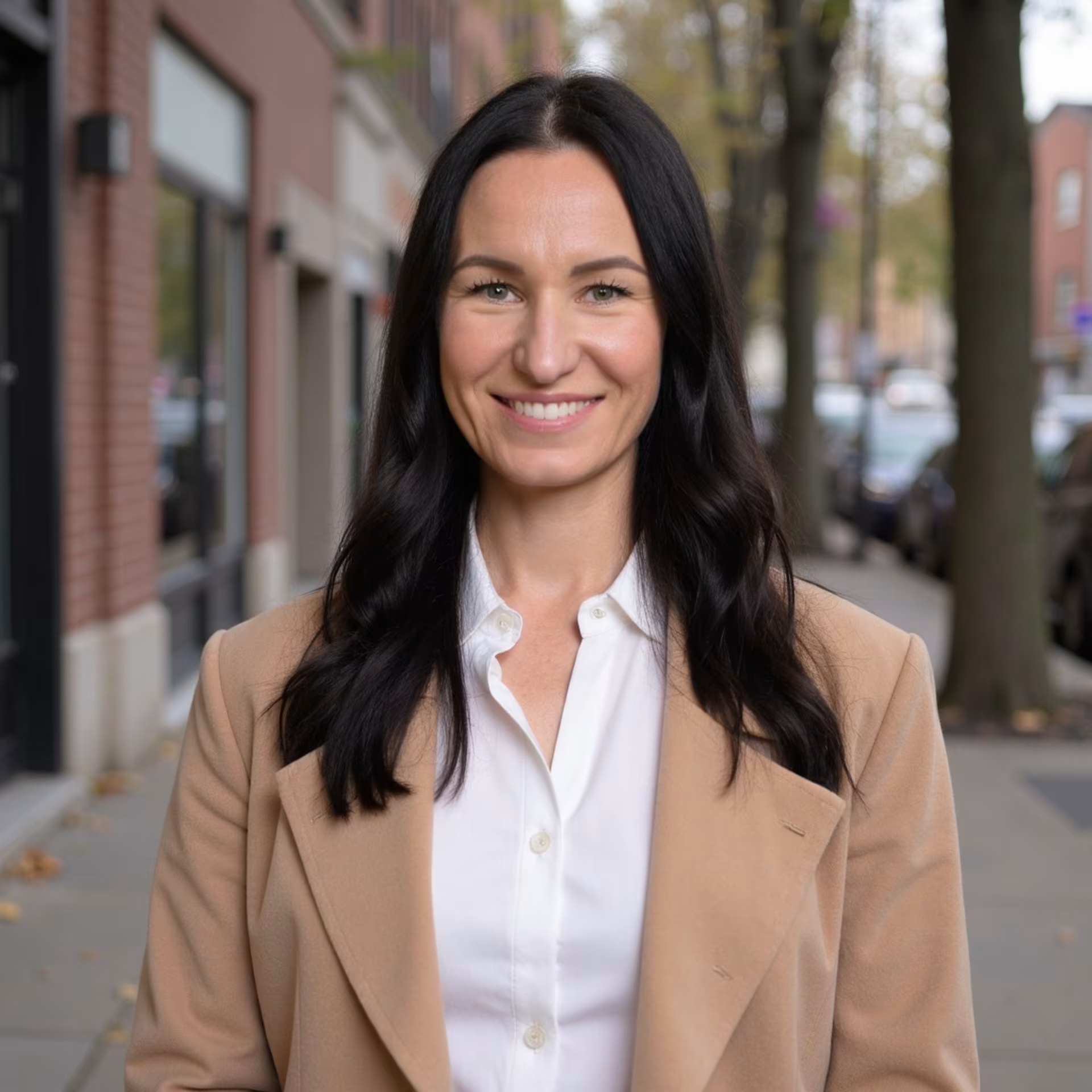
Alum Profile – Dr. Lily Skots, PhD in General Psychology: Cognition and Instruction, Educator, Researcher and GCU Alum
Program Context - Balancing doctoral study with full‑time work, family responsibilities and active involvement in her faith community.
Redefining Productivity Through a Full Plate
When Dr. Lily Skots began her doctoral program, she was managing a demanding schedule. She worked full-time and maintained a busy household. “Balancing was a challenge,” she recalls. “I had a full‑time job, I was a fifth‑grade teacher, and all my kids were in the same private school.”
Like many doctoral learners, she began with one course at a time and initially felt confident. “I realized we had a big assignment every other week, and I thought, well, that’s pretty easy. So I decided to double up courses.” She strategically staggered her classes so that each week had a major assignment, but by the seventh class, the workload changed. “By class seven, I thought, now I can’t do that. The assignments were getting bigger, and I had to spend so much time researching things I hadn’t researched before and navigating different systems.”
The turning point came when she realized she needed a new definition of productivity that honored her responsibilities without sacrificing her well‑being.
Building a System That Worked
Dr. Skots leaned heavily on the organizational strategies she learned in her undergraduate education. “What helped me was my previous teaching preparation programs, which showed us how to do block studying times and make sure we have family first or faith first.” She filled the spaces around her workday with focused study blocks, often working during moments most people would consider downtime. “As my kids were growing, all of them joined sports or gymnastics. So, I figured out I’d have to have my computer with me all the time.”
Her solution was simple but powerful: she adapted. When she didn’t have an assignment to work on, she joined GCU's Thursday Qualitative Research Office Hours, using the time to learn from peers and gather feedback. “Blocking and changing your mindset — everything together helped.” Her approach wasn’t about perfection. It was about steady progress, adaptability and refusing to let obstacles derail her momentum.
Prioritizing Faith, Family and Purpose
Dr. Skots remained committed to her faith community. “One of my huge priorities is the church, my faith. I serve in the worship group, and that took about seven hours of my schedule every other week.” Rather than viewing these commitments as competing with her doctoral work, she saw them as grounding forces.
“I wouldn’t say I had the perfect balance. I just thought about what is important at this moment and based my priorities.” Her philosophy was simple: balance isn’t about equal time — it’s about aligned priorities.
Time Management Tips for PhD Students That Graduates Actually Used
These graduates highlight that effective time management during their doctorate focused on protecting cognitive energy and working with intention, rather than merely increasing productivity. They structured their time around mental capacity, emotional bandwidth and personal realities.
Commonly used approaches included:
Managing More Than Time: Protecting What Fills You Up
Dr. Kelly Maguire encourages doctoral students to think beyond calendars and deadlines. “I would tell doctoral students to manage more than your time — focus on what fills you up. Being in a doctoral program can be very draining intellectually, spiritually and emotionally. We need to continue to fill those other aspects of our lives so we can keep pursuing the high intellectual work of a doctoral program.” This mindset reframes time management as a holistic practice: protecting rest, relationships and personal well‑being so that academic work remains sustainable.
Choosing the One Thing That Moves You Forward
Dr. Maguire also shares a quote from one of her own professors that shaped how she approached daily tasks: ‘‘What could I do today if I knew I wouldn’t fail? “I clung to that quote because it helped me balance out my checklist.” Instead of overwhelming herself with unrealistic expectations, she learned to identify the single task that mattered most.
“Sometimes my checklist was way too much. So I’d go back to that quote and ask, what on my list can I do today, knowing I’m not going to fail? Maybe it was just one thing. But completing one thing gave me that sense of accomplishment.”
Using Small Blocks of Time Strategically
For Dr. Lily Skots, time management meant embracing the reality that uninterrupted hours were rare. She learned to use small pockets of time with precision. “I never had a day when I wouldn’t write something. I had blocks in my schedule dedicated only to researching and others only for writing.”
She used short bursts of research time to gather “ingredients” for later writing sessions. “If I had 30 minutes of spare time, I would only research and annotate. I wasn’t worrying about perfect sentences. Then on Friday and Saturday, my writing blocks, I was only writing. I used what I prepared in those small pieces of time.”
Finding Your People
Both graduates emphasize that time management is not just an individual skill — it’s a community practice. Dr. Maguire describes how forming a small peer cohort transformed her experience:
“I private‑messaged a couple of classmates and asked if they wanted to be in a tiny cohort where we could email and text one another.”
Their group, affectionately named the D Divas Plus One, became a daily source of accountability and encouragement. “We texted throughout the day, encouraged each other when things got tough and kept going when one of us felt like quitting.”
The relationships didn’t end at graduation. “Two of us have published 10 to 12 scholarly articles together. We still present across the country.” She encourages doctoral students to “find your people, find your tribe.”
Dr. Skots echoes this sentiment, emphasizing the importance of staying connected.” “Even if you think you’ve got it, make sure you have support. Make sure you have your team.” She describes her dissertation chair as a partner in the journey. “Your chair is your bus rider. If you face something on the road, like a flat tire, you both fix it. It’s not personal. It’s about the journey.”
Setting Boundaries Early and Heeding the Warnings
Time management also requires boundaries, especially when personal and academic responsibilities collide. Dr. Maguire encourages students to pay attention when loved ones notice signs of strain. “Set the boundaries. If your spouse is telling you that you need a break, listen. Go for a walk. Do something to reset.” She also reminds students that doctoral work is inherently challenging and that setbacks are part of the process.
“It might not go as fast as you think. You’re going to have failures and setbacks. That’s OK.”
One of her mentors offered a perspective she still shares with students, “It’s not about becoming smarter — it’s about becoming better.” This mindset can help students approach time management with grace rather than perfectionism.
Time Management Is About Alignment, Not Perfection
Across interviews, these graduates agree that doctoral time management is less about rigid schedules and more about:
Redefining Success and Balance During a PhD Program
Alumni and faculty emphasize a critical reframing: progress, not perfection, is the true measure of success during a doctoral program. Let go of unrealistic expectations and embrace a more sustainable definition of achievement.
Graduates describe balance not as a flawless daily routine, but as a long‑term alignment with their goals. They found that they made the most meaningful progress when they:
Doctoral success, they agree, is not about constant output; it’s about endurance, adaptability and the willingness to evolve.
For Dr. Kelly Maguire, one of the most transformative moments in her doctoral journey came when she received difficult feedback on her proposal. “The professor said something like, ‘As written, this is not a viable study.’ I was crushed because I knew I had put in 100%.”
The emotional impact was immediate and overwhelming. “I just cried and cried for hours because I was so sad to hear that my study as written wasn’t going to work.” But what happened next reshaped her entire mindset. Her husband encouraged her to step away. “He said, ‘Put it aside for 48 hours. Do not look at it.’”
When she returned to the feedback with fresh eyes, everything shifted. “My husband asked, ‘Was the professor right?’ And I said yes. Then he said, ‘Then go fix it.’” That moment taught her that failure wasn’t final — it was directional.
Dr. Lily Skots echoes this theme, describing how the dissertation process forced her to confront her own reactions to feedback and difficulty. “The dissertation process comes with lots of emotions. Whether you got feedback you didn’t like or didn’t understand, you can take it personally.” She developed a mantra that guided her through the hardest moments:
“If I am not changing something, I’m choosing it.”
She used this phrase with her students as well. “If you’re not happy with your grade, you need to change it. If you don’t change anything and just complain, you’re choosing it.” This mindset helped her push through challenges rather than avoid them. It also helped her achieve milestones she once doubted were possible. “During dissertation, I was able to publish in the Journal of Scholarly Engagement.”
These graduates illustrate a powerful truth: doctoral success is not defined by flawless execution, but by the willingness to persist, adapt and grow. Balance during a doctoral program is not a static state; it is a continual process of:
Reflections That Shape the Doctoral Journey
These doctoral graduates remind us that balance is not a finish line to cross, but an ongoing practice of adjustment as life and scholarship evolve together. If you are considering your own doctoral journey, the College of Doctoral Studies offers programs designed to support you academically, professionally and personally through every phase of that journey. Now is the time to learn more, explore the programs available and take the next step toward a doctorate that empowers not just your research, but your growth as a scholar and professional.
Lead With Purpose
You’ve seen what’s possible with the right support. Take the next step toward your goals by exploring doctoral degree programs at GCU.


