

Some classes stay with you long after the final exam. An elective can introduce a lasting interest, while the writing skills from a required English course may prove useful years into a career.
To learn which classes adults remember and value most, Grand Canyon University analyzed 2,685 survey responses from across the United States. We explored favorite high school subjects, the college electives respondents enjoyed and what they would choose to study today.
Key Findings
The Favorite College Elective Category in Each State
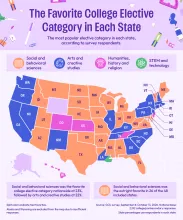
Social and behavioral sciences led college elective favorites at 23%, narrowly ahead of arts and creative studies at 22%. The leading category includes subjects such as psychology, sociology, anthropology and political science.
At the state level, social and behavioral sciences was the outright favorite in 26 of the 48 included states. Arizona was among them, with 30% of its college respondents choosing this category. It also led in Texas and Florida.
Arts and creative studies, which includes visual art, music, theater, photography, film and creative writing, led outright in 16 states, including California, New York and Washington.
Where Arts and Creative Studies Stood Out
The five states with the highest share of college respondents naming arts and creative studies as their favorite elective category were:
41.9%
36.8%
35.9%
32.6%
29.7%
41.9%
36.8%
35.9%
32.6%
29.7%
Humanities, history and religion led in Colorado, Kansas and Hawaii. Three states had ties. New Jersey and Tennessee split between arts and creative studies and humanities, history and religion. Louisiana had a three-way tie among arts and creative studies, social and behavioral sciences, and STEM and technology.
The High School Classes Adults Value Most
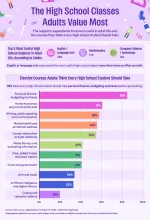
English or language arts was the most useful high school subject in adult life for 38% of respondents. Mathematics followed at 17%, with computer science or technology third at 14%.
That puts English well ahead of the other subjects surveyed. More than twice as many respondents chose it as chose math, highlighting the lasting value adults place on the material they learned in English class.
Personal Finance Was the Clear Priority for Future Students
When asked which courses every high school student should take before graduating, 85% selected personal finance, budgeting and taxes. It led the next most popular choice, home economics and practical life skills, by about 24 percentage points.
Other widely supported courses included:
Choices show strong interest in classes that connect school to everyday responsibilities, from managing money to communicating clearly.
What Adults Would Study If They Could Choose Again
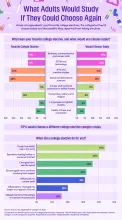
Nearly 3 in 5 respondents would choose a different college elective category today. Among the 2,067 respondents who selected one of the eight named categories in both questions, 59% picked a different category for their choice today than for their past favorite.
Business, communication and career skills were the most popular choice today at 19%, followed by STEM and technology at 18%. Several categories attracted a larger share of current choices than past favorites:
Arts and creative studies remained a popular choice, with 16% selecting it today. Social and behavioral sciences, the leading past favorite, drew 15% of current choices.
The Benefits That Last Beyond the Classroom
Respondents also described how their electives affected life after the course ended. 44% said an elective taught them skills they use at work, and 31% said one influenced their career path.
The benefits extended to personal interests, too. 40% said an elective sparked a lasting hobby or interest, while 20% said one influenced or changed their major or program of study. For these respondents, the impact of an elective continued well beyond a semester.
How Men and Women Differ on Favorite Classes
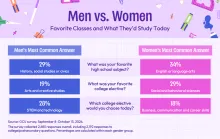
The survey also revealed differences in which classes men and women enjoyed and what they would study today.
Favorite High School Subjects
Women were about 2.4 times as likely as men to name English or language arts as their favorite high school subject, at 34% versus 14%. History, social studies or civics was the top choice among men, at 29%.
Favorite College Electives
Social and behavioral sciences was the favorite college elective category for 29% of women, compared with 13% of men. Arts and creative studies was the most common favorite among men.
Electives They Would Choose Today
Men were about twice as likely as women to choose STEM and technology today, at 28% versus 14%. Among women, business, communication and career skills was the most common choice, at 18%.
The College Electives People Still Remember
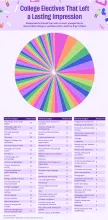
We asked respondents to take a trip down memory lane and share the most memorable elective they took in college. Their answers included a few classes you might wish you’d spotted in the course catalog:
40% of college respondents said an elective sparked a lasting hobby or interest, giving them something to keep exploring long after the semester wrapped up.
College offers plenty of ways to follow your curiosity, including electives, student clubs and campus activities. Take advantage of what’s available and give a new interest a try. You might discover a favorite pastime that sticks around long after graduation.
Closing Thoughts
Choosing courses is a chance to explore your interests and develop skills you can use beyond the classroom. The findings highlight the value adults saw in electives and required subjects, along with strong support for practical learning in personal finance.
At Grand Canyon University, you can explore areas of study that connect with your interests and academic goals. Browse our degree programs to learn more about your options and take the next step in your educational journey.
Methodology
Grand Canyon University collected 2,685 survey responses from U.S. adults between September 8 and October 13, 2026. High school questions used the full response base. College and postsecondary questions used 2,192 responses from people who had graduated or completed a program, or who had previously attended and were not currently enrolled.
State comparisons reflect respondents’ current residence, rather than the location of the institution they attended. Alaska, Wyoming and Washington, D.C., were excluded from the state analysis due to insufficient responses. Tied state favorites are shown together.
The 59% comparison uses 2,067 respondents who selected one of eight named elective categories for both their past favorite and their choice today. Questions about courses every high school student should take and the benefits of college electives allowed multiple selections. Results are unweighted, and percentages are rounded to the nearest whole number unless otherwise indicated. Memorable elective examples are self-reported.
Fair Use
You are welcome to use, reference, and share non-commercial excerpts of this study with proper attribution. If you cite or cover our findings, please link back to this page so readers can view the full methodology, charts and context.