
Executive Summary
Ask a prospective student today where they started looking for a college, and the honest answer is rarely "the school's website." In reality, it is far more likely to come from a Google search, a TikTok video or a prompt typed into ChatGPT.
Grand Canyon University, in collaboration with Grand Canyon Education, wanted to find out exactly how that search behavior has shifted, surveying 1,518 U.S. adults who are actively researching, applying to, or have recently enrolled in a degree program. The data presented throughout this article is the result of this survey, and it shows a definitive shift on how prospective students research their further education.
AI is now a normal part of the college search for the large majority of prospective students. 87% have used an AI tool for research or say they have considered it, and when asked who they would trust for a genuinely impartial comparison between two universities, more students picked an AI assistant (20%) than picked any single human source, including school counselors, independent advisors or admissions reps.
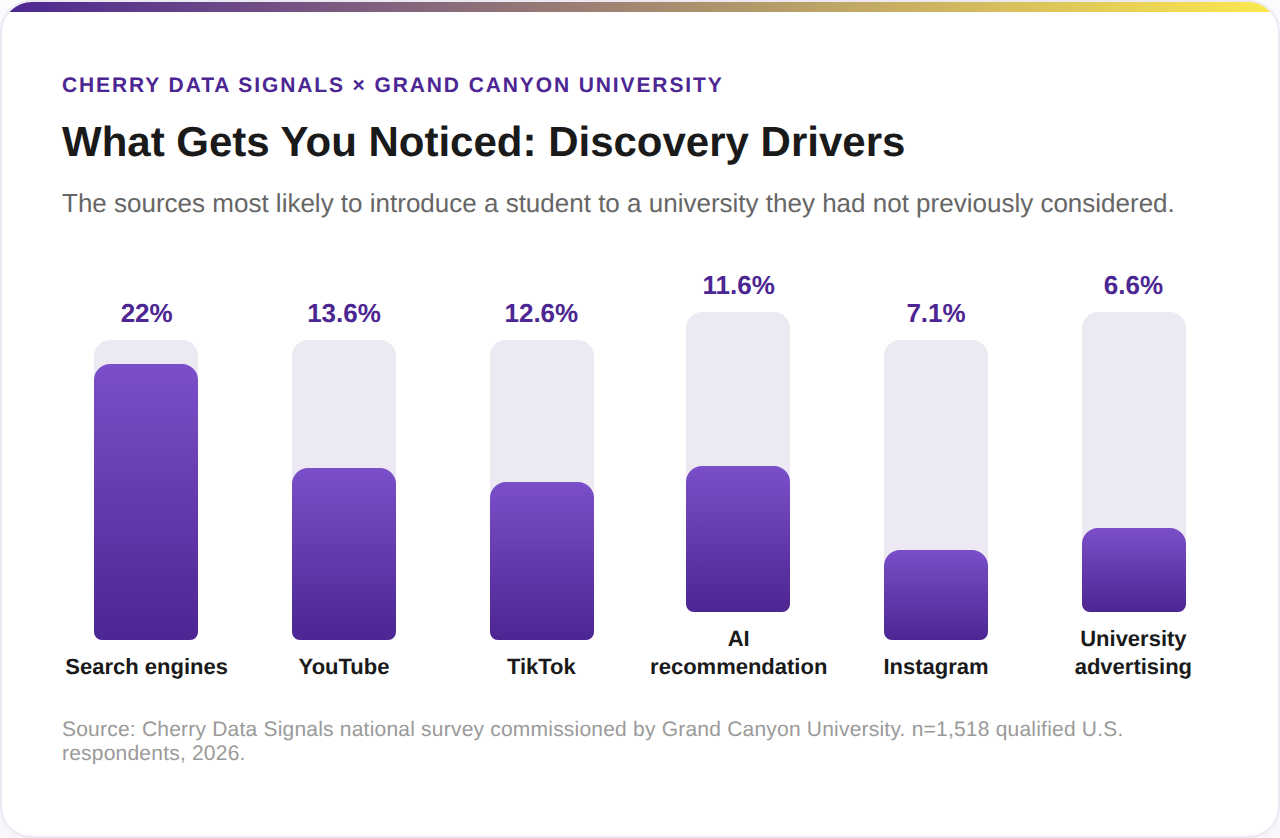
Video is doing something search engines used to do alone. TikTok and YouTube introduce students to universities they hadn't previously considered almost as often as search engines do (26% vs. 22%), and nearly half of respondents (49%) say they have added or removed a school from consideration because of something they saw on social media.
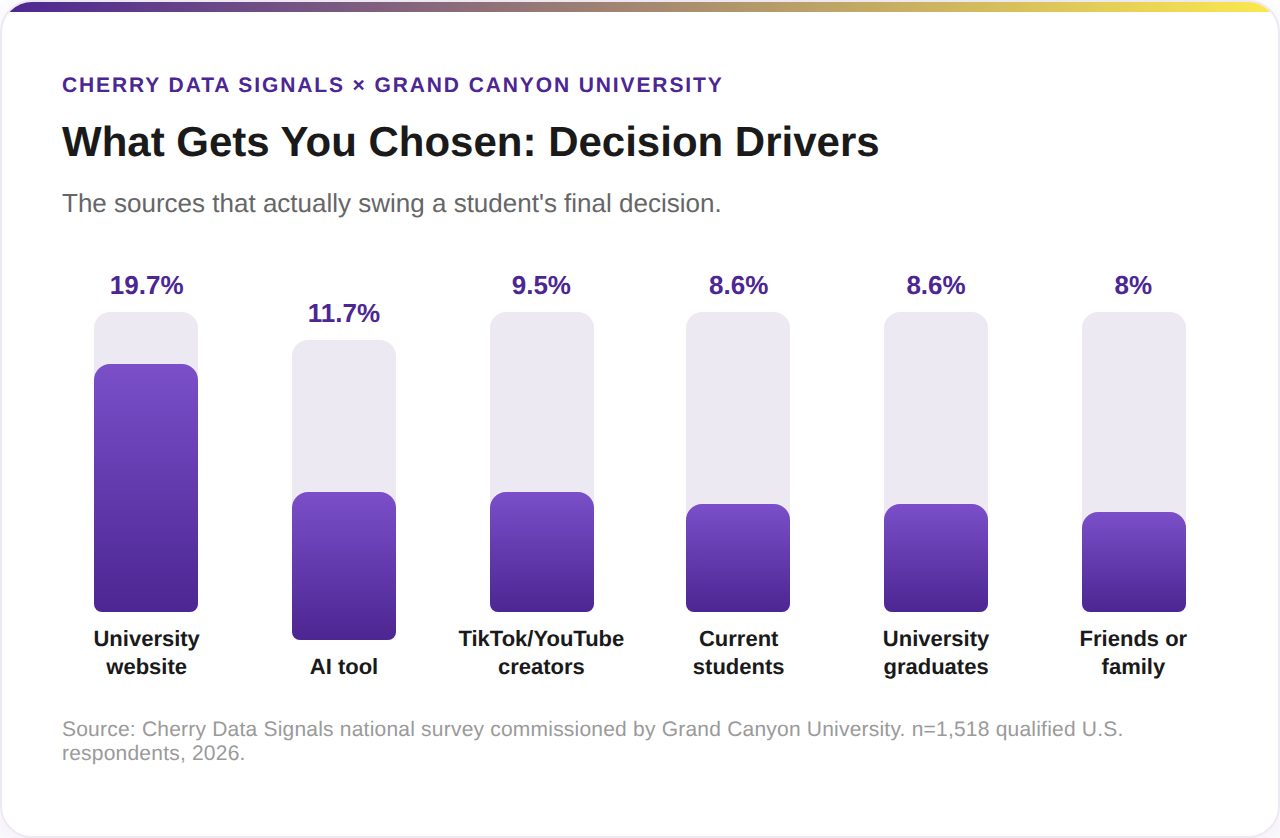
None of this replaces the university's own website. When students need to verify something they read or heard elsewhere, the official site is still their first stop by a wide margin (24%), and it remains the single biggest influence on their final decision (20%), ahead of Al, creators and even current students.
There is a cost to getting the follow-up wrong, too. 39% of respondents say they have avoided contacting a university altogether because they were worried about being hit with repeated calls, texts and emails afterward.
The sections that follow break down what students told us at each stage of the modern research journey, from first discovery through final decision, and what it means for anyone trying to make sense of that journey themselves.
How this research was conducted
This report draws on a survey fielded by Grand Canyon Education and Cherry Data Signals among 1,518 qualified U.S. adults who identified as either current students or people actively considering further education. The survey explored how students discover, prioritize and trust different research sources, including AI tools, social video, Reddit and other online communities, verification behavior, and the role of human admission guidance throughout the college search.
Respondents who did not meet the study's eligibility criteria, meaning they were not a student and had no plans to pursue further education, were screened out and excluded from all figures reported here; of 4,275 total survey starts, 1,518 qualified and completed the survey.
Respondents were carefully chosen from a geographically representative online panel of double opt-in members. This selection was further tailored to meet the precise criteria required for each unique survey. Throughout the survey, we designed questions to carefully screen and authenticate respondents, guaranteeing the alignment of the survey with the ideal participants.
To ensure the integrity of our data collection, we employed an array of data quality methods. Alongside conventional measures like digital fingerprinting, bot checks, geo-verification, and speeding detection, etc. each response underwent a thorough review by a dedicated team member to ensure quality and contextual accuracy. Our commitment extends to open-ended responses, subjecting them to scrutiny for gibberish answers and plagiarism detection.
Percentages for multi-select questions can total more than 100%, since respondents were able to choose more than one answer. All figures are rounded to the nearest whole percent and may not sum to exactly 100% due to rounding.
AI Is Already Embedded in Education Search
Eighty-seven percent of prospective students have either already used an AI tool such as ChatGPT, Gemini or Copilot to help with their college search, or say they had considered it. Only one in ten rule it out completely.
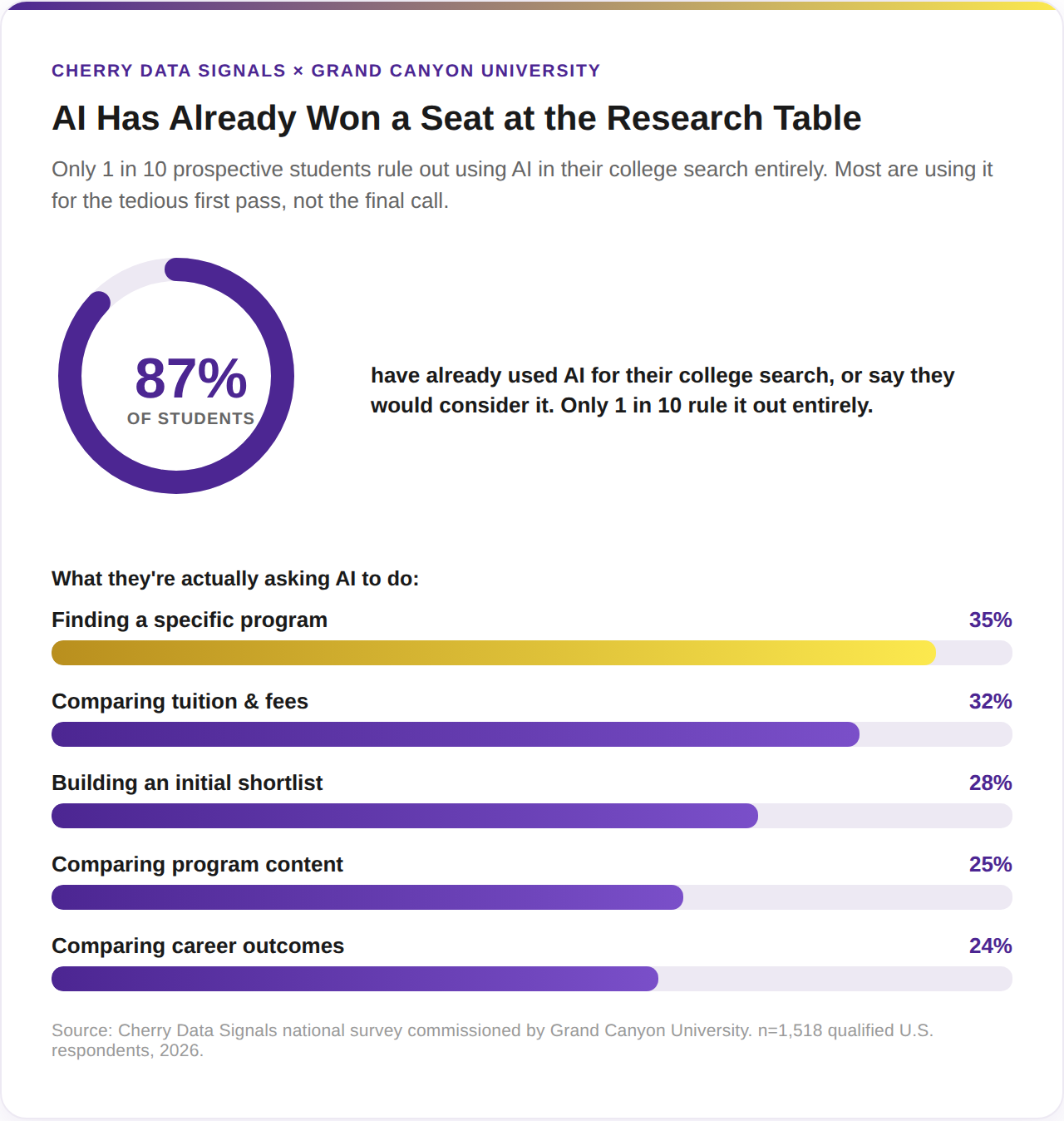
Respondents were specifically asked what they task AI to do. The results showed that the majority of the groundwork is unglamorous: tasks such as finding universities that offer a specific program (35%), comparing tuition and fees (32%), building an initial shortlist (28%), and comparing program content (25%) and career outcomes (24%) side by side.
This is not necessarily a narrative of students outsourcing chatbots to decide their future. It's more a story about outsourcing the tedious first pass so they can spend their own time on the schools that actually make the cut.
That difference is important, because trust in AI is not unconditional. Just over half of respondents (51%) say they would trust an AI-generated recommendation a great deal or completely, but the moment money or eligibility enters the picture, most want a second opinion. Financial aid (40%), tuition and fees (37%), admission requirements (31%) and accreditation (29%) top the list of things students say they would always verify through an official or independent source, no matter what an AI tool told them.
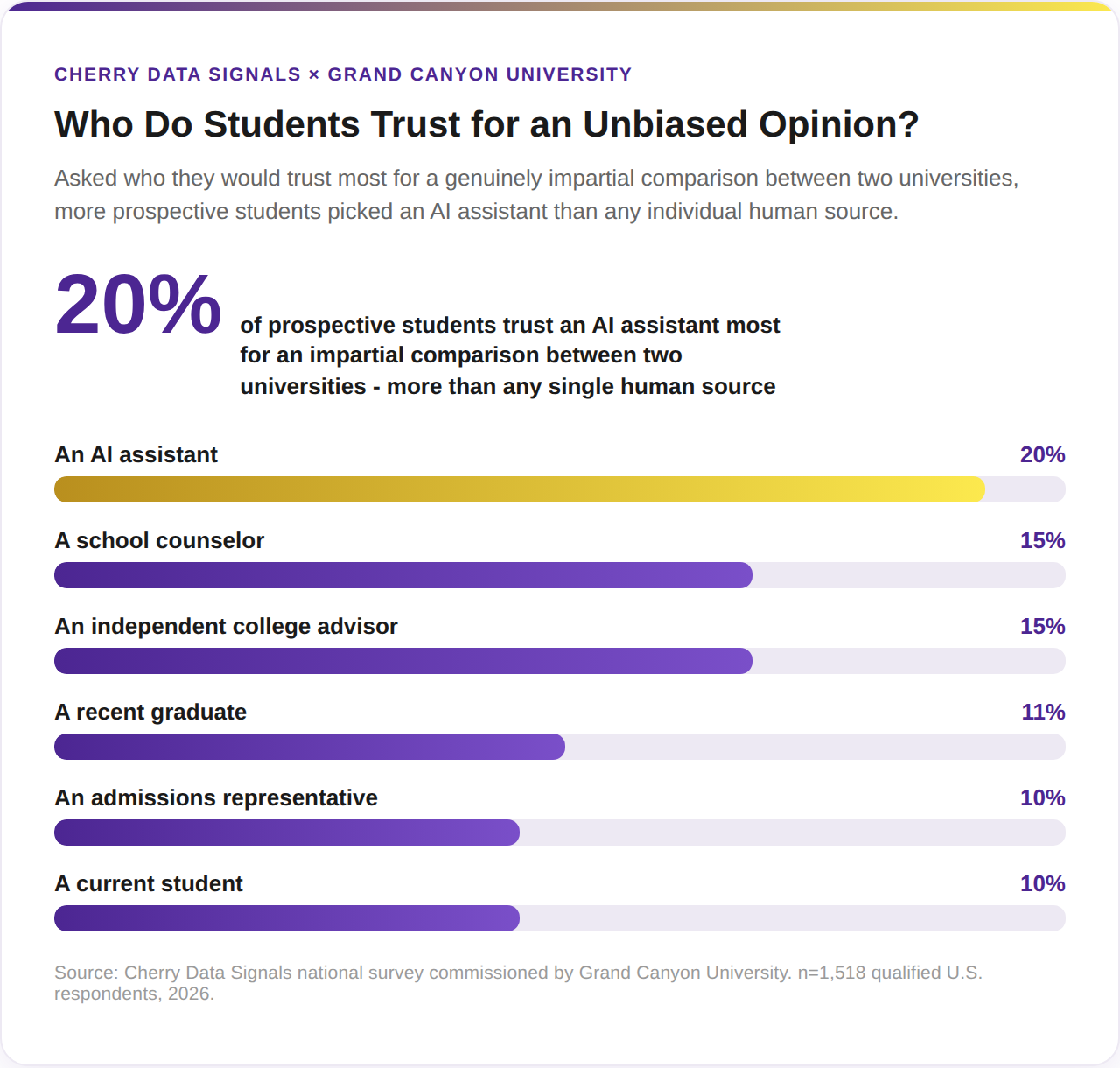
And here is a statistic that stood out from the survey: when asked who they would trust most to give a genuinely impartial comparison between two universities, more students picked an AI assistant (20%) than picked a school counselor (15%), an independent advisor (15%), a recent graduate (11%) or an admissions representative (10%). Students don't necessarily see AI as smarter. They see it as having no incentive to sell them anything, which, fairly or not, is a credibility advantage no human recruiter starts with.
Who do students trust for an unbiased opinion?
Asked who they'd trust most for a genuinely impartial comparison between two universities, more prospective students picked an AI assistant than any individual human source.
What this means for your college search: It is reasonable to treat AI tools as a fast first pass, not a final answer. Use them to build a long list and compare basics, then verify anything involving cost, deadlines or admission requirements directly on the university's own site or with an official representative.
TikTok and YouTube Are Doing a Search Engine's Job
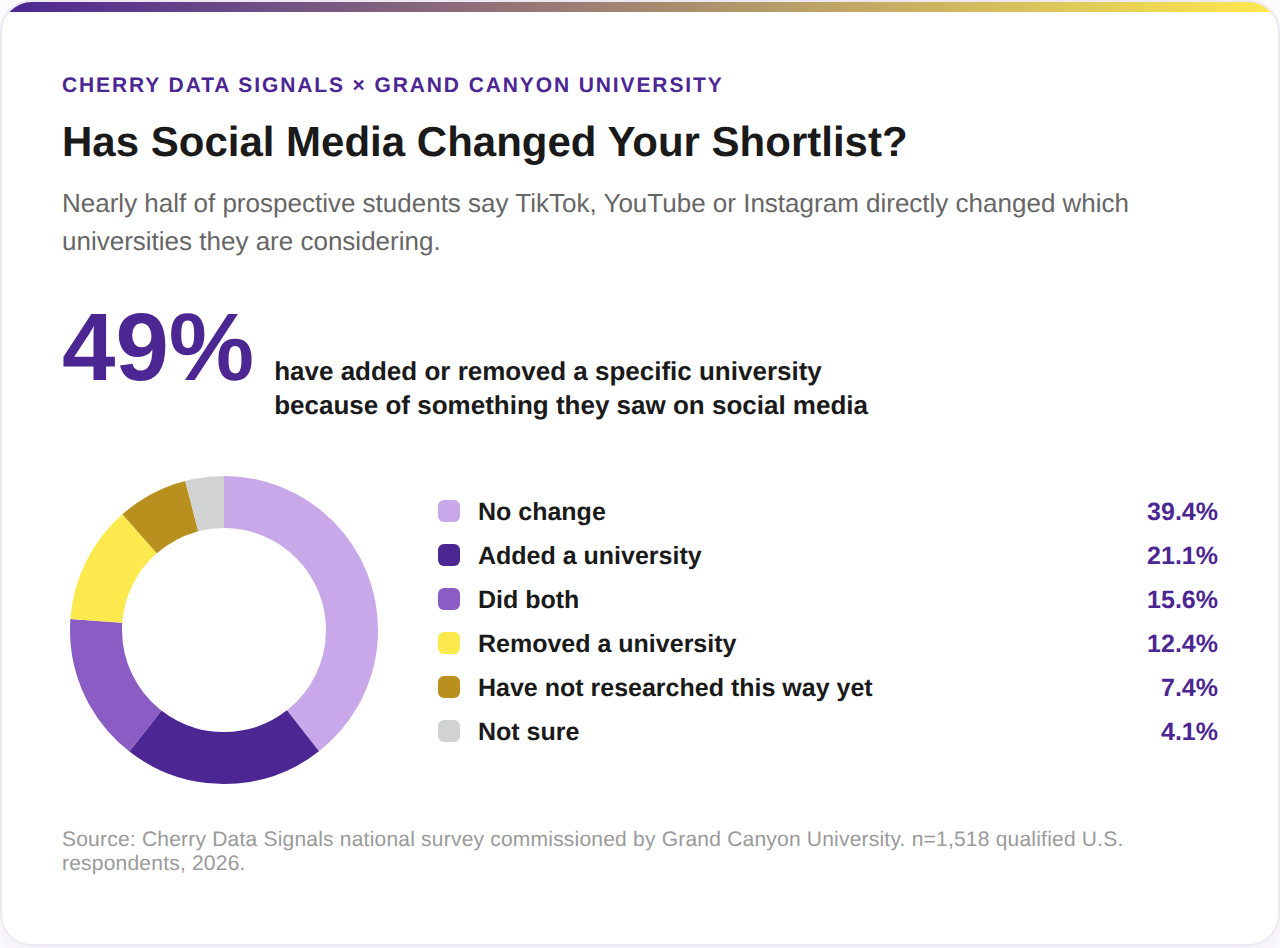
Six in ten respondents (60%) say social video platforms have influenced their impression of a university, either significantly (35%) or somewhat (25%). That influence isn't passive scrolling, either: 49% say they have actually added or removed a specific university from consideration because of something they saw on TikTok, YouTube or Instagram.
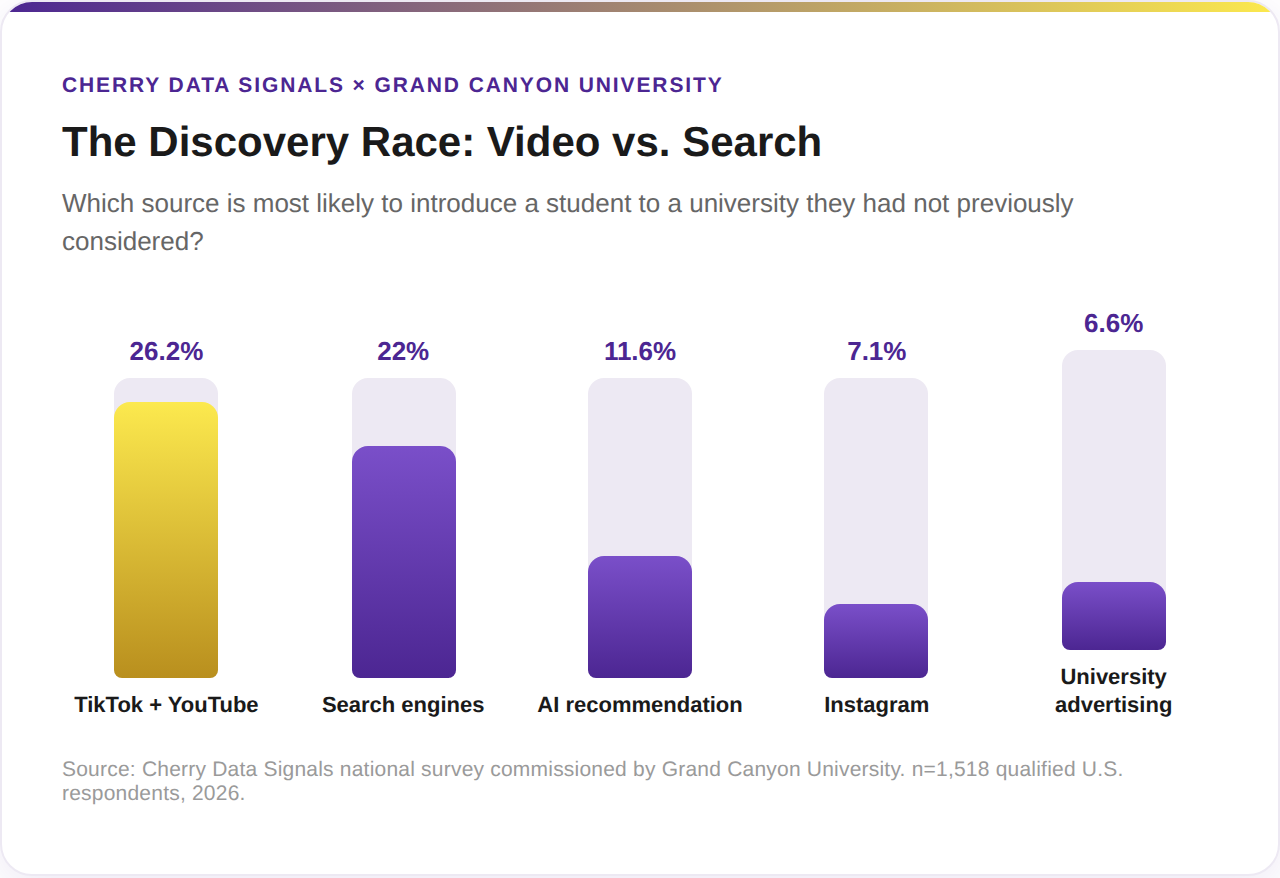
Discovery is where this shows up most clearly. When we asked which source is most likely to introduce a student to a university they hadn't previously considered, TikTok and YouTube combined (26%) edged out traditional search engines (22%). For a meaningful share of prospective students, the first "touchpoint" with a school now looks like a 15-second campus tour clip, not a search result.
Not all creator content earns equal trust, though. Campus tours (41%) and day-in-the-life videos (39%) are the formats students say are most useful, well ahead of polished admissions advice (17%) or application tips (13%). Students want to see the place, not be told about it.
It appears that students are paying attention to who's talking, too. Asked who they would trust most to describe the real student experience, a recent graduate (29%) beat an official student ambassador (15%) and an independent student content creator (11%) by a wide margin; another 17% said they would rather compare several perspectives than trust any single one. Disclosure matters as well: 46% say knowing a creator was paid or supported by the university makes them trust that content less, though 19% say clear disclosure makes no difference, and 13% say it can even build trust if the information turns out to be accurate.
What this means for your college search: Look for content from recent graduates or independent creators alongside anything official, and check whether sponsorships are disclosed before deciding how much weight to give it.
Reddit: Distrusted as a Source, Relied on for the Truth
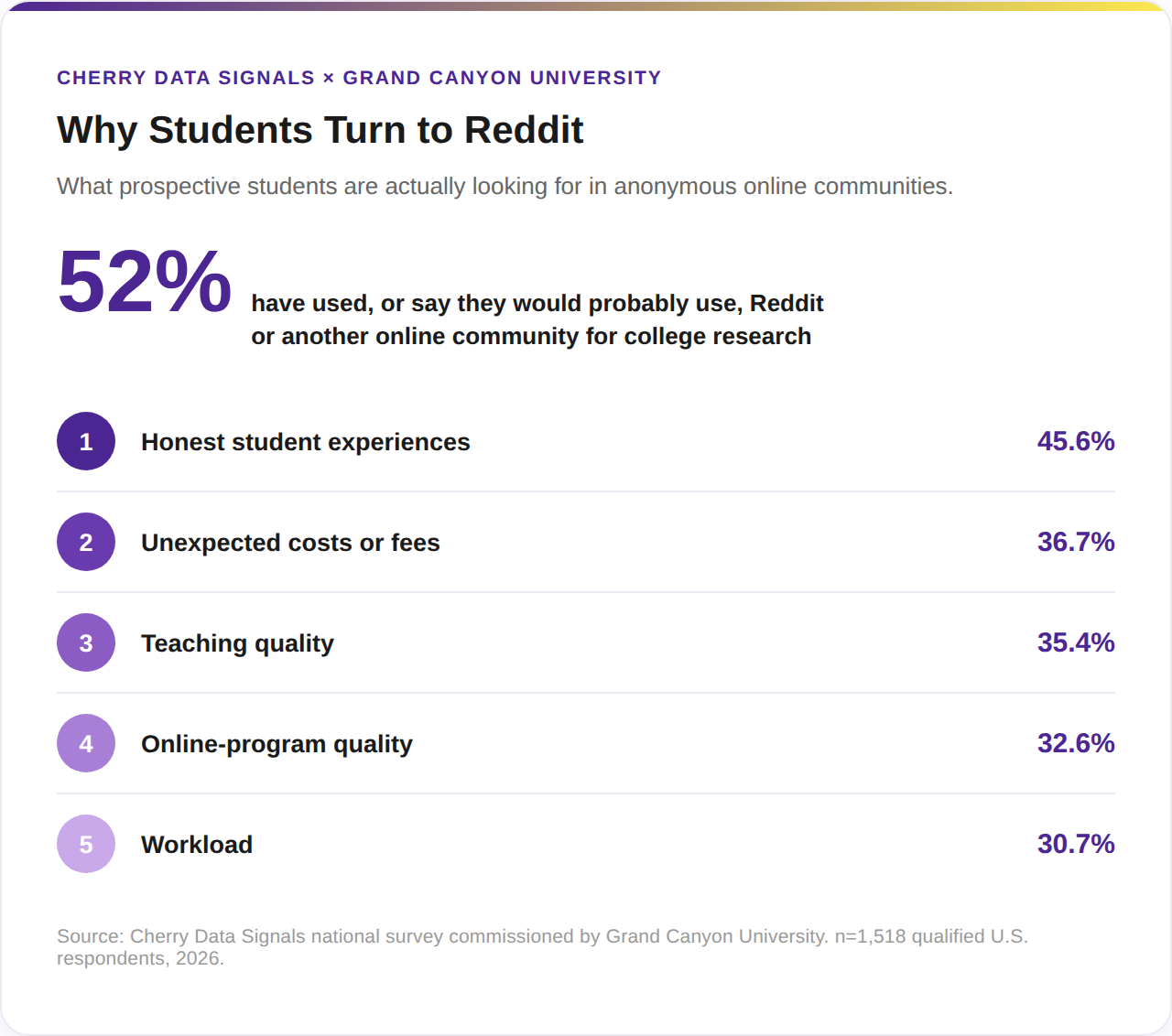
More than half of respondents (52%) have already used Reddit or a similar online community for college research, or say they probably would; only 18% rule it out entirely. That's a striking number for a platform built on anonymous, unverifiable posts.
What they're actually looking for is specific: honest student experiences (46%), unexpected costs or fees (37%), teaching quality (35%), the quality of online programs (33%) and workload (31%).
Personal student experiences (44%) and advice about campus life (30%) are the categories they say they would trust most on Reddit; only 12% say they wouldn't trust anything there without verifying it elsewhere, which means the other 88% are applying some kind of judgment rather than dismissing the platform wholesale.
Negative comments don't automatically sink a university's chances, either. 17% say a run of negative comments would make them remove a university from consideration immediately. The more common reactions are becoming more cautious (27%) or actively investigating the claims through other sources (24%), and 11% say they would go as far as asking the university directly about the issue. Negative chatter online is usually a prompt to dig deeper, not a verdict.
What this means for your college search: Treat Reddit threads the way you would treat a candid conversation with a stranger, useful for texture and warning signs, but worth checking against an official source before you let it change your shortlist.
The University Website Is Still the Tiebreaker
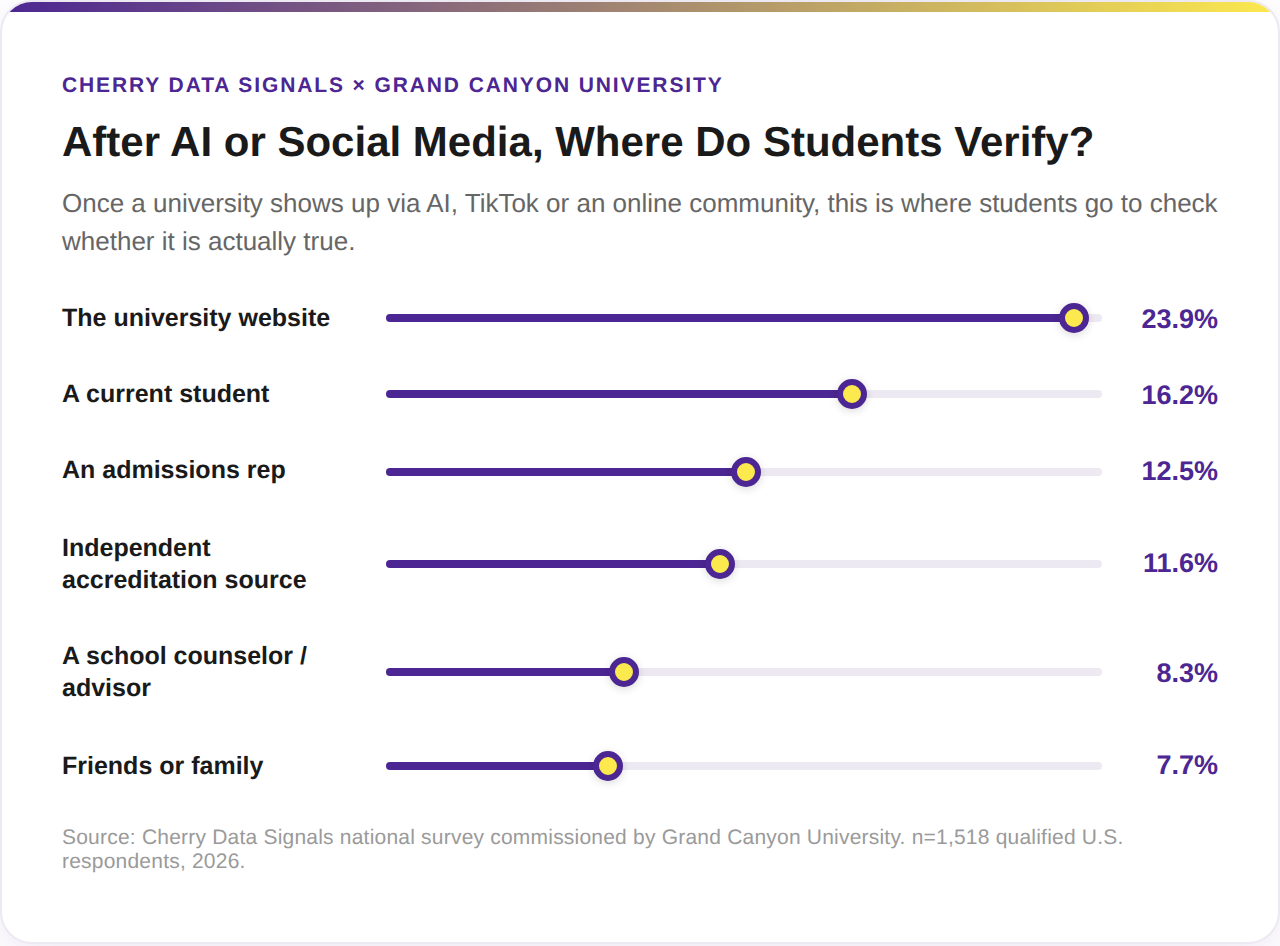
For all the attention AI and social platforms get, there's one place students consistently go to settle the question: the university's own website. When asked where they would verify something they first encountered through Al, social media or an online community, 24% said the university website, well ahead of the next most common answer, a current student (16%).
The content that actually rebuilds confidence after a student has seen unofficial or conflicting information is specific: clearly displayed tuition and fees (40%), detailed program and course information (38%), accreditation details (35%) and independently verified career outcomes (30%). Direct access to current students (24%) and unedited student Q&A (21%) also rank well above polished testimonials or slick video content.
The pattern across every section of this study points the same direction: students will use AI to move fast and social platforms to get a feel for a place, but they treat the official website as where claims get checked.
What this means for your college search: Whatever you find on TikTok, Reddit, or through an AI assistant, run it past the university's own site before it changes your decision.
Students Want Help Earlier, and Less of It Afterward
Ask when a conversation with an admissions representative would actually be useful, and the most common answer isn't "when I'm ready to apply." It's "at the very start of my research" (26%), ahead of checking program details (20%), comparing a short list of schools (18%), or the application stage itself (15%). Students are telling universities, in effect, that they want a human option available before they have narrowed anything down, not just at the finish line.
That doesn't mean they want constant contact. Asked to describe their preferred research and admission experience, the top two answers, a balance of digital tools and human guidance (24%) and fully self-service (24%), are essentially tied, and together with "mostly self-service with optional help" (16%), that's 64% of respondents who want to lead the process themselves with human support available on request, not the other way around.
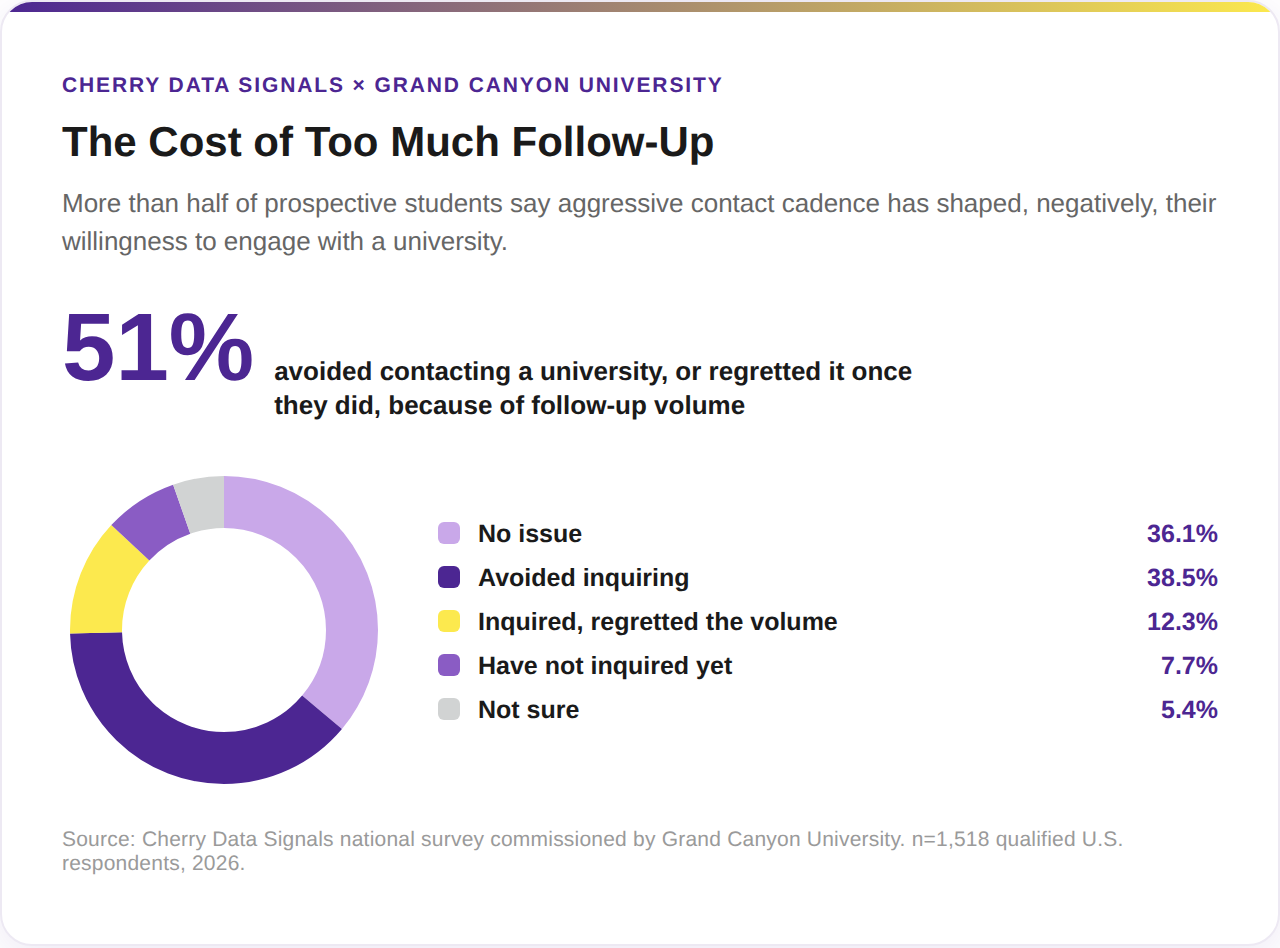
The cost of getting this wrong is not abstract. Thirty-nine percent of respondents say they have avoided making an inquiry with a university specifically because they were worried about being subject to repeated calls, texts or emails afterward, and another 12% say they made an inquiry and regretted the volume of follow-up they received. That's over half of this study's respondents whose relationship with a university's admission process was shaped, negatively, by contact cadence alone, before a single conversation about programs or fit even happened.
What this means for your college search: If you want a real conversation early, ask for one; most admissions teams are used to fielding exploratory questions well before application season. And if a school's follow-up starts to feel excessive, it's reasonable to ask them to dial it back or switch to a channel of communication you prefer.
More Research Makes the Decision Easier, Not Harder
Despite having more sources of information available to them than any previous generation of applicants, 64% of respondents say access to more college information makes their decision easier, either much easier (36%) or slightly easier (29%); only 14% say it makes things harder. Most students also aren't drowning in sources: 65% expect to consult somewhere between two and four sources.
When it comes to what actually swings the final decision, the university's own website leads again (20%), ahead of AI tools (12%), TikTok or YouTube creators (10%), current students (9%), university graduates (9%) and friends or family (8%). No single social or AI channel comes close to matching the influence of the official source once a student is actually deciding, even though those channels dominate earlier in the process.
Asked to describe how they expect to make that final call, 32% say they will carefully weigh the evidence and pick the strongest overall option, 27% say they'll go with whatever feels like the best personal fit, and 18% say affordability will decide it. Only 5% expect to be strongly swayed by trusted people in their life, a reminder that even in an era of TikTok recommendations and Reddit threads, most prospective students still see the final choice as theirs to make on the merits.
What this means for your college search: It is reasonable to use Al, video and community platforms to build and narrow your list quickly, but budget real time near the end to compare the specifics, cost, program content and verified outcomes, directly on each university's own site before you commit.
Your Research Checklist
Frequently Asked Questions
Do prospective students trust AI to help choose a university?
Yes, with limits. 87% have used or considered using an AI tool for their college search, and AI assistants were the single most trusted source for a genuinely impartial comparison between two universities (20%), ahead of school counselors, independent advisors and admissions reps. Most students still verify financial aid, tuition, admission requirements and accreditation independently before trusting an AI-generated answer completely.
Does TikTok actually influence where students apply?
Yes. 60% of surveyed prospective students said social video platforms like TikTok and YouTube had influenced their impression of a university, and 49% had added or removed a specific school from consideration because of something they saw on social media. TikTok and YouTube combined (26%) were almost as likely as search engines (22%) to introduce students to a university they had not previously considered.
Should universities be worried about what students find on Reddit?
Somewhat, but not in the way many assume. 52% of prospective students have used or would use Reddit for college research, mainly to find honest student experiences, unexpected costs and information about teaching quality. 17% say negative comments would make them rule out a university immediately; most treat negative discussion as a reason to investigate further, not a final verdict.
How many sources do students check before choosing a university?
Most prospective students consult between two and four sources before deciding, and 64% say having more information available makes the decision easier rather than harder.
What ultimately has the biggest influence on a student’s final decision?
The university's own website. It was the single most influential source at the final-decision stage (20%), and the most common place students go to verify information they first encountered through AI, social media or online communities (24%).
Do prospective students want to talk to an admissions representative?
Yes, but earlier than many universities assume. The most common answer for when a conversation with an admissions rep would be most useful was “at the very start of my research” (26%), not at the application stage.
Why do students avoid contacting universities directly?
The most common reason is contact fatigue. 39% of respondents said they had avoided making an inquiry because they were worried about receiving repeated calls, texts or emails afterward, and another 12% said they made an inquiry and regretted the volume of follow-up they received.
Conclusion
The modern college search doesn't run through a single channel anymore, and this data confirms it. Students are asking AI assistants to do the early sorting, watching creators for a feel of campus life, checking Reddit for the parts marketing departments leave out, and still, at the end of it, coming back to the university's own website to settle the question.
That's arguably good news for universities willing to be genuinely transparent. The channels have multiplied, but what actually earns trust hasn't changed much: clear pricing, verifiable outcomes, honest representation, and a human being available when a student wants one, without being chased afterward.
For prospective students, the takeaway is similar: use the new tools, they genuinely make the process faster and, according to this data, easier. Just budget the time to verify the parts that matter most — cost, accreditation and outcomes — directly with the source before you commit.
Research conducted by Grand Canyon Education and Cherry Data Signals on behalf of Grand Canyon University. Sample: 1,518 qualified U.S. respondents.