

One college has the academic program you want. Another feels like home as soon as you step on campus. A third sends a financial aid offer that changes your entire calculation.
For students comparing schools, choosing a college can quickly become a balancing act between what they want, what they can afford and what they expect their education to do for their future.
Which factor ultimately wins?
According to our survey, cost leads by a wide margin. Seven in 10 students named total cost after scholarships and financial aid as one of their top three college decision factors, with 42% saying it had the single biggest impact on where they enrolled.
Still, price was not the only feature drawing students to a school. Academic programs, location, career outcomes, campus feel, family advice and social life all played a role. Students’ answers also reveal an important difference between what attracts them during the college search and what they believe mattered after they began their college experience.
To learn more about the factors students consider when choosing a college, Grand Canyon University, in collaboration with Grand Canyon Education, surveyed more than 1,500 college students across the U.S. We asked what influenced their final enrollment decision, where they found vital information and what they would prioritize differently if they could choose again.
Key Findings From the College Choice Survey
What Factors Matter Most When Choosing a College?
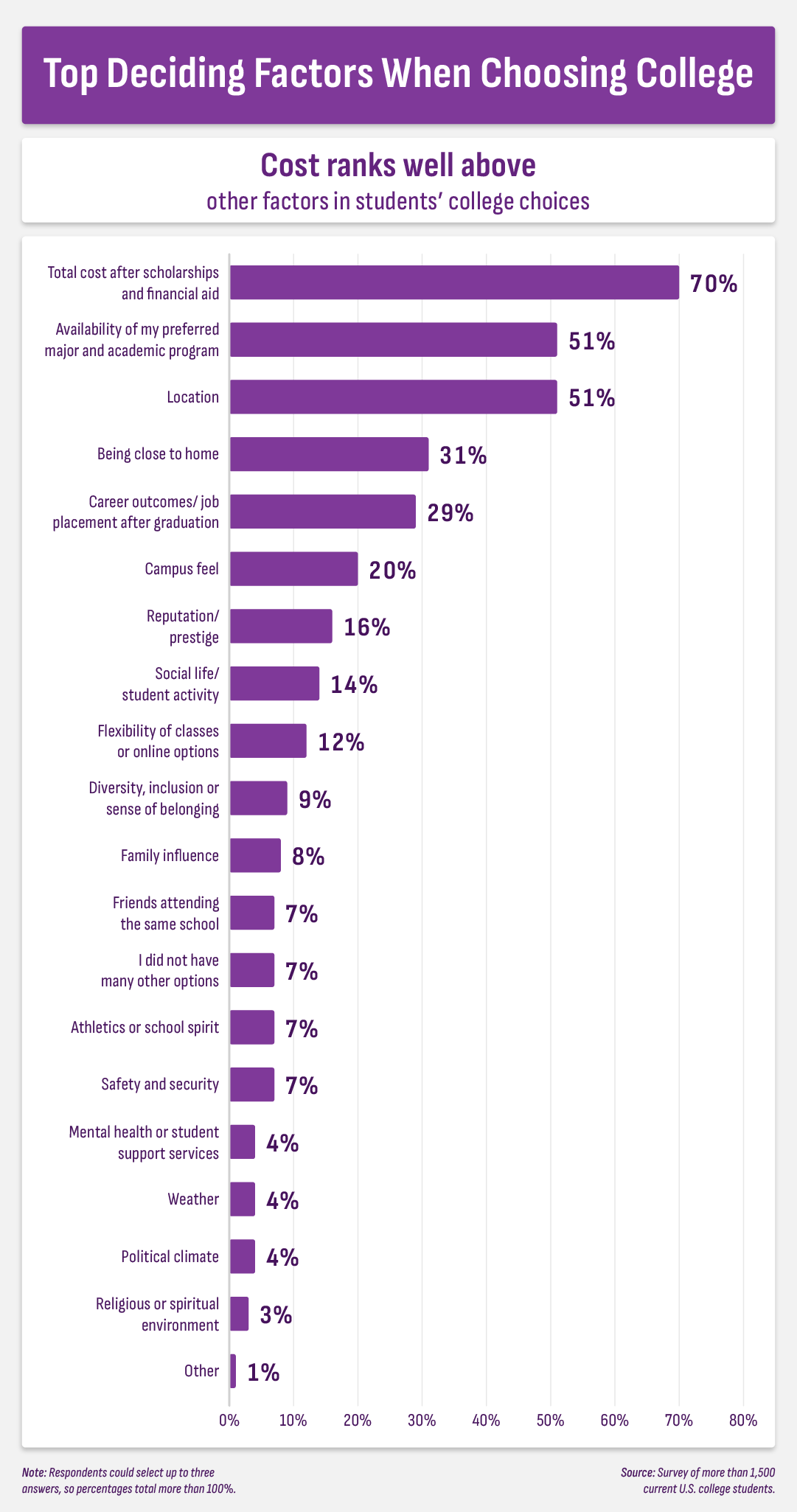
When students considered the most important factors in choosing a college, affordability stood well above the rest.
A total of 70% named cost after scholarships and financial aid as one of their top three factors. That placed it 19 percentage points ahead of both the availability of a preferred major and location, which tied for second at 51%.
Being close to home ranked fourth at 31%, followed by career outcomes or job placement at 29%. Campus feel influenced 20% of students, while 16% cited reputation or prestige and 14% considered social life or student activities among their top three priorities.
Factors that often receive attention during the college search were less commonly selected. Athletics/school spirit and safety and security each influenced 7% of respondents.
Cost became even more dominant when students had to name only one factor. More than two in five students (42%) said total cost after scholarships and aid had the greatest impact on their final college decision. The availability of their preferred major followed at 12%, while 9% selected location.
Looking at the issue another way, nearly three in four students said the total cost of attendance was either the deciding factor or one of the most important factors in choosing their college.
For many students, then, affordability may act as the first filter. A school can offer a desirable program, location or campus experience, but those features may not remain under consideration if the cost feels out of reach.
That filter was especially noticeable among first-generation respondents.
Of those who named cost as the biggest influence on their final decision:
For those who chose cost as the deciding factor:
Household income shaped the calculation as well. Nearly half of students from households earning under $50,000 when they were applying to college said cost had the biggest impact on their final choice. That compares with about one-quarter of students from households earning $150,000 or more.
Does Financial Aid Matter More Than College Rankings?
Cost is a broad consideration. Financial aid is where that cost becomes personal.
Nearly one in four students, 23%, said scholarships, grants or other financial aid offers changed where they ultimately enrolled. Another 24% said an offer made them consider a college more seriously, while 34% said it helped confirm the school they had already planned to attend.
By comparison, 12% said financial aid did not affect their decision, and 7% reported that they did not receive a scholarship, grant or financial aid offer.
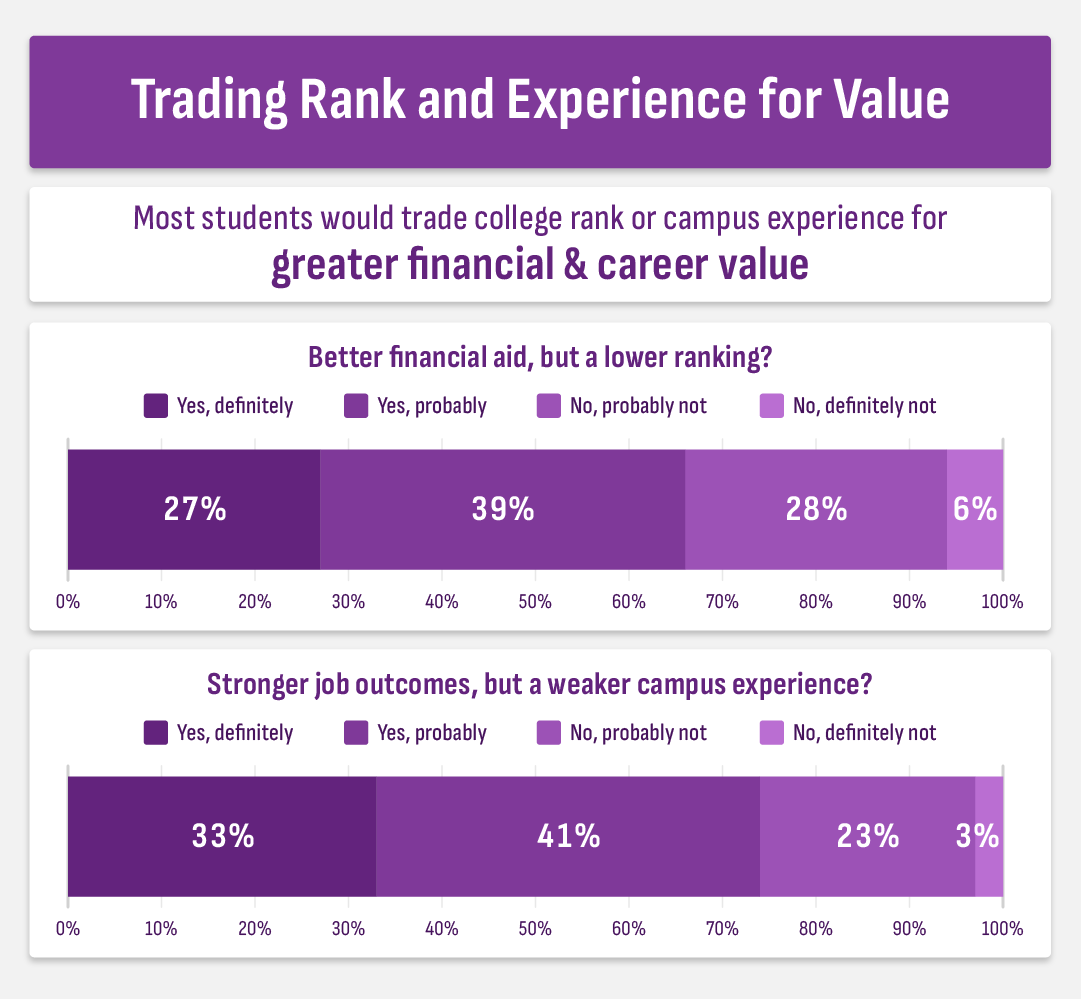
The potential impact becomes even clearer when students are asked to choose between aid and rankings. Two-thirds of respondents said they would definitely or probably select a lower-ranked college if it offered a much better financial aid package. This includes 27% who would definitely make that choice and 39% who probably would.
Students expressed a similar preference when reflecting on the decision they had already made. Nearly 63% agreed that their financial aid offer mattered more than their college’s reputation or ranking, including 32% who strongly agreed.
Women were somewhat more likely than men to say they would definitely choose the lower-ranked college for better aid, 30% versus 24%.
The difference was wider across income groups. Three in four students from households earning under $50,000 would choose a lower-ranked school for a much better financial aid package, compared with 47% of students from households earning at least $150,000.
Students from lower-income households were also more than twice as likely to say they would definitely make that trade, at 38% compared with 16% of higher-income respondents. Eight in 10 students from households earning under $50,000 agreed that financial aid mattered more than reputation, compared with 38% of those from households earning $150,000 or more.
These findings do not mean rankings are irrelevant. Prestige or reputation ranked among the top three factors for 16% of students overall, rising to 30% among respondents from households earning at least $150,000. However, the results suggest that when an aid package meaningfully changes what a student or family must pay, many are willing to place affordability ahead of ranking position.
Do Students Prioritize Career Outcomes Over Campus Life?
Career value may not always be the first feature students mention, but it plays a substantial role when they compare long-term outcomes with the college experience.
Nearly half of respondents said expected career outcomes — including job placement, salary potential and opportunities after graduation — were either the deciding factor or one of the most important factors in their college choice. Only 5% said career outcomes did not matter.
When asked to compare priorities directly, 55% agreed that expected career outcomes mattered more to their decision than the overall college experience.
Students were even clearer when presented with a tradeoff: 74% would definitely or probably choose a college with stronger job outcomes even if its campus life or social experience seemed weaker. One-third said they would definitely choose the school with better outcomes, while 41% said they probably would.
This preference was especially common among students from households earning under $50,000. About 81% would prioritize better job prospects, compared with 62% of students from households earning $150,000 or more.
First-generation students were also more likely to make the trade. About 80% would choose stronger career outcomes over a stronger campus experience, compared with 71% of non-first-generation students.
One notable pattern appears when these responses are compared with students’ initial priorities. The availability of a preferred major ranked among the top three decision factors for 51% of students, while 29% explicitly selected career outcomes or job placement. This may suggest that students evaluate career value in more than one way. Some may view the strength and availability of their intended academic program as part of preparing for a future career, even if they do not separately select job placement.
Which Sources Influence College Decisions?
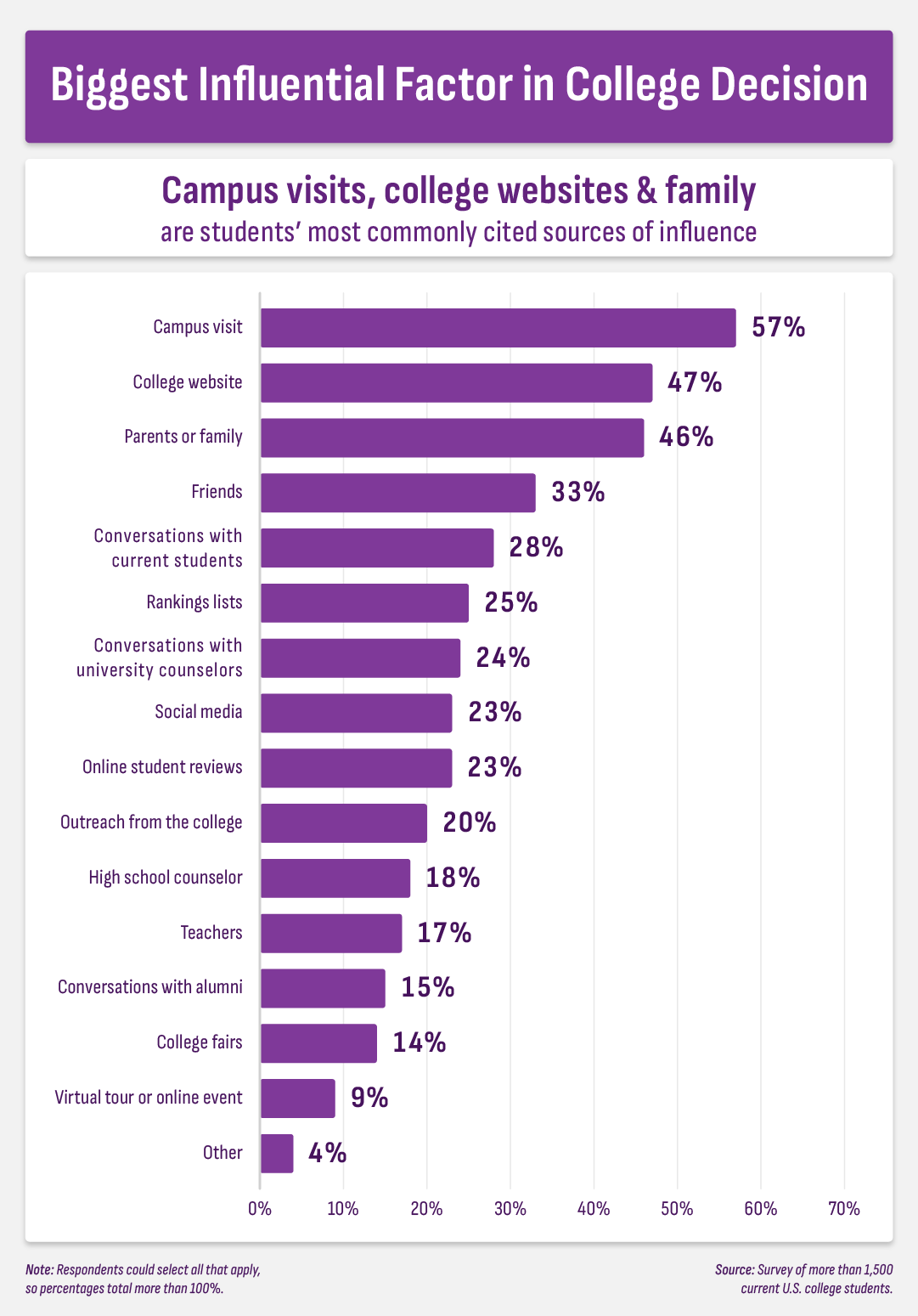
Students have access to more college information than ever before, but their most commonly cited sources suggest that firsthand experiences and trusted relationships remain especially influential.
Campus visits ranked first, with 57% of students saying a visit influenced their college decision. College websites followed at 47%, while 46% cited parents or family.
Friends played a role for one-third of respondents, and 28% were influenced by conversations with current students. About one-quarter consulted college rankings, while 24% cited university counselors.
Social media and online student reviews each influenced about 23% of respondents. Other sources included outreach from the college at 20%, high school counselors at 18%, teachers at 17%, alumni at 15% and college fairs at 14%.
Taken together, the leading sources reveal an important combination. Students use digital information to research their options, but they also want to see a campus for themselves and talk with people they trust.
Family influence extended beyond serving as an information source. More than half of students agreed that their family had a major influence on where they enrolled, including 24% who strongly agreed and 31% who somewhat agreed.
However, not every student had the same support network. First-generation respondents were more likely than non-first-generation students to rely on a high school counselor, 24% versus 16%. They were also less likely to cite parents or family as an influential information source, 38% versus 49%.
There were differences by gender as well. Women were more likely than men to cite university counselors and conversations with current students. Men were more likely to cite rankings lists and teachers.
What Do Students Wish They Had Prioritized Differently?
Choosing a college requires students to predict what will matter to them before they have experienced college life. Once enrolled, those priorities can look different.
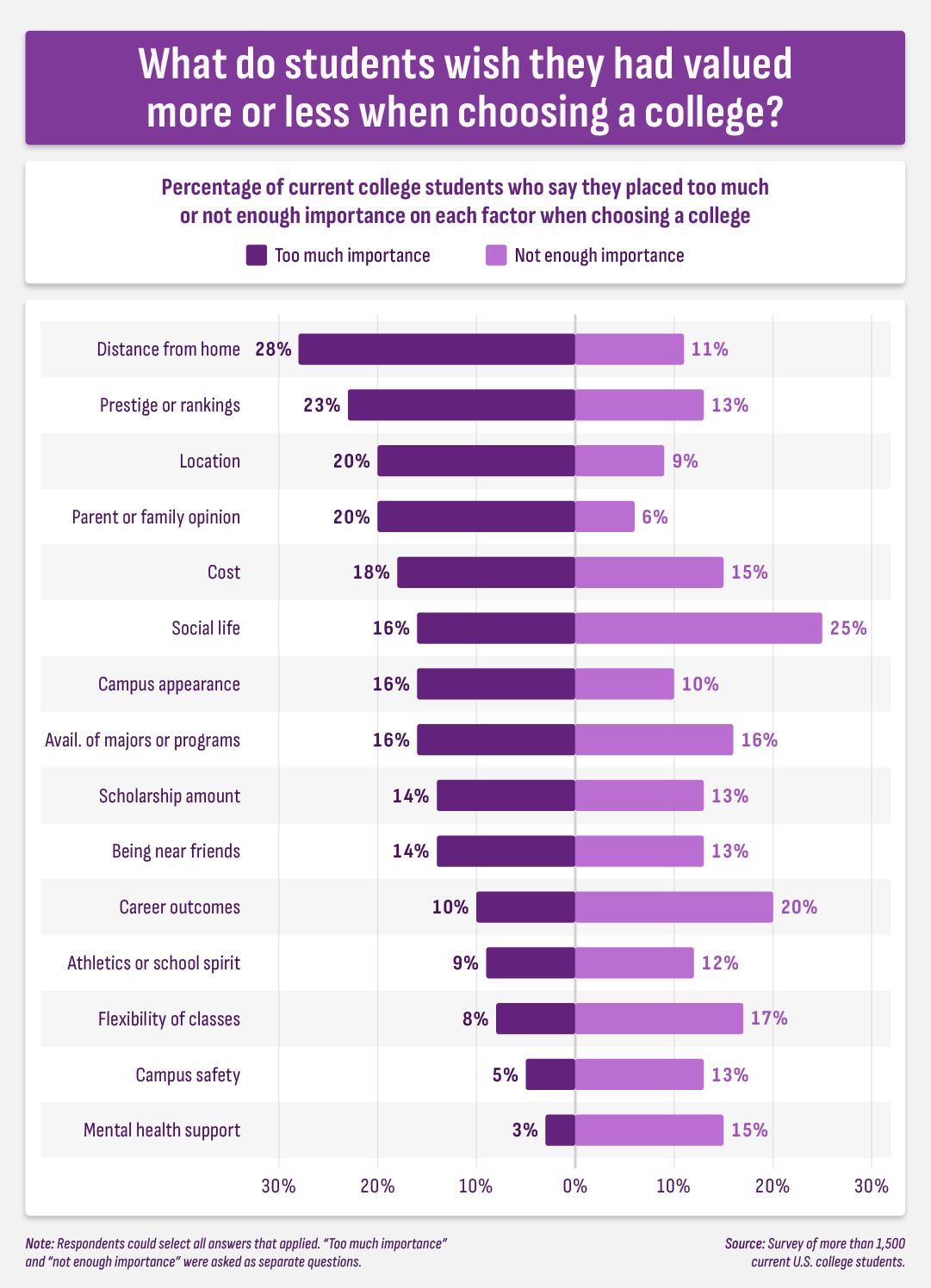
Distance from home was the factor students most frequently said they had overvalued, cited by 28%. Prestige or rankings followed at 23%, while 20% said they placed too much importance on location, and another 20% said the same about parent or family opinion. Cost was overvalued by 18%, followed by social life and campus appearance at 16% each.
Students’ answers about what they undervalued tell another side of the story. Social life ranked first at 25%, followed by career outcomes at 20% and flexibility of classes at 17%. Sixteen percent wished they had placed more importance on the availability of specific majors or programs, while 15% cited mental health support.
Some of the largest differences appeared in aspects of students’ everyday college experience. Mental health support was undervalued by 15% but overvalued by only 3%. Career outcomes were undervalued by 20% and overvalued by 10%. Class flexibility was undervalued by 17% and overvalued by 8%.
The reverse was true for several features that are visible early in the college search. Distance from home was overvalued by 28% and undervalued by 11%. Parent or family opinion was overvalued by 20% and undervalued by 6%. Prestige was overvalued by 23% and undervalued by 13%.
Social life provides another notable contrast. Only 14% initially ranked social life or student activities among their top three college decision factors, yet 25% later said they had not given social life enough weight.
A similar pattern appeared with support and safety. Mental health or student support services ranked among the top three factors for only 4% of respondents, but 15% later believed they had undervalued mental health support. Campus safety was initially selected by 7%, while 13% said they had not placed enough importance on it.
This does not mean students should place campus life ahead of affordability, academic programs or career preparation. Instead, the findings show that college fit is multidimensional. The features that shape a student’s daily routine, relationships and well-being may be difficult to understand until that student is living the experience.
Closing Thoughts
So, what features draw students to a college?
The clearest answer is practical value. Students begin with cost, academic programs and location. Many then compare financial aid, career opportunities and whether the school remains financially realistic for them and their families.
But the results also show that choosing a college is not a purely financial calculation. Campus visits, trusted conversations, social connection, class flexibility, safety and mental health support can shape whether a student feels comfortable and supported after enrolling.
For prospective students, the findings point toward a balanced decision-making process:
- Compare the total or net cost after grants and scholarships, not only the published tuition
- Confirm that the school offers the intended major and the academic resources needed to pursue it
- Research graduation rates, post-graduation employment rates and other post-college outcomes
- Visit the campus and talk with current students, university counselors and family members
- Consider the everyday experience, including class flexibility, community, safety and student support
No single school will rank first in every category. The goal is to understand which features are essential, where tradeoffs are acceptable and which school best aligns with a student’s financial circumstances, academic interests, career goals and desired college experience.
At GCU, prospective students can use the Degree Finder to explore campus and online programs, review tuition and financial aid options and schedule a campus visit. Together, these resources can help students evaluate both the practical value of a college and the community in which they will pursue their education.
Methodology for the College Choice Survey
Grand Canyon University, in collaboration with Grand Canyon Education, surveyed more than 1,500 college students across the country about the factors that influenced their college decision-making process. Responses were collected in July 2026.
Respondents attended a range of institutions, including public and private four-year colleges and universities, community colleges, private for-profit colleges and trade, technical or career schools.
The survey asked students about the importance of cost, scholarships and financial aid, academic programs, career outcomes, location, campus life, family influence and the information sources they used when choosing a school. Students were also asked which factors they believe they overvalued or undervalued.
Results are reported as percentages of respondents who answered each question. For questions that allowed respondents to select multiple options, percentages may total more than 100%. Percentages in the article and graphics may not always total exactly 100% because of rounding. Findings reflect the self-reported experiences and opinions of the surveyed students.
Fair Use
You are welcome to use, reference and share non-commercial excerpts of this study with proper attribution. If you cite or cover our findings, please link back to this page so readers can view the full methodology, charts and context.
Find What You’re Looking for at GCU
Explore GCU’s academic programs, campus community and student resources to discover the college experience that may be right for you.