



Environmental chemistry plays a crucial role in understanding how chemicals interact with the air, water, soil and living organisms around us. This field helps scientists and industry professionals evaluate environmental impact, develop cleaner technologies and protect the environmental and public health.
To offer an inside look into the scientific field of environmental chemistry, we sat down with Dr. Randhir Deo, assistant professor for the College of Natural Sciences at GCU. In the following interview, he breaks down key concepts, emerging trends and the skills students need to succeed in this exciting field.
Explaining Environmental Chemistry
How would you answer "What is environmental chemistry?" to students who are interested in the field?
“Environmental chemistry is the study of how chemicals behave in the environment, i.e., how they move, transform and interact with air, water, soil and living organisms. As a field, it combines principles of chemistry with real-world environmental challenges. I would explain it to a new student as the science that helps us understand why pollutants end up where they do, how long they stay there, and what effects they may have on ecosystems or human health.
It’s also a field focused on solutions. Environmental chemists work on monitoring pollution, understanding chemical risks and developing cleaner technologies or remediation approaches to protect the environment."
"Since the work intersects with ecology, sustainability, public health, environmental law and policy, students experience an interdisciplinary science that connects the lab, the field and decision making for communities."
Types of Environmental Challenges
What types of environmental challenges do environmental chemists study, and how do chemistry principles help us understand or solve these issues?
“Environmental chemists study how chemicals interact with different parts of the environment, including air, water, soil and living organisms, to better understand the sources of pollution, how the contaminants move through the ecosystems and their potential impacts on human and environmental health. Chemistry principles play a central role in explaining and predicting these behaviors.
For example, the molecular properties of a chemical, such as whether it is hydrophilic (water-loving) or hydrophobic (water-repelling), strongly influence where it will accumulate in the environment. Hydrophilic compounds are more likely to dissolve and travel through water systems, while hydrophobic chemicals tend to bind to soil particles or sediments. Likewise, chemical structure and bond stability help determine how persistent a pollutant will be in the resultant environmental matrix. Chemicals with strong bonds or resistant functional groups may degrade very slowly, allowing them to persist in the environment and potentially bioaccumulate in living organisms.
Environmental chemists also apply principles such as acid–base chemistry, redox reactions and thermodynamics to understand phenomena like acid rain formation, metal mobility in soils and the transformation of pollutants into more (or less) toxic forms. By combining these chemical insights, environmental chemists can not only identify and track pollutants but also develop strategies for remediation, such as selecting appropriate treatment technologies or designing greener, more degradable chemicals.”
"Today’s most pressing environmental challenges, including access to clean water, development of clean energy, and maintaining safe, sustainable ecosystems, require collaboration across multiple disciplines: chemistry, engineering, ecology, data science, public health and policy. Preparing students to work across these boundaries, to communicate effectively, and to lead ethically is essential to creating solutions that protect human and environmental health."
Environmental Chemistry vs. Environmental Toxicology
How do environmental toxicology and chemistry overlap, and why is this relationship important for understanding pollutant behavior and human/ecosystem health?
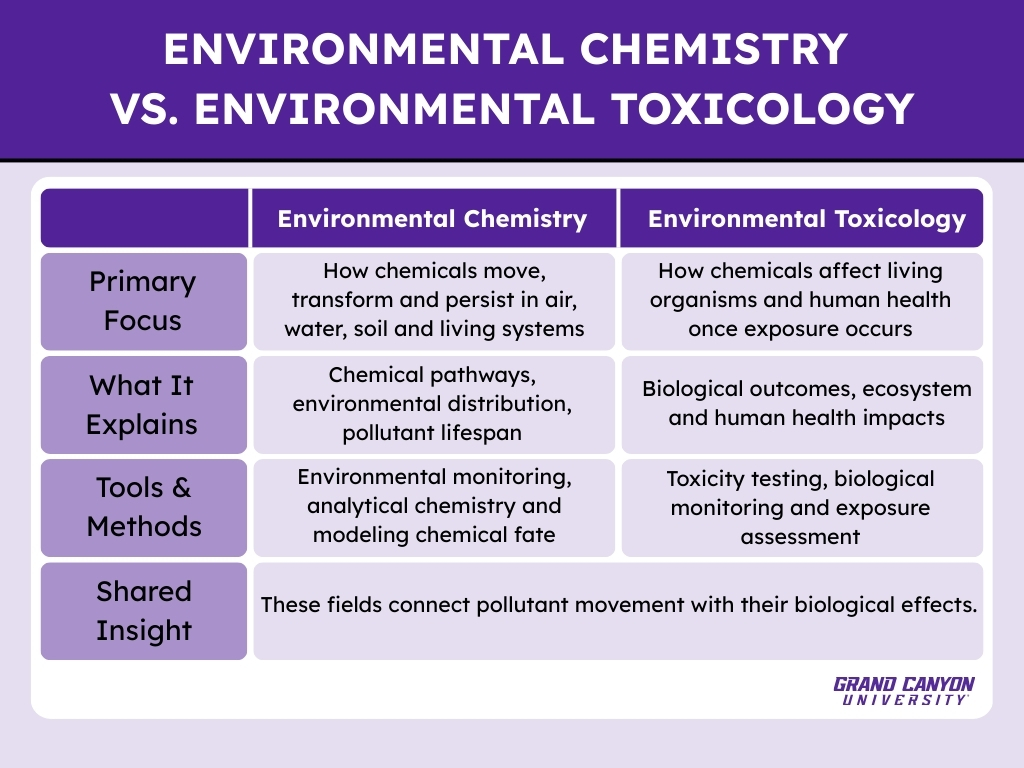
“Environmental toxicology and chemistry are closely connected fields that help us understand not only where pollutants go in the environment but also what they do once they reach the living organisms. For example, environmental chemistry focuses on the chemical’s behavior, i.e., how it moves, transforms and persists in air, water and soil matrices of the environment, while environmental toxicology examines the biological effects of those chemicals on human and ecosystem health.
These two fields overlap because the fate of a pollutant directly influences its toxicity. For example, properties such as polarity, hydrophobicity, volatility and chemical stability determine whether a contaminant will dissolve in water, bind to soils or sediments, bioaccumulate in organisms, or degrade into more (or less) toxic products. These same properties also influence the various exposure pathways, i.e., whether a chemical is inhaled, ingested or absorbed through the skin, and therefore its potential risk.
For example, methylmercury forms from inorganic mercury through microbial biotransformation in aquatic environments. Because methylmercury is more lipid soluble and readily binds to biological tissues, it bioaccumulates and biomagnifies in aquatic food webs, demonstrating how chemical speciation, environmental conditions and transformation processes directly shape both exposure and toxicological outcomes.
Understanding this relationship is essential because a pollutant’s toxicity cannot be evaluated without understanding its availability and behavior in the environment. A chemical that is highly persistent, hydrophobic and bioaccumulative may pose long-term risks even at low concentrations, while a compound that rapidly degrades or remains confined to a certain environmental compartment may present a very different toxicological profile. By linking chemical fate with biological impact, these fields together provide a more complete picture of how pollutants influence both human health and ecosystems.”
Environmental Chemistry Skills
What core skills or competencies do students begin developing in GCU's environmental program with an environmental chemistry emphasis and how might these prepare them for advanced studies or technical roles related to environmental problem-solving?
“Students in GCU’s environmental chemistry emphasis begin developing a strong foundation in analytical chemistry, environmental science and data-driven problem-solving skills. This is paired with hands-on lab and field experience, thereby translating chemical principles into real environmental solutions.
Early coursework builds core science proficiency in general chemistry, biology, physics, ecology, statistics and scientific communication. “It then moves into discipline-specific skills such as quantitative analysis and sampling, environmental chemistry of air–water–soil systems, environmental law and risk concepts, and applied investigation and remediation.”
Some of the key competencies GCU students can build in this program include:
These competencies position graduates for advanced study in areas like environmental chemistry, toxicology and environmental engineering. They also learn skills that are relevant for environmental chemistry careers, such as environmental monitoring and analytics, water and air quality testing, site assessment and remediation support, regulatory/compliance assistance and lab-based R&D.
"GCU’s program’s emphasis on inquiry, instrumentation, risk concepts and regulatory awareness reflects the degree’s stated outcomes and coursework structure, giving students a portfolio of data, reports and project work that aligns with employer and graduate school expectations."
Emerging Trends in Environmental Chemistry
Are there emerging scientific trends, tools or research topics in environmental chemistry that you believe students should be aware of as they explore the field?
“Environmental chemistry is evolving quickly, and there are several emerging scientific trends, analytical tools and research areas that students should be aware of as they explore the field. Many of these align naturally with the competencies emphasized in GCU’s environmental chemistry curriculum, including advanced analytical methods, data-driven environmental decision-making, sustainability and remediation-focused innovation.
Advances in analytical instrumentation and environmental measurement continue to reshape the field. Techniques in chromatography and spectroscopy that are already introduced through courses like Analytical Chemistry and Instrumental Analysis are becoming more sensitive, more automated and increasingly coupled to high-resolution detectors. These developments improve our ability to detect contaminants at trace levels, characterize complex mixtures and track chemical signatures used in environmental forensics and site assessment. Students can benefit from early exposure to these tools, as they form the backbone of environmental monitoring and contaminant tracking work emphasized in upper-division courses.
Data-centric environmental science is expanding rapidly. Modern environmental chemistry relies heavily on computational modeling, statistical analysis and big data interpretation, which are reinforced in the program through relevant courses and domain competencies in data analysis and statistical modeling. These approaches support predictive modeling of contaminant fate and transport, exposure assessment, risk characterization and decision making for remediation strategies. “Students entering the field will increasingly engage with environmental datasets from sensors, remote sensing platforms, GIS-based mapping tools and integrated monitoring networks.”
"The field’s rapid growth reinforces the value of a chemistry-centered environmental science education. By developing strong analytical, computational, regulatory and remediation-focused skills early in their academic journeys, students position themselves to contribute to emerging research areas, environmental protection efforts and the development of new technologies that support human and environmental health."
Emerging contaminants and transformation chemistry are high-visibility research areas. Topics such as PFAS behavior and treatment, microplastics, pharmaceutical and personal care product residues and climate-relevant atmospheric chemistry align directly with themes in this program. Understanding how these substances partition, degrade or persist requires strong grounding in chemical kinetics, thermodynamics and environmental speciation. Students develop these skills progressively across foundational chemistry and upper-division coursework.
Sustainability science and green chemistry continue to expand as interdisciplinary pillars of the field. GCU’s curriculum highlights sustainability through courses like Environmental Management and Sustainability, where students examine waste management, green chemistry and sustainable system design. Students entering the field will increasingly be expected to evaluate environmental impacts holistically, considering life cycle perspectives, resource conservation and environmentally responsible chemical design.
Advances in remediation science, including bioremediation, environmental microbiology, advanced oxidation processes and integrated physical-chemical treatment methods remain central to emerging practice. Students explore innovative strategies for site analysis, chemical fingerprinting, exposure pathway identification and remediation planning. As technologies evolve, environmental chemists are increasingly involved in designing remediation approaches that are not only effective but sustainable, economically viable and aligned with regulatory frameworks.
Environmental Chemist Education Requirements
Aspiring environmental chemists typically begin by earning at least a bachelor’s degree, building strong foundations in core chemistry areas such as organic chemistry and biochemistry, while also gaining broad knowledge in environmental science fields.
Students may choose to pursue an environmental chemistry or environmental science degree. Coursework often covers fieldwork methods, data collection and analysis, human–geologic interactions, environmental pollution, U.S. environmental protection laws and foundational microbiology.
Gaining early experience through internships can make securing that first job easier, so students are encouraged to find hands on opportunities and begin building professional references.
Environmental Chemistry Careers
Environmental chemistry degrees open doors to paths including environmental engineering technician, environmental scientist and specialist, and environmental restoration planner.
Environmental engineering technicians support the work of environmental engineers by implementing pollution control plans, collecting and analyzing samples and operating equipment used in environmental monitoring and cleanup.
Environmental scientists and specialists, who generally hold at least a bachelor’s degree in a natural science area,(See disclaimer 1) conduct research, gather environmental data and develop strategies to protect ecosystems and public health.
Those drawn to ecosystem recovery may pursue careers as environmental restoration planners. These professionals assess degraded habitats, develop restoration plans, coordinate with scientists and stakeholders and oversee the implementation of projects designed to rehabilitate natural environments.
Median annual wage for environmental scientists and specialists in May 2024(See disclaimer 1)
Study Environmental Chemistry at GCU
If exploring how chemicals move through our air, water and soil inspires you, a career in environmental chemistry may be the right path. Becoming an environmental chemist typically begins with earning a specialized degree that builds a strong foundation in chemistry, environmental science, laboratory methods and data analysis.
GCU’s Bachelor of Science in Environmental Science: Environmental Chemistry emphasis program is designed to equip students with the coursework and hands-on experience needed to pursue roles in research, consulting, government organizations or contributing to pollution analysis and mitigation.
Explore Environmental Chemistry at GCU
Discover GCU’s environmental chemistry emphasis to develop career ready skills for protecting ecosystems and communities.


