

Biostatistics is a foundational discipline within public health that supports evidence-based decision-making, disease prevention and health promotion. Nearly every major public health initiative, ranging from vaccination programs to environmental health policies, relies on statistical evidence. Understanding biostatistics allows public health professionals to interpret data responsibly and translate research into meaningful action.

In this guide, Danielle Henderson, MPH and faculty member with the College of Nursing and Healthcare Professions, shares her insights into this important public health discipline.
Introduction to Biostatistics
Biostatistics applies statistical principles to biological, medical and population health research. It enables professionals to design studies, analyze health data and evaluate interventions that improve community well-being.
Public health practitioners use biostatistics to address questions such as:
• Does a prevention program reduce disease rates?
• Which populations are most affected by health disparities?
• How effective are health policies?
These questions are central to understanding and improving population health.
What Is Biostatistics in Simple Terms?
Biostatistics integrates mathematics, statistics and health sciences to analyze health-related data.(See disclaimer 1) It encompasses research design, data collection, statistical analysis and the interpretation of findings. Through these processes, biostatistics ensures that health research is conducted rigorously and that conclusions are scientifically valid. As a whole, biostatistics is essential for transforming scientific research into practical health solutions that improve population well-being.(See disclaimer 2)
Why Does Biostatistics Matter?
Biostatistics matters because it turns complex health data into meaningful insights that then guide important decisions. From tracking disease patterns to measuring the effectiveness of new treatments, biostatistical methods help researchers and healthcare leaders interpret data with clarity and precision. Without this analytical foundation, medical advancements and public health strategies would rely on assumptions rather than evidence.
By applying statistical reasoning to biological and health-related questions, biostatistics helps improve patient outcomes, inform policy decisions and advance scientific discovery. Its impact can be seen across healthcare, research institutions, government agencies and nonprofit organizations focused on improving population health.
Is Biostatistics Part of Public Health?
Biostatistics supports evidence-based public health by ensuring that decisions are grounded in reliable and systematically analyzed data. It plays a critical role in identifying risk factors, evaluating health interventions, reducing health disparities and strengthening healthcare systems.
During the COVID-19 pandemic, for example, statistical modeling guided public health responses and informed resource allocation worldwide.(See disclaimer 3) This demonstrated how biostatistical evidence can directly influence policy and protect community health.
What Does a Biostatistician Do?
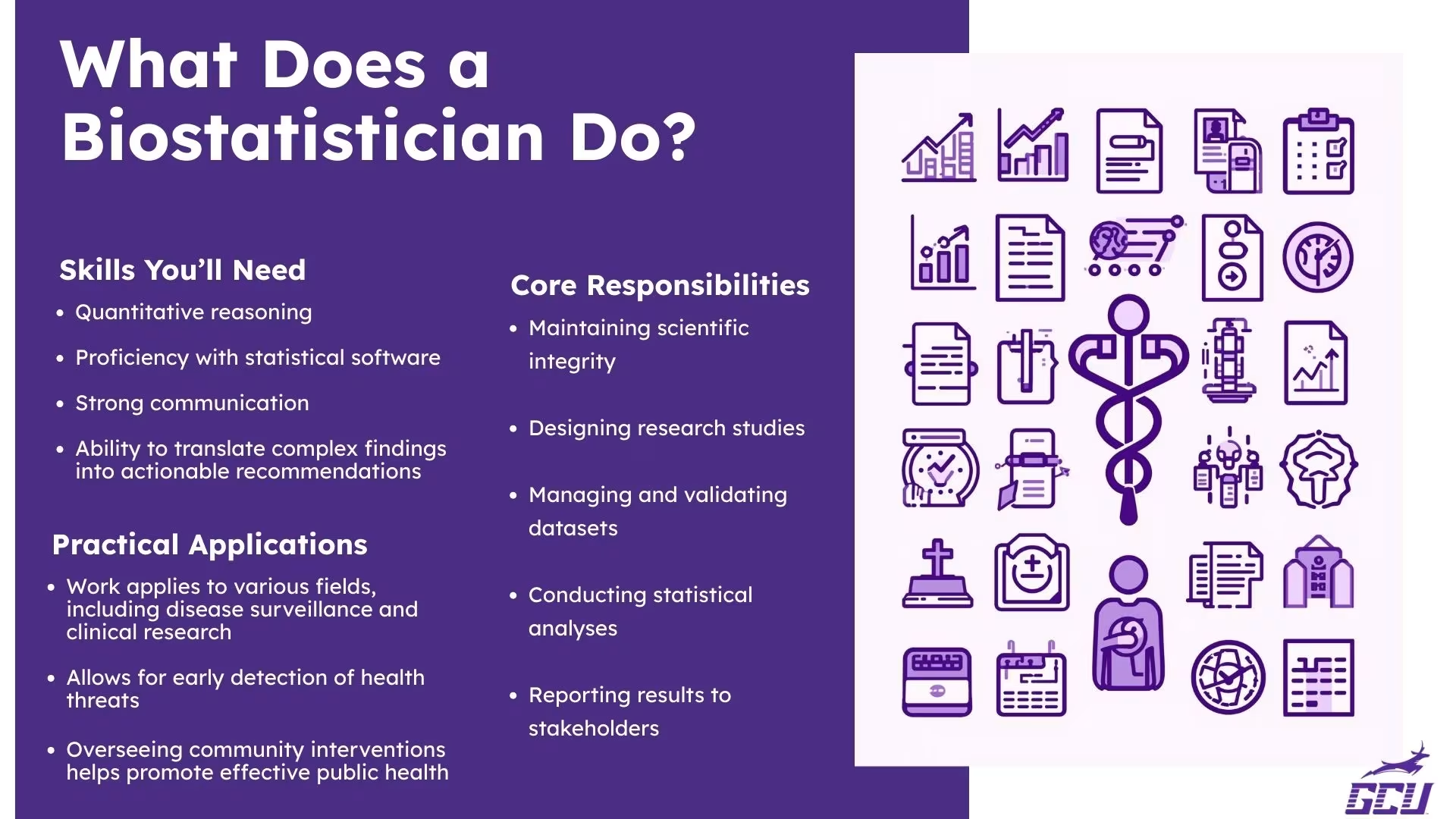
Biostatisticians play an essential role in modern healthcare and public health by helping ensure that research findings are accurate, reliable and purposeful. They work at the intersection of data, science and decision-making, contributing analytical expertise that supports medical discovery and population health efforts.
Core Responsibilities
Biostatisticians are responsible for maintaining the scientific integrity of health research. Their work includes designing studies, managing and validating datasets, conducting statistical analyses and reporting results to diverse stakeholders. These responsibilities help ensure accuracy, transparency and credibility in public health research.
Practical Applications
Biostatisticians contribute to many areas of public health practice, such as disease surveillance, clinical research, environmental health studies and program evaluation. Their analyses support early detection of health threats, assessment of treatment effectiveness and evaluation of community-based interventions. For instance, cancer surveillance systems rely on statistical methods to monitor incidence trends and guide screening policies.(See disclaimer 4)
Skills You’ll Need
Professionals in biostatistics develop a combination of technical and interpersonal competencies. These include quantitative reasoning, critical analysis, proficiency with statistical software, effective data management and strong communication skills. Clear communication is also particularly important, as biostatisticians must translate complex findings into actionable recommendations for policymakers, healthcare providers and community leaders.
Is Biostatistics Hard?
Biostatistics is often perceived as challenging, particularly for students who are new to advanced mathematics or data analysis. Like many quantitative disciplines, it requires persistence, critical thinking and the ability to apply abstract concepts to actual health issues. However, while the subject may present obstacles, those challenges are manageable with the right strategies and support and the long-term professional rewards that can make the effort worthwhile.
Common Challenges and How To Overcome Them
If a student encounters challenges when studying biostatistics, it is often due to mathematical complexity, abstract concepts, unfamiliar software applications or specialized research terminology. These challenges are particularly common among students without strong quantitative backgrounds. Therefore, they may initially create anxiety or frustration when encountering statistical coursework.
Success in biostatistics is supported through consistent practice, use of academic support services, participation in applied learning experiences and collaborative study with peers. Engaging with real public health data helps reinforce theoretical concepts and improve comprehension. Research indicates that contextualized instruction enhances statistical understanding in health education.(See disclaimer 5)
Is Biostatistics Worth It?
Despite its challenges, biostatistics offers significant professional benefits. It enables public health practitioners to evaluate scientific evidence, inform policy decisions, promote health equity and lead data-driven initiatives. These competencies are essential for effective leadership and responsible decision-making in modern public health systems.
What Is the Role of a Biostatistician in Public Health?
Biostatisticians play a critical role in strengthening public health systems through data-driven insight and evidence-based decision-making. By analyzing complex health data, they help shape interventions, guide policy and support collaboration across disciplines. Their expertise not only improves population health outcomes but also positions them as essential contributors within research, healthcare and community-based settings.
Improving Outcomes
Biostatisticians help improve population health by identifying effective interventions and eliminating ineffective practices. Data-driven evaluation supports disease prevention and health promotion efforts.(See disclaimer 6)
Collaboration Across Teams
Public health relies on interdisciplinary collaboration. Biostatisticians regularly work with:
This teamwork ensures that statistical findings are integrated into practical solutions.
Career Outlook
Employment opportunities for professionals with statistical training continue to expand. According to the U.S. Bureau of Labor Statistics, job growth for mathematicians and statisticians is expected to increase by 8% from 2024 to 2034, accounting for an estimated 2,200 job openings per year.(See disclaimer 7) Graduates with biostatistical training can be prepared for positions in government agencies, research institutions, hospitals and nonprofit organizations.
Education Pathways for Biostatistics Careers
The Bachelor of Science in Public Health (BSPH) introduces students to essential analytical skills, including descriptive and inferential statistics, research methods, epidemiology and data interpretation. These foundational competencies support evidence-based practice and align with standards established by the Council on Education for Public Health.(See disclaimer 8)
Master of Public Health (MPH) programs provide advanced education in biostatistical methods, program evaluation and applied research. Graduate coursework emphasizes the practical application of data analysis for population health improvement, policy development and program assessment.
Along with a degree, professional certifications may potentially strengthen career opportunities, including:
These credentials demonstrate technical expertise and professional commitment.
Why Study Biostatistics at GCU?
At GCU, biostatistics education is integrated with ethical leadership and service-oriented values. Instruction emphasizes the responsible use of data to improve community health and reduce disparities.
Our key program priorities include crucial concepts, such as:
If biostatistics is a topic of interest or a potential career option for you, consider enrolling in one of the online public health degrees at GCU. For BSPH and MPH students, biostatistics is integrated into the curriculum to build essential analytical skills. This education can equip you to interpret data, inform decision-making and contribute effectively in a wide range of public health and healthcare settings.
Turn Data Into Impact
Explore how a BSPH or MPH can help you inform research, shape health initiatives and support evidence-based decision-making.