GCU Logo Mobile
Apply NowRequest Info
  • GCU Login
GCU LoginRequest Info
Grand Canyon University logo in bold purple uppercase text on a white background
  • Degree Programs
    • Areas of Study
      • Business
      • Teaching
      • Language
      • Counseling
      • Psychology
      • Healthcare
      • Nursing
      • Criminal Justice
      • Legal Studies
      • Engineering
      • Science
      • Technology
      • Theology
      • Ministry
      • Digital Arts
      • Digital Media
      • Fine Arts
    • Locations
      • Campus
      • Online
      • Evening
    • Degree Level
      • Bachelor's
      • Master's
      • Doctoral
      • Certificates
      • Bridge
      • Post-Master's
    • Other Course Options
      • Minors
      • Individual Courses
      • High School Dual Enrollment
      • Current Teacher Continuing Education
      All Majors & Programs
      All Majors & Programs
  • Academics
    • Colleges
      • Doctoral
      • Arts & Media
      • Business
      • Education
      • Engineering & Technology
      • Humanities & Social Sciences
      • Natural Sciences
      • Nursing & Health Care
      • Theology
      • Honors
    • More About GCU
      • Academic Catalog & Policies
      • University Accreditation & Regulation
      • Educational Alliances
      • Faculty Directory
      • Office of Assessment
      • Provost Message
      Academics
      Academics
  • Admissions
    • Admissions
      • Admission Requirements
      • Visit Campus
      • Undergraduate Admissions
      • College Transfer Center
      • Graduate & Doctoral Admissions
      • Campus Resources
      Admissions
      Admissions
  • Tuition & Financial Aid
    • Tuition
      • Online & Evening
      • On-Campus
      • Housing & Meal Costs
      • Other Fees
      • Cost of Attendance
    • Financial Aid
      • FAFSA
      • Scholarships & Grants
      • Student Loans
      Tuition & Financial Aid
      Tuition & Financial Aid
  • Why GCU
    • Student Journey
      • Online Learning
      • Campus Life
      • Evening Classes
      • Hybrid Learning
      • Military & Veteran
      • ROTC
      • International Students
      • Native American
    • Our Story
      • University Spirit & Traditions
      • Christian Identity & Mission
      • History & Campus Growth
      • Community Outreach
    • About
      • Leadership Team
      • Campus Locations
      • Blog
      • Offices
      • Contact
      • Media & Branding
      Why GCU
      Why GCU
Apply NowRequest Info

Read time 5 minutes

Published on Oct 21, 2024


In This Article
  • Overview
  • What Is a Documentary Film? 
  • What Is the Difference Between Documentary Modes, Categories and Styles? 
  • Styles of Documentaries 
  • How To Make Various Types of Documentaries 
  • Explore Filmmaking and Documentary Creation at GCU
In This Article
Overview
What Is a Documentary Film? 
What Is the Difference Between Documentary Modes, Categories and Styles? 
Styles of Documentaries 
How To Make Various Types of Documentaries 
Explore Filmmaking and Documentary Creation at GCU
Tags
Theatre and Drama|Digital Film
Related Articles In
Performing Arts & Digital Arts
Close-up of a person holding a camera with the lens in sharp focus, showing aperture blades and colorful light reflections.

What Is Digital Arts?

Trying to decide whether a digital arts degree is right for you? Here we share an overview of what the degree and what new skills you will gain.

10/28/2025

|

7 min read

Side-by-side image of a vintage typewriter and a modern laptop keyboard, symbolizing the contrast between traditional media and the digital innovations of new media.

Traditional vs. New Media: What’s the Difference?

Explore the key differences between traditional vs. new media, their impact on communication and how this can look in a modern media career.

09/16/2025

|

4 min read

A red-haired person works on a laptop at a desk with a notebook and cookies, set in a room with industrial-style decor.

How To Become a Screenwriter

What does a screenwriter do? Discover screenwriting careers and learn how to become a screenwriter. Earn a degree from GCU.

07/29/2025

|

5 min read

We're here to help.

I'm Ready to ApplyI Need More Information
GCU Logo White
1-855-GCU-LOPELive Chat
3300 West Camelback Road  - 
Phoenix, AZ 85017
Grand Canyon University © 2025
All Rights Reserved
  • Majors & Programs
  • Admission
  • Financial Resources
  • Academic Calendar
  • Academic Catalog & Policies
  • Online Learning
  • Why GCU
  • Contact Us
  • Careers
  • Title IX
  • Media & Licensing
  • Consumer Information
  • Financial Disclosures
  • Privacy Policy
  • Cost of Attendance
Find Your Purpose Logo
Video from GCU
FacebookTwitter/XLinkedInInstagramYouTube
  • Current Students
    |
  • Alumni
    |
  • Athletics
    |
  • Arena
    |
  • GCU News
    |
  • Lope Shops
    |
  • GCBC
    |
  • Canyon Promotions
    |
  • Lope House
    |
  • GCU Golf

Privacy / Cookie Disclaimer: Our site uses cookies to personalize content, to provide social media features/ads and to analyze site traffic. We share information about your use of this site with our social media, advertising and analytics teams who may combine it with other information that you’ve provided to them. By continuing to navigate this site you are consenting to the collection of information via our use of cookies. For more information on our cookie collection and use please visit our Privacy Policy.

Share This Story
FacebookTwitter/XLinkedInShare via Email

  1. Home/
  2. Blog/
  3. Performing Arts & Digital Arts/
  4. Types of Documentaries: Categories and Styles

Types of Documentaries: Categories and Styles

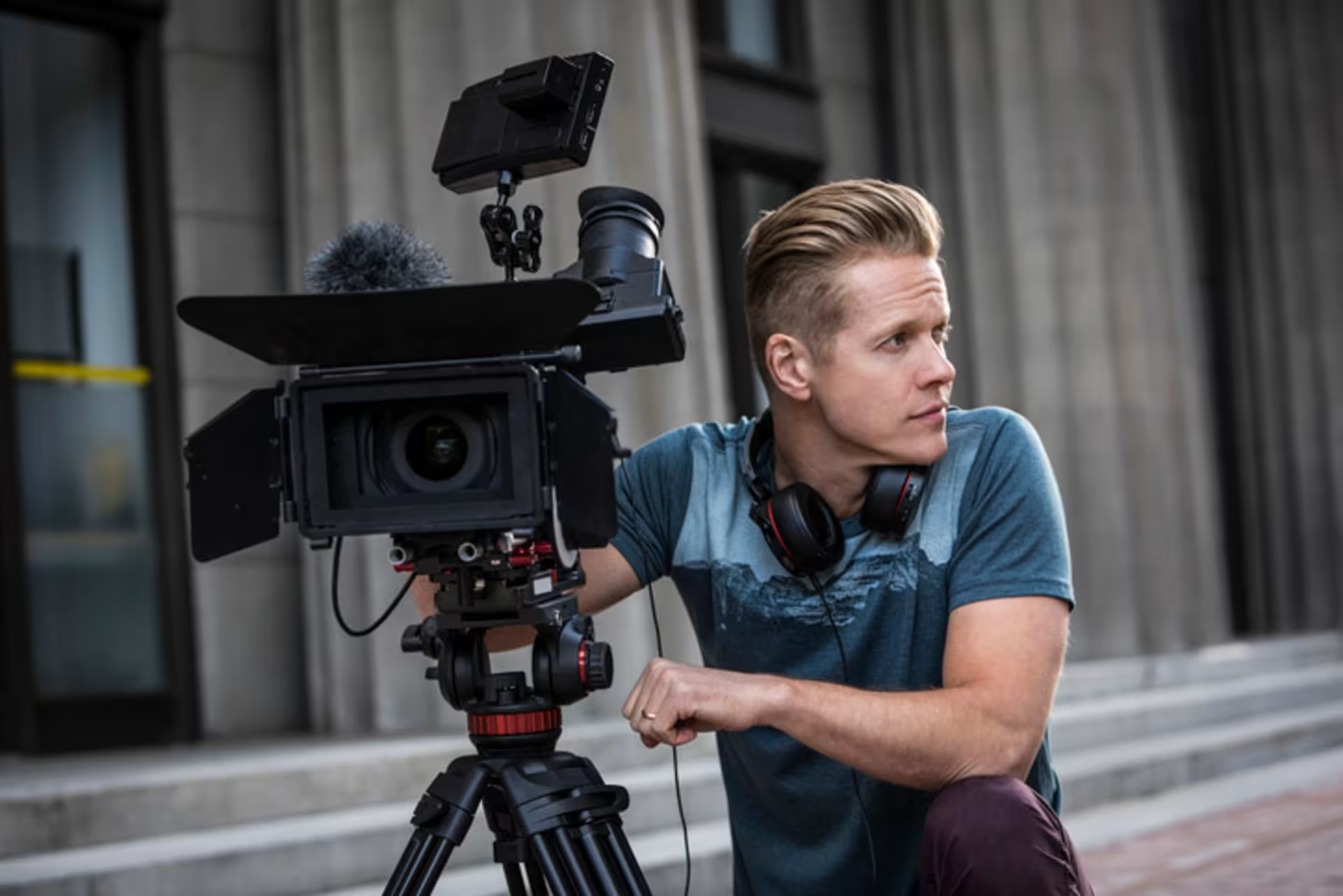
man kneeling next to a camera during filming
Start your GCU
journey today.
Step 1: Educational Interests
This helps us connect you with the right enrollment counselor to help you through the process.
Make a selection
Select One
Bachelor's
Master's
Doctoral
Bridge
Make a selection
First select a degree level
Make a selection
First select a degree level and how you would like to attend
Make a selection
First select degree level, modality, and area of interest
Make a selection
Select One
Yes
No
Make a selection
Select One
Yes
No
Make a selection
Select One
Yes
No
West Valley (Phoenix, AZ) ABSN
Select One
Albuquerque, NM ABSN
Boise (Meridian, ID) ABSN
Denver (Englewood, CO) ABSN
East Valley (Chandler, AZ) ABSN
Las Vegas (Henderson, NV) ABSN
Miramar (Miami, FL) ABSN
Orlando (Lake Mary, FL) ABSN
Salt Lake (Sandy, UT) ABSN
St. Louis, MO ABSN
Sun City, AZ ABSN
Tucson, AZ ABSN
West Valley (Phoenix, AZ) ABSN
Make a selection
Select One
Still in High School
High School Diploma or GED
Some College
Associate Degree or over 60 credits
Bachelor's Degree
Master's Degree or Higher
Bachelor's with Cert. & Experience
BS in Nursing
Make a selection
Select One
2029
2028
2027
2026
2025
2024
2023
2022
2021
2020
2019
2018
2017
2016
2015
2014
2013
2012
2011
2010
2009
2008
2007
2006
2005
2004
2003
2002
2001
2000
1999
1998
1997
1996
1995
1994
1993
1992
1991
1990
1989
1988
1987
1986
1985
1984
1983
1982
1981
1980
1979
1978
1977
1976
1975
1974
1973
1972
1971
1970
1969
1968
1967
1966
1965
1964
1963
1962
1961
1960
1959
1958
1957
1956
1955
1954
1953
1952
1951
1950
1949
1948
1947
1946
1945
1944
1943
1942
1941
1940
1939
1938
1937
1936
1935
U.S. Citizen
U.S. Citizen
Non-U.S. Citizen
No military affiliation
Make a selection
No military affiliation
Active
Spouse
Retired
Veteran
United States
United States
Afghanistan
Albania
Algeria
American Samoa
Andorra
Angola
Anguilla
Antarctica
Antigua And Barbuda
Argentina
Armenia
Aruba
Australia
Austria
Azerbaijan
Bahamas
Bahrain
Bangladesh
Barbados
Belarus
Belgium
Belize
Benin
Bermuda
Bhutan
Bolivia
Bosnia And Herzegovina
Botswana
Bouvet Island
Brazil
British Indian Ocean Territory
Brunei Darussalam
Bulgaria
Burkina Faso
Burundi
Cambodia
Cameroon
Canada
Cape Verde
Cayman Islands
Central African Republic
Chad
Chile
China
Christmas Island
Cocos (keeling) Islands
Colombia
Comoros
Congo
Congo, The Democratic Republic Of The
Cook Islands
Costa Rica
Cote D'ivoire
Croatia
Cuba
Cyprus
Czech Republic
Denmark
Djibouti
Dominica
Dominican Republic
East Timor
Ecuador
Egypt
El Salvador
Equatorial Guinea
Eritrea
Estonia
Ethiopia
Falkland Islands (malvinas)
Faroe Islands
Fiji
Finland
France
French Guiana
French Polynesia
French Southern Territories
Gabon
Gambia
Georgia
Germany
Ghana
Gibraltar
Greece
Greenland
Grenada
Guadeloupe
Guam
Guatemala
Guinea
Guinea-bissau
Guyana
Haiti
Heard Island And Mcdonald Islands
Holy See (vatican City State)
Honduras
Hong Kong
Hungary
Iceland
India
Indonesia
Iran, Islamic Republic Of
Iraq
Ireland
Israel
Italy
Jamaica
Japan
Jordan
Kazakstan
Kenya
Kiribati
Korea, Democratic People's Republic Of
Korea, Republic Of
Kosovo
Kuwait
Kyrgyzstan
Lao People's Democratic Republic
Latvia
Lebanon
Lesotho
Liberia
Libyan Arab Jamahiriya
Liechtenstein
Lithuania
Luxembourg
Macau
Macedonia, The Former Yugoslav Republic Of
Madagascar
Malawi
Malaysia
Maldives
Mali
Malta
Marshall Islands
Martinique
Mauritania
Mauritius
Mayotte
Mexico
Micronesia, Federated States Of
Moldova, Republic Of
Monaco
Mongolia
Montenegro
Montserrat
Morocco
Mozambique
Myanmar
Namibia
Nauru
Nepal
Netherlands
Netherlands Antilles
New Caledonia
New Zealand
Nicaragua
Niger
Nigeria
Niue
Norfolk Island
Northern Mariana Islands
Norway
Oman
Pakistan
Palau
Palestinian Territory, Occupied
Panama
Papua New Guinea
Paraguay
Peru
Philippines
Pitcairn
Poland
Portugal
Puerto Rico
Qatar
Reunion
Romania
Russian Federation
Rwanda
Saint Helena
Saint Kitts And Nevis
Saint Lucia
Saint Pierre And Miquelon
Saint Vincent And The Grenadines
Samoa
San Marino
Sao Tome And Principe
Saudi Arabia
Senegal
Serbia
Seychelles
Sierra Leone
Singapore
Slovakia
Slovenia
Solomon Islands
Somalia
South Africa
South Georgia And The South Sandwich Islands
Spain
Sri Lanka
Sudan
Suriname
Svalbard And Jan Mayen
Swaziland
Sweden
Switzerland
Syrian Arab Republic
Taiwan, Province Of China
Tajikistan
Tanzania, United Republic Of
Thailand
Togo
Tokelau
Tonga
Trinidad And Tobago
Tunisia
Turkey
Turkmenistan
Turks And Caicos Islands
Tuvalu
Uganda
Ukraine
United Arab Emirates
United Kingdom
United States
United States Minor Outlying Islands
Uruguay
Uzbekistan
Vanuatu
Venezuela
Viet Nam
Virgin Islands, British
Virgin Islands, U.s.
Wallis And Futuna
Western Sahara
Yemen
Zambia
Zimbabwe

By clicking submit, you give GCU consent to use automated technology to call and text you regarding educational services. Your consent is not required to receive educational services. GCU will never sell your information. By submitting this form, you agree to GCU's privacy policy.

Related Resources

Online Degrees
Admission
Scholarships & Grants
Transfer Center
Unlock Your Potential

Speak with a University Counselor today.

Apply Now

Approved and verified accurate by the digital film chair of the College of Arts and Media on Oct. 9, 2024.

The views and opinions expressed in this article are those of the author’s and do not necessarily reflect the official policy or position of Grand Canyon University. Any sources cited were accurate as of the publish date.

What Is a Documentary Film? 

Films that strive for a factual and balanced presentation are documentaries. Their name acknowledges the fact that they document an aspect of life.

As a type of film, documentaries are a way to explore factual experiences and events through visually artistic storytelling and narrative techniques. Fictional movies also embrace visual artistry, and some of them may be based on true events, but may not offer a strict presentation of facts.

Documentaries may follow certain people, explain certain events or share the history of something that might not be common knowledge. Part of the popularity of documentaries is that people come away knowing a lot more about a topic than they did before they watched it, which could trigger an emotional response to the material and artistry of the film.

If you’re passionate about films, especially documentaries, you’ll be excited to know that documentary filmmaking is now more accessible than ever. With advancements in video technology, many filmmakers can even shoot their first film on a mobile phone with high-quality picture and audio capabilities.

How To Make Various Types of Documentaries 

If making a documentary is something you are interested in, get started by watching a lot of documentaries to figure out what genre and type of documentary you would like to make. Then, follow these steps:

1. Choose the Right Topic 

When you create a documentary, make sure you are sharing a story that you are passionate about. If you do not care about the topic, that will come through in the movie. When you are passionate about a subject and you make a documentary about it, people may be more likely to react positively to the film and get invested in what you are sharing.

2. Do Your Research 

Preparing to create a documentary means that you need a lot of information from all sides of the topic. You will need multiple storylines and points of view. You will have to do a lot of digging and follow a lot of leads.

These may require you to interview people, read a lot of texts and watch other films. As you are doing your research, you are likely to come across people who you want to interview for your film.

3. Write and Storyboard 

Start creating an outline from your research and decide how to tell your story. Make lists of the people that you want to include and start reaching out to make sure they are willing to be involved in your project. Storyboard different shots and decide how to put the information together in a narrative format.

4. Script and Shoot 

The next step is scripting. While documentaries often feature unscripted (spontaneous) commentary, such as interviews, you may have scripted (pre-written) voice-over narration. You should also write out at least some of your interview questions in advance.

You will need to gather the necessary equipment, such as cameras, memory cards, tripods, audio equipment (recorder and microphone) and lighting kits, and you will need to choose the location for each scene.

Start filming the parts of your documentary that you can. Complete your interviews and handle any needed cinematic and outdoor shots. Once you have your footage, you may need to tweak the narration script before recording it and consider how you will edit the film.

5. Edit and Release 

Edit your film using film editing software and get the narration recorded. Check to make sure that you have not included any copyrighted or trademarked items in your film or get clearance for them. Add music and other production elements.

Then, get your documentary out into the world. Unless you’re under contract to produce the documentary for a film company, you’ll need to self-distribute and market it. Some strategies include: 

  • Submit your film to documentary film festivals 
  • Network with small art theaters in your area and see if they are interested in hosting a screening 
  • Connect with a distributor or agent to explore selling your film to streaming services and/or broadcast television

In contrast to movies, documentaries are films that explore events and stories as they happened in real life. Although they are largely educational in nature, the various types of documentaries have the potential to elicit an emotional reaction in the audience. If you aspire to become a filmmaker, you might consider whether making documentary films could be the right niche for you.

In This Article: 

  • What Is a Documentary Film? 
  • What Is the Difference Between Documentary Modes, Categories and Styles? 
  • Styles of Documentaries 
  • How To Make Various Types of Documentaries 
  • Explore Filmmaking and Documentary Creation at GCU

What Is the Difference Between Documentary Modes, Categories and Styles? 

Just like fiction films, documentary films come in different types and categories. However, the process and approach of making a documentary is quite different than that of a fictional movie. Documentary filmmakers need to ensure that they put forth the facts as they are generally accepted by experts in the field, and that any potential biases are balanced by a broad range of opinions.

Documentary Modes 

Documentary filmmakers have a variety of styles and categories to choose from, each offering different approaches and modes of storytelling. What is a documentary mode? It refers to a specific type of documentary with six main modes explained below.

Documentary Styles 

Documentary styles and modes are essentially the same, with "styles" and "modes" both referring to the various types of documentary films.

Documentary Categories 

First, take a moment to reflect upon the categories of fictional movies. There is a wide range — from drama to action to horror and beyond.

Similarly, there are many categories for documentaries. 

These include: 

  • True crime 
  • Nature and wildlife 
  • Historical 
  • Environmental 
  • Social and cultural 
  • Biography 
  • Sports 
  • Anthropological 
  • Politics

Explore Filmmaking and Documentary Creation at GCU

If you are an aspiring documentary filmmaker, you can explore the creative and technical process of production at Grand Canyon University. The Bachelor of Arts in Digital Film with an Emphasis in Production degree program explores modern cinematography in various categories and styles.

 
Develop Your Unique Artistic Voice
GCU's digital film degrees teach you how to create innovative and impactful documentaries.
Request More Information


Styles of Documentaries 

There are six primary types (including modes or styles) of documentaries:

1. Expository Documentary 

This is the most well-known. An expository documentary involves extensive research. It aims to educate and explain things. It includes interviews, visuals and narration that support the argument.

2. Observational Documentary 

The observational documentary is known as the fly-on-the-wall documentary. It is shot without intervention by the filmmaker. There are no questions, commentary or narration, and the viewer is left to interpret things on their own.

3. Participatory Documentary 

The participatory documentary is one where the filmmaker and subject are on screen together and participating in the activity. For example, the filmmaker interviews the subject and captures their reactions.

4. Reflexive Mode Documentary 

A reflexive mode documentary is fairly complex. It centers on the relationship between the audience and the filmmaker and the process of documentary-making itself. Unlike other documentaries, which present facts, reflexive documentaries are uncertain about the truth. It offers questions for reflection and challenges the audience’s and the filmmaker’s preconceived ideas.

5. Poetic Mode Documentary 

A documentary in poetic mode focuses on expression and feeling. It values cinematography over heavy content. These documentaries strive to trigger an emotional response or to strike a specific mood or tone. They aim to allow the audience to explore the world from another point of view.

6. Performative Mode Documentary 

A documentary in performative mode shows the filmmaker’s involvement with the subject. They share their views through their own experiences. The performative mode gives viewers the perspective of what it is like to be there.