


Discernment in the Bible refers to the God‑given ability to understand truth, recognize His will (Rom. 12:2) and distinguish between what aligns with Scripture and what does not (Phil. 1:9-10).(See disclaimer 1) Often described as spiritual discernment, this practice goes beyond natural wisdom, inviting believers to rely on Scripture, prayer and the guidance of the Holy Spirit.
Christians should understand the spiritual discernment meaning in the context of facing complex decisions, competing voices and cultural influences. This article explores the definition of discernment, provides key biblical examples and discusses how to develop and apply it in daily life. Dr. Joel Sienkiewicz, Instructor with GCU’s College of Theology, who brings biblical scholarship and theological insight to help deepen understanding of discernment from a scriptural perspective.
Explaining Biblical Discernment

Rather than interpreting reality without the Creator, biblical discernment recognizes that God has already defined what is true, good and meaningful. Dr. Sienkiewicz notes, “True biblical discernment is not the perspective that I interpret reality apart from the Creator. But that I have already, by God’s grace, been given an interpretation of reality.” Thus, discernment is about recognizing and walking faithfully within the truth God has revealed.
"For a Christian, we’re seeking the will of God, and I think that’s what makes things different."
This understanding influences how believers evaluate their thoughts, actions and beliefs, using Scripture as their lens. The Holy Spirit guides them in applying that truth. Dr. Sienkiewicz emphasizes the connection between discernment and God’s definition of value: “Doesn’t God define value? All these things make me valuable because this is how God has defined what value is for humans.” Christians are called to discern and embrace God’s definition rather than seek meaning elsewhere.
Ultimately, biblical discernment is an act of alignment. Believers seek God’s wisdom with humility and obedience. As Dr. Sienkiewicz summarizes, “Biblical discernment is essentially aligning my mind and thinking with that which is found in Scripture.” Through this alignment, Christians grow in clarity, confidence and faithfulness in living according to the truth God has revealed.
Spiritual Discernment Meaning in Scripture
Spiritual discernment in the Bible is linked to wisdom, understanding and faithful obedience. In the Old Testament, concepts like binah (understanding) and chokmah (wisdom) highlight the importance of moral and spiritual perception shaped by reverence for God. Proverbs often teaches that true wisdom starts with the fear of the Lord.
In the New Testament, the Greek term diakrisis refers to the ability to distinguish or judge rightly, regarded as a gift from the Holy Spirit. This discernment enables believers to recognize truth and navigate complex situations, and it is associated with spiritual maturity, humility and love.
Discernment in the Bible Versus Human Wisdom
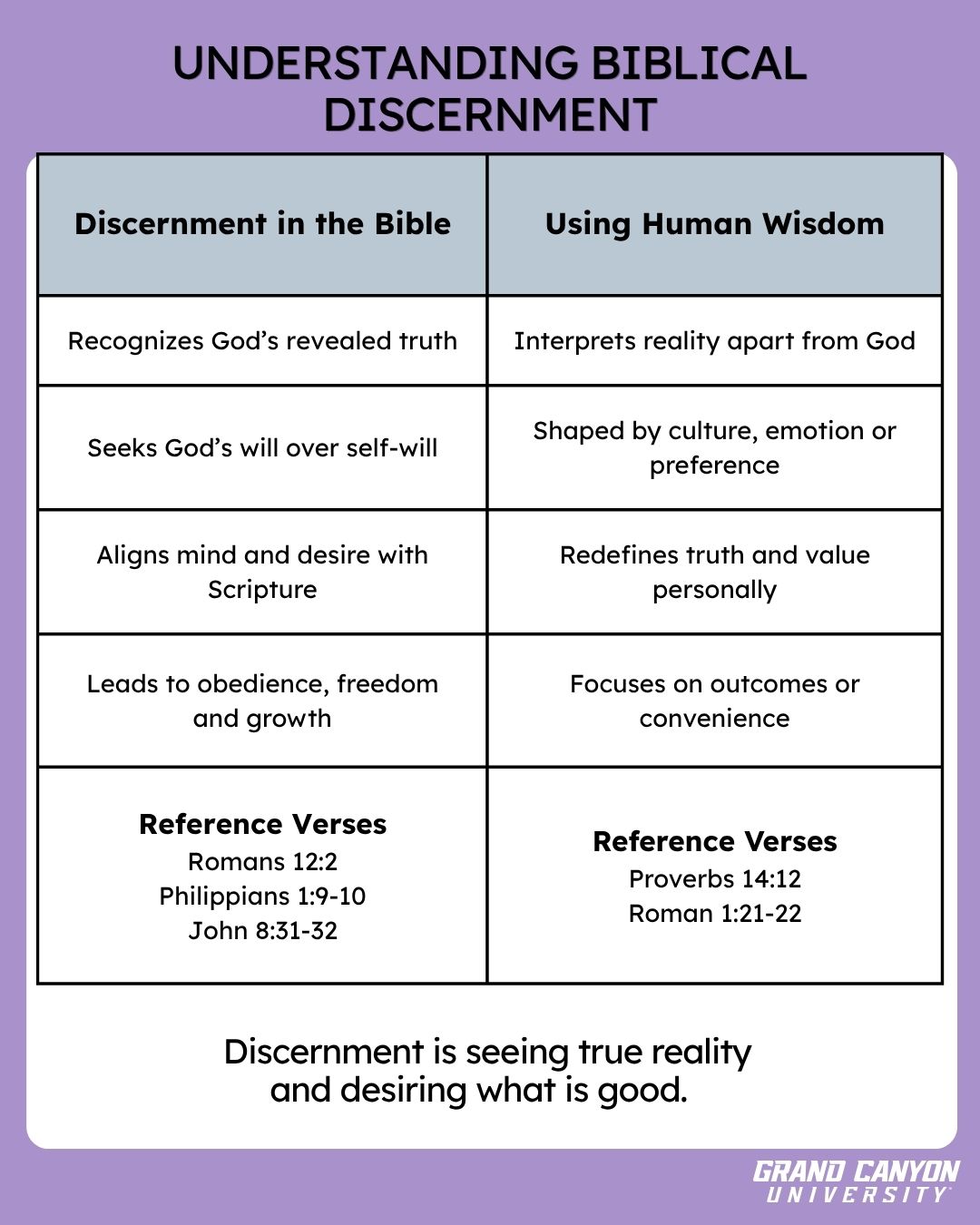
Human wisdom relies on experience and logic, but biblical discernment is grounded in divine truth and spiritual insight. While human reasoning often focuses on appearances and societal norms, biblical discernment encourages believers to seek God’s higher perspective.
Scripture values wisdom from experience but warns against relying solely on human understanding. True discernment involves listening to the Holy Spirit, engaging with Scripture and being open to correction, enabling believers to make faithful and clear spiritual decisions.
Why Spiritual Discernment Matters for Christians Today
In a world filled with competing voices, shifting values and constant demands, spiritual discernment is essential for Christians aiming to live faithfully. It guides everyday decisions, attitudes and actions, helping believers clarify truth, resist confusion and remain grounded in God’s purposes amidst cultural pressures and personal uncertainties.
Knowing God’s Will Through Discernment in the Bible
Spiritual discernment matters for believers as it helps align decisions with God’s will, rather than relying on personal preferences or circumstances. It enables Christians to evaluate opportunities and challenges through prayer and dependence on God, ensuring obedience and faithfulness.
Discernment is tied to our unique calling and encourages thoughtful consideration in career, relationships and ministry. By seeking wisdom from Scripture and the Holy Spirit, believers may face discomfort but ultimately experience personal growth and deeper trust in God.
Discernment and Spiritual Growth
Beyond decision‑making, spiritual discernment is essential for ongoing spiritual growth. It helps believers become more attuned to God’s truth and aware of influences that can detract from a Christ‑centered life. By relying on God’s Word and engaging in prayer, discernment fosters character development, promoting humility and love.
As Christians practice discernment, they learn to respond to situations with wisdom and grace rather than reacting emotionally or succumbing to cultural pressures. This process strengthens their faith, leading to a resilient, intentional alignment with God’s truth and enhancing their wisdom and devotion as they walk with Christ.
Discernment in the Bible Examples
The Bible provides clear examples of discernment, showing how God empowers His people to understand truth and respond wisely in complex situations. Both the Old and New Testaments illustrate that discernment is shaped by humility, obedience and reliance on God, offering timeless guidance for believers seeking to practice spiritual discernment today.
Old Testament Examples of Discernment
One well‑known example of discernment in the Old Testament is Solomon’s prayer for wisdom (1 Kings 3:5-9). As king, Solomon asked God for an understanding heart to discern between right and wrong, prioritizing this over wealth or power. God granted him exceptional wisdom (1 Kings 3:10-12), evident in his compassionate and insightful judgments, such as his famous decision in a case involving two women claiming the same child (1 Kings 3:16-28). His story illustrates that biblical discernment begins with humility and dependence on God.
Another powerful example is Joseph, whose discernment was shaped by spiritual insight and faithfulness while imprisoned in Egypt. He accurately interpreted dreams (Gen. 40:5-22), recognizing their divine origins, and later prepared Egypt for famine through wise decisions that saved lives (Gen. 41:39-57). His experiences showcase how discernment involves trusting God’s purposes even in difficult circumstances.
This theme of discernment unfolds within a broader Old Testament pattern. Dr. Sienkiewicz explains, “In the Old Testament, you have one select group of people, Israel, who are in a covenantal relationship with the one true God,” contrasting them with surrounding nations (Exod. 19:5-6; Deut. 7:6), “cut off from the life of Yahweh…in deception, essentially in darkness.” Discernment, then, was tied to covenantal knowledge of God, which was largely absent among these nations.
This contrast between light and darkness is central to Old Testament prophecy. Isaiah anticipates a future when discernment would extend beyond Israel. Dr. Sienkiewicz points to Isaiah 9:2, where “those who walk in darkness have seen a great light,” a promise referring to the coming Messiah. These hopes envision a time when divine truth would penetrate a world marked by spiritual confusion and idolatry (Isaiah 2:2-3).
As the Old Testament draws to a close, discernment points toward the promised light, fulfilled in Jesus Christ as later proclaimed by New Testament writers.
New Testament Examples of Discernment
In the New Testament, Jesus exemplifies spiritual discernment by perceiving reality and responding with perfect wisdom, truth and compassion. He understood the hearts and motives of those around Him (John 2:24-25), always aligning his discernment with the Father’s will (John 5:19-20). Dr. Sienkiewicz describes this as discernment of the mind — “a correct perception of true reality…seeing true reality versus believing and seeing something that’s not true.” He adds that discernment is closely linked to desire, noting that “the will of God is better and more beautiful and good than going against it.”
The apostle Paul reinforces this connection between discernment, love and transformed thinking. In Philippians, he prays that believers’ “love may abound more and more with knowledge and all discernment,” enabling them to “approve or test what is excellent.” As Dr. Sienkiewicz explains, Paul’s prayer points toward growth — a developing ability “to discern the will of God… and then to be able to walk in it.” Paul encourages a renewal of the mind in Romans 12:1-2, allowing Christians to “test and discern” God’s will, moving from deception to clarity.
Discernment is also seen as spiritual warfare. In 2 Corinthians 10:3–5, Paul explains that while Christians live in the flesh, their battle against strongholds is not waged with worldly weapons. Strongholds, Dr. Sienkiewicz explains, are “ways and patterns of thinking that we have affirmed in our hearts and minds… that keep us captive under deception.” God’s truth can dismantle these false beliefs and restore freedom.
Jesus teaches in John 8:31–32 that true discipleship begins with abiding in His word, which brings truth and freedom. This truth shapes believers’ vision and desire, revealing that obedience to God’s will is not only right but truly good.
Together, Jesus and Paul present discernment as a transformative practice, anchoring believers in truth, renewing the mind, reordering desire and equipping them to walk faithfully in the freedom Christ provides.
How To Grow in Spiritual Discernment Biblically
Growing in spiritual discernment is a lifelong process of recognizing God’s truth, listening attentively for His guidance and applying biblical wisdom to everyday situations. It involves developing skills through intentional spiritual practices and nurturing a relationship with God, shaping our thoughts, responses and decisions in light of His Word.
Scripture, Prayer and the Holy Spirit: Core Biblical Means of Cultivating Discernment
The Bible consistently points to Scripture, prayer and the Holy Spirit as foundational sources of spiritual discernment. Engaging with Scripture helps believers recognize truth and align their values with God’s character. Prayer deepens this discernment by fostering humility and inviting God’s guidance in uncertain situations. The Holy Spirit aids in interpreting Scripture and applying its teachings, leading to clarity and conviction. Together, these elements equip believers to grow in wisdom and spiritual awareness.
Practicing Discernment in Everyday Life
Biblical discernment should be applied in daily situations, helping believers respond wisely in relationships and establish healthy boundaries. It also enables Christians to thoroughly evaluate ideas in teaching and learning environments rather than accepting everything uncritically.
Practicing discernment, however, begins with humility. As Dr. Joel Sienkiewicz reminds us, “You can know the Bible, but not know the Bible.” Accumulating information alone is not the same as spiritual understanding. True discernment requires what he calls a receptive posture — approaching Scripture as learners who remain dependent on God, regardless of education or experience. He notes that discernment is ultimately a gift of grace, not intellectual achievement.
"No matter what degrees I have, no matter how much I’ve studied, I am essentially a receptive learner toward the Bible."
Discernment is also important for Christians when interacting with culture and media. They should evaluate whether these influences align with biblical truth or distract from Christ‑centered living, relying on the Holy Spirit rather than self‑confidence in this process. As Dr. Sienkiewicz notes, “It takes spiritual discernment — that is, the Spirit giving you insight into the truth of it.”
Importantly, discernment develops over time. “It’s not a sprint — don’t burn out. It’s a marathon,” he advises. God progressively reveals deeper understanding as believers walk faithfully with Christ, allowing insight and maturity to accumulate gradually. Over time, practicing discernment shapes character, habits and spiritual clarity.
By being humble, Spirit‑dependent and patient, Christians enhance their discernment, enabling them to recognize truth, pursue goodness and live faithfully with wisdom, purpose and trust in God’s guidance.
Common Misunderstandings About the Meaning of Spiritual Discernment
Spiritual discernment is often misunderstood, leading to confusion about how it should be practiced and applied. In Scripture, discernment is presented not as a tool for criticism or self‑assertion, but as a humble pursuit of God’s truth. As Dr. Joel Sienkiewicz explains, “Discernment simply involves the recognition of true reality.” It is the ability to perceive God’s will within the created order and to develop a corresponding love and desire for that will.
Discernment vs. Being Judgmental
One common misunderstanding is equating discernment with being judgmental. Dr. Sienkiewicz clarifies that “being judgmental, in the sense of looking down on others, is not God’s will.” While Christians are called to discern what is good and evil, or what aligns with God’s will and what does not, Scripture does not support an attitude of moral superiority. As he points out, because “all have sinned and lack the glory of God” (Rom. 3:23), believers cannot view themselves as above others or presume a posture of condemnation.
At the same time, biblical discernment does involve making moral and spiritual judgments. According to Dr. Sienkiewicz, “correct discernment of what is good and evil, or what is God’s will and not God’s will, is God’s desire for us.” The distinction lies not in whether judgments are made, but in the spirit in which they are made. Discernment evaluates actions, beliefs and teachings while maintaining humility, compassion and awareness of one’s own dependence on grace.
Ultimately, spiritual discernment calls Christians to align their understanding and desires with God’s truth while relating to others with grace. As Dr. Sienkiewicz emphasizes, this discussion “simply refers to the attitude or disposition of Christians towards people in general.” When practiced faithfully, discernment encourages truth‑seeking without pride, conviction without cruelty and obedience without self‑righteousness — reflecting both the holiness and humility modeled in Christ.
Discernment vs. Personal Preference
Another frequent misunderstanding is confusing discernment with personal preference or opinion. Personal preferences are shaped by personality, culture and experience, while spiritual discernment is anchored in God’s truth as revealed in Scripture.
Helpful distinctions include:
Recognizing the difference helps believers avoid misusing spiritual language to justify personal choices. Discernment involves testing thoughts, decisions and influences against Scripture while being open to the Holy Spirit’s guidance. Proper discernment fosters clarity, maturity and alignment with God’s will. By understanding its true nature, Christians can engage thoughtfully in their faith and live with integrity and wisdom.
Why Discernment in the Bible Still Matters
Biblical discernment refers to the God‑given ability to recognize truth, understand God’s will and respond faithfully in a world filled with competing voices and complex choices. More than intellectual insight, spiritual discernment calls believers to examine teachings and decisions through Scripture and the Holy Spirit, shifting how they think and act and leading them to obedience, wisdom and spiritual maturity.
As Dr. Joel Sienkiewicz explains, discernment remains essential for Christians in every time and culture because “the same fundamental problem continues.” Drawing from Scripture, he notes that Satan “is deceiving the whole world” and actively seeks to blind minds from seeing “the light of the glory of Christ.” Under these circumstances, discerning God’s will and accurately perceiving reality is not optional; it is necessary for faithful Christian living.
Dr. Sienkiewicz also emphasizes that the modern moment presents unique challenges. While idolatry in biblical contexts was often visible and unmistakable, today it is frequently subtle and unnamed. In ancient cultures like Babylon, idols were clearly identifiable. In contrast, he explains, “in America, the idols are not called idols and often not viewed in that light,” making deception more difficult to recognize. This hidden nature of modern idolatry increases the risk of syncretism, where devotion to God becomes diluted by competing loyalties. As he observes, “the threat that is unknown is always more dangerous than the threat that is known.”
Because Christ has delivered believers from deception and calls them to a life of devotion to God, discernment remains vital. Dr. Sienkiewicz points to Paul’s exhortation in Romans 12 as a clear call to action: “Do not be conformed to this world, but be transformed by the renewal of your mind, that by testing you may discern what is the will of God.” In a culture shaped by shifting values and subtle forms of idolatry, spiritual discernment enables believers to resist conformity, remain grounded in truth and live faithfully according to God’s will.
When practiced with humility and reliance on Scripture, discernment strengthens spiritual maturity, deepens trust in God and equips Christians to navigate life’s complexities with clarity, integrity and faithfulness.
Next Steps to Deepen Spiritual Discernment
Growing in spiritual discernment is an intentional journey that develops over time through consistent spiritual practices and supportive community.
Believers can take meaningful steps by:
For those seeking to deepen their faith through education, Grand Canyon University offers a Christ‑centered academic environment rooted in a Christian worldview. GCU’s ministry programs integrate faith, scholarship and practical application, equipping students to lead with wisdom and conviction.
To explore opportunities for further study, including theology degrees, prospective students can learn more about programs designed to support spiritual formation, leadership development and service grounded in biblical truth. By deliberately and faithfully pursuing discernment, believers can continue to grow in wisdom, clarity and devotion as they walk with God.
Discover Biblical Discernment for Everyday Life
Learn how biblical discernment through Scripture and prayer can strengthen faith and guide daily decisions.


