


BS in Occupational Therapy Assistant Degree
Work Toward Helping Individuals Gain Their Independence
Grand Canyon University offers those seeking employment in the occupational therapy field the opportunity to earn their degree through our OTA program.

Up to 90 credits, only 84 can be lower division
Credits: Fill out the Lopes Eval to find out what will transfer
Admission Requirements (Bachelor's)
- 16+ years old
- High School Graduate
- 2.8+ Unweighted GPA
OR 2.5+ Unweighted GPA and
- ACT: 19
- SAT: 1000*
Admission requirements may differ based on degree level, program and modality, or transfer status. Some programs of study may require a higher GPA and/or other qualifying criteria for admission. Please review full admission and program requirements in the University Policy Handbook.
*Math and reading only on a 1600 point scale (test date after 3/1/2016). SAT score of 1380 required for 2400 point scale (test date before 3/1/2016).
Take the Next Step With GCU’s OTA Degree
Throughout your program, you will have the opportunity to gain competence and a well-rounded knowledge base in occupational therapy assisting. GCU instills aspects of a Christian worldview in all our programs, helping you understand the importance of delivering ethical, respectable and holistic care to your patients. This also includes looking at client needs, restoration, and the physical, mental and spiritual betterment of the whole person. Graduates will advocate for the advancement of human flourishing.
You will have the opportunity to gain valuable skills and apply occupational therapy concepts and best practices through on-campus experiences, a baccalaureate project and your fieldwork requirements.
These skills include:

Take OT Assistant Degree Courses Online or on Campus
As an OTA student, you will have the opportunity to complete your courses on campus or online.(See disclaimer 1) Students have access to numerous benefits that GCU offers, including learning tools, tutoring and support services to assist you as you complete your program. Online students will also be expected to attend on-campus experiences.
Blend Science, Healthcare and Leadership Courses
As you work through the curriculum, you will have the opportunity to gain important skills necessary to the occupational therapy assistant profession.
The OTA program courses are designed to cover different subject areas, including:
Anatomy and physiology
Lifespan development
Kinesiology
Medical terminology
Clinical reasoning
Evidence-based practices
Abnormal psychology
Mental health, geriatric and pediatric practice
Leadership and management
Physical and neurological rehab
Build Your Skills for Helping Patients
As an occupational therapy assistant student, you will be taught to work with individuals who have emotional, developmental and physical disabilities through implementing research-based practices.
As a graduate of this program, you will have been taught:

Career Paths for OTA Degree Graduates
The goal of this bachelor’s program is to qualify you to work in the occupational therapy field as an occupational therapy assistant. Through studying the scientifically based academic and clinical curricula, you will be taught critical thinking and the application of best practices, allowing you to help others implement useful methods and techniques that can help them lead independent lives. This program can also be a path to the OT graduate program, as a master's degree is required to become an OT.
Pursue Your Undergraduate at an Accredited University
GCU is an institutionally accredited university, earning continuous accreditation from the Higher Learning Commission since 1968. We are proud to offer programs that meet the high standards established by our accreditor, allowing us to provide a quality education to all students.
The baccalaureate degree level occupational therapy assistant program has applied for accreditation and has been granted Candidacy Status by the Accreditation Council for Occupational Therapy Education (ACOTE) of the American Occupational Therapy Association (AOTA), located at 7501 Wisconsin Ave., Suite 510E, Bethesda, MD 20814. ACOTE’s telephone number c/o AOTA is 301.652.AOTA and its web address is acoteonline.org. The program must have a pre-accreditation review, complete an on-site evaluation and be granted Accreditation Status before its graduates will be eligible to sit for the national certification examination for the occupational therapy assistant administered by the National Board for Certification in Occupational Therapy (NBCOT). After successful completion of this exam, the individual will be a Certified Occupational Therapy Assistant (COTA). In addition, all states require licensure in order to practice; however, state licenses are usually based on the results of the NBCOT Certification Examination. Note that a felony conviction may affect a graduate’s ability to sit for the NBCOT certification examination or attain state licensure.
After successful completion of this exam, the individual will be a Certified Occupational Therapy Assistant (COTA). An occupational therapy assistant is certified for three years. After three years, an occupational therapy assistant may apply for recertification by NBCOT. In addition, all states, the District of Columbia, and Puerto Rico require licensure in order to practice; however, state licenses are usually based on the results of the NBCOT Certification Examination. Please refer to the AOTA State Licensure webpage.
For more information on the certification exam, please contact NBCOT. Telephone: 301-990-7979, email: info@nbcot.org. Note that a felony conviction may affect a graduate’s ability to sit for the NBCOT certification examination or attain state licensure.
Frequently Asked Questions
If you’re looking to positively impact people’s lives by becoming an OTA, read through some commonly asked questions to gain more insight into this career path and earning your degree.
How long is GCU’s occupational therapy assistant (OTA) program?
What’s the difference between OTA vs. PTA?
What are the benefits of getting a bachelor’s vs. an associate degree in OTA?
Does this degree qualify me for an MSOT program?
What is an occupational therapy assistant?
Program Curriculum
General Education Requirements
Core Courses

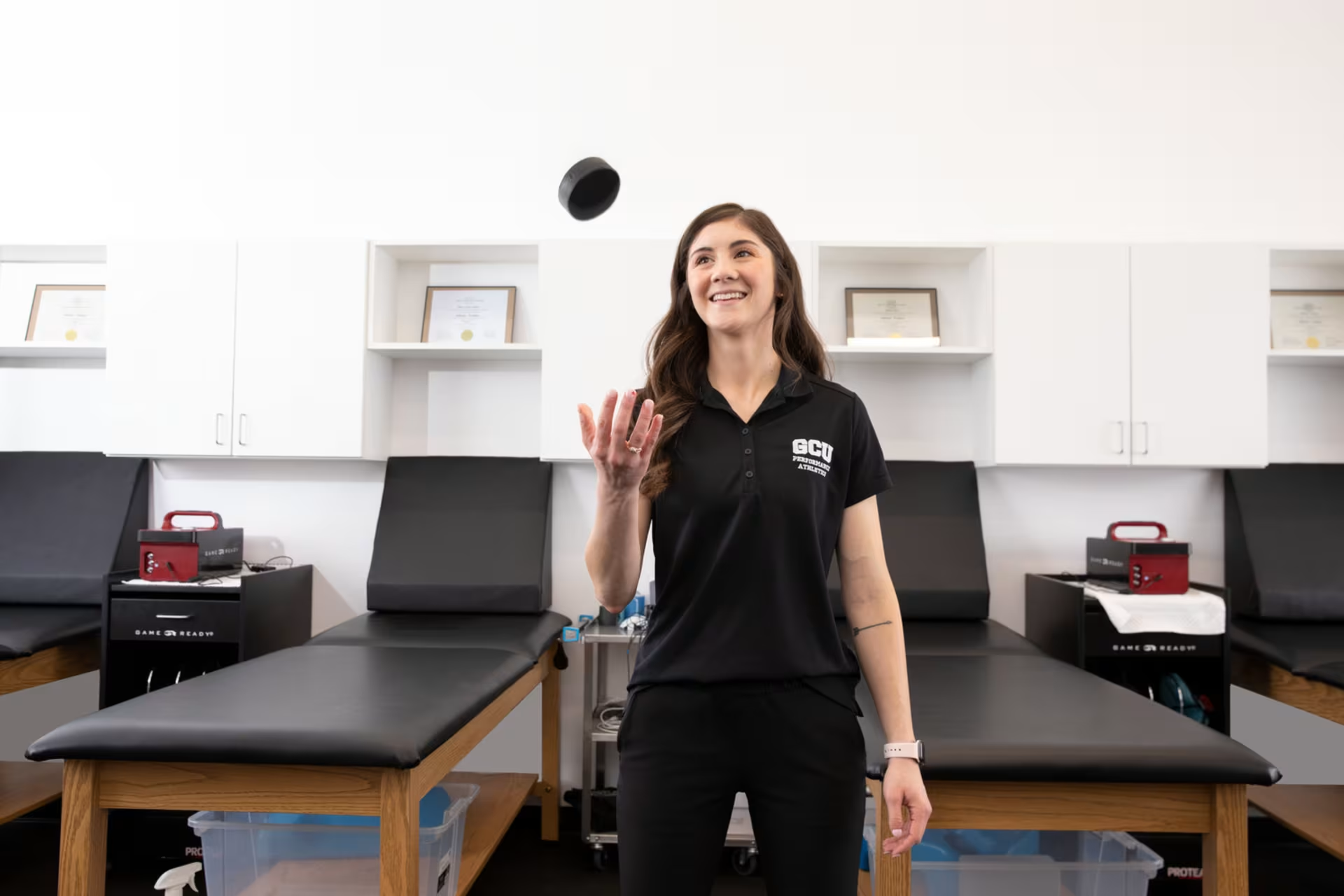
Fill out the form on this page to learn more about earning your Bachelor of Science in Occupational Therapy Assistant degree at GCU.
- Fieldwork completed in state of residence; immersion hours completed at the GCU campus in Phoenix, AZ.