

BS in Communication Sciences and Disorders (CSD) Degree
What Is a BS in Communication Sciences and Disorders Degree?
The Bachelor of Science in Communication Sciences and Disorders (CSD) is an undergraduate degree that studies how people develop, use and are affected by speech, language, hearing and communication. The CDS degree at GCU is offered online(See disclaimer 1 )and on campus for students who want to support individuals with communication disorders and prepare for roles such as speech-language pathology assistant (SLPA)(See disclaimer 2 )or graduate study in speech-language pathology (SLP).(See disclaimer 3 )
The program blends scientific concepts with hands-on applications across healthcare, education and community settings. Coursework introduces principles of assessment, intervention and communication development, while building practical skills in critical thinking, analysis and evidence-based practice.

Up to 90 credits, only 84 can be lower division
Credits: Fill out the Lopes Eval to find out what will transfer
Admission Requirements (Bachelor's)
- 16+ years old
- High School Graduate
- 2.8+ Unweighted GPA
OR 2.5+ Unweighted GPA and
- ACT: 19
- SAT: 1000*
Admission requirements may differ based on degree level, program and modality, or transfer status. Some programs of study may require a higher GPA and/or other qualifying criteria for admission. Please review full admission and program requirements in the University Policy Handbook.
*Math and reading only on a 1600 point scale (test date after 3/1/2016). SAT score of 1380 required for 2400 point scale (test date before 3/1/2016).
What’s It Like Going to GCU for Your CSD Degree?
At GCU, you can prepare to serve individuals with communication and related disorders while making ethical decisions and practicing cultural humility. As a private Christian university, GCU integrates a Christian worldview into the curriculum and encourages our students to act as moral servant leaders. You can earn your degree in a format that fits your needs, whether on campus or online, with access to a wide range of learning resources and support services throughout your program.(See disclaimer 3)
What To Expect in a Bachelor’s in Communication Sciences and Disorders Degree
Flexible Online Learning for Your CSD Degree
Work through your coursework with added flexibility, thanks to the convenience of online classes. GCU’s digital learning platform helps students stay on track with accessible course materials, clear deadlines and structured weekly engagement with peers.

An Engaging Campus Experience in Phoenix
As an on-campus student, you’ll enjoy our modern student housing and wide variety of dining options. Our campus community also enjoys plenty of options for activities, clubs and worship services.

University Accreditation
GCU has been institutionally accredited by the Higher Learning Commission since 1968. The College of Nursing and Health Care Professions shares the university’s commitment to upholding the principles and standards established by our accrediting bodies.
Support Services for CSD Students
Students earning this bachelor’s in communication sciences and disorders will be supported by robust student resources that enrich the academic experience and facilitate progress. You can work with the Office of Field Experience to arrange your practicums and benefit from access to internship opportunities through Career Services.
What Will I Study in Communication Sciences and Disorders?
During this communication sciences and disorders undergraduate program, you will study various topics related to typical and disordered speech, language, hearing and swallowing. Competencies in screening, diagnosis and evidence-based intervention methodologies provide a framework for working with clients who need help overcoming communication challenges.
At GCU, there is an emphasis on professional ethics. Students are expected to absorb and reflect on the ethics guidelines and legal requirements established by professional bodies, including the American Speech-Language-Hearing Association (ASHA).

CSD Degree Core Course Topics
This BS in Communication Sciences and Disorders offers a comprehensive, multidisciplinary curriculum designed to build foundational knowledge in speech, language and hearing processes, while introducing evidence-based assessment and intervention strategies. You’ll study everything from human anatomy and physiology as they pertain to communication to cultural-linguistic factors that influence the delivery of care services. You’ll complete both didactic coursework and hands-on learning opportunities, including practicum/field experience hours and a practice-focused professional capstone course, which includes clinical hours.
Competencies covered in this CSD Degree include:
Anatomy and physiology
Study the structure and function of anatomical systems involved in speech, hearing and swallowing.
Communication disorders
Analyze common communication disorders and explore evidence-based interventional methodologies.
Communication development
Examine typical and atypical communication development, including developmental milestones and cultural variations.
Phonology and phonetics
Study the sound systems of language, including speech production, perception and patterns of expressive and receptive speech.
Audiology introduction
Gain foundational knowledge in hearing science, including screening, diagnostic processes and basic intervention approaches.
Neurological communication disorders
Explore neuroanatomy and the impact of neurological conditions on communication, including both sudden-onset and progressive disorders.
BS in Communication Sciences and Disorders vs. MS in Speech-Language Pathology
A bachelor’s degree in communication sciences and disorders and a master’s degree in speech-language pathology serve different purposes in the pathway toward working in the communication sciences field. A BS in Communication Sciences and Disorders provides foundational undergraduate preparation in speech, language, hearing, communication development and related disorders. A master’s in speech-language pathology is typically the graduate-level degree needed to pursue licensure and certification as a speech-language pathologist.
The table below explains how these two degree levels differ and how they may work together as part of a longer academic and career pathway.
Bachelor’s (undergraduate)
Prepare for SLPA roles or graduate study
Assessment, diagnosis, treatment, clinical experience
Bachelor’s (undergraduate)
Prepare for SLPA roles or graduate study
Assessment, diagnosis, treatment, clinical experience
What Can You Do With a CSD Degree?
Many graduates of a communication sciences and disorders (CSD) degree pursue roles as speech–language pathology assistants (SLPAs), supporting licensed speech–language pathologists by helping deliver therapy services, communicating with patients and families and assisting with administrative tasks.(See disclaimer 2,4)
Licensure note: SLPA requirements vary by state. This degree may help prepare students for SLPA-related opportunities, but students are responsible for reviewing their state’s education, supervision and licensure requirements.
Beyond career pathways, this program helps you develop cultural humility and respect for individuals from diverse backgrounds, along with practical skills in assessment and intervention. These competencies can be applied across a range of healthcare, educational and clinical settings.
Some settings where an SLPA may pursue employment can include:(See disclaimer 4)
Schools
Assisting K-12 students with communication challenges
Hospitals
Working with patients across the lifespan on speech, language and swallowing difficulties
Nursing homes
Helping elderly residents overcome communication and swallowing disorders
Private practices
Implementing treatment plans for clients with a range of challenges
Program Tuition
GCU believes that quality higher education should be accessible to all. We’re committed to keeping our academic programs affordable for our students by offering competitive online tuition rates and millions in institutional scholarships. An education at GCU is an investment in your future.
.jpg)
GCU has not increased campus tuition rates since 2009
Ways To Save
Your education is an important financial investment, and there are several ways to help manage costs while earning your degree. GCU’s university counselors are available to help you explore available options and provide personalized guidance on your estimated cost of attendance.
Complete the Free Application for Federal Student Aid (FAFSA) annually to determine eligibility for federal grants and student loans. Since some aid is awarded on a first‑come, first‑served basis, GCU recommends submitting the FAFSA as early as possible after Oct. 1 to maximize funding opportunities.
If you’ve earned college credits from another institution, you may be able to complete your degree sooner at GCU by transferring those credits. Submit the Lopes Unofficial Credit Evaluation form, then connect with a university counselor who can provide you with personalized guidance.
You may be able to reduce your college costs by applying for GCU’s on-campus or online student scholarships. We invite you to explore available institutional scholarships and determine which opportunities you may be eligible for. GCU also encourages students to seek out third‑party scholarships and grants.
Explore Your Financial Options
Connect with a university counselor to learn more about tuition, cost-planning resources and available options.
CSD Degree Frequently Asked Questions
Review these FAQs to learn more about GCU’s bachelor’s in communication sciences and disorders, including coursework, career pathways, SLPA-related opportunities and graduate study options.
Can I become an SLPA with a CSD degree?
Do I need a master’s degree to become a speech-language pathologist?
Will a communication sciences and disorders degree help prepare me to be a speech pathologist or audiologist?
Are clinical or field experiences required in the online CSD degree?
How long does it take to complete a bachelor’s in communication sciences and disorders?
What should I consider before choosing a CSD degree?
What is the difference between a CSD degree and a speech-language pathology master's degree?
Getting Into GCU
GCU has streamlined the admissions process. Our school does not require a personal statement or essay and there is no application fee. High school students may meet the admission requirements with either a minimum GPA or SAT or ACT exam scores. Specific requirements can vary, depending on the degree or program. Your university counselor will help you navigate the process of applying.
You can apply to a degree program at GCU in just three simple steps. Your university counselor is standing by to assist you with any questions about the application process.
It starts with selecting the program that aligns with your goals from one of GCU's 380+ academic programs — from undergraduate degrees to post-master’s certificate programs to doctoral degrees.
Pick your program
Explore our on-campus, online or evening cohort options under the Degree Programs page to find the right program for you.
Complete our online application
Your university counselor will direct you to the online application. Fill in all required information and submit the form.
Submit supporting documents
Submit your official transcripts and any relevant test scores, and confirm with your university counselor that all forms for your desired program are submitted.
Program Curriculum
General Education Requirements
Core Courses


.jpg)

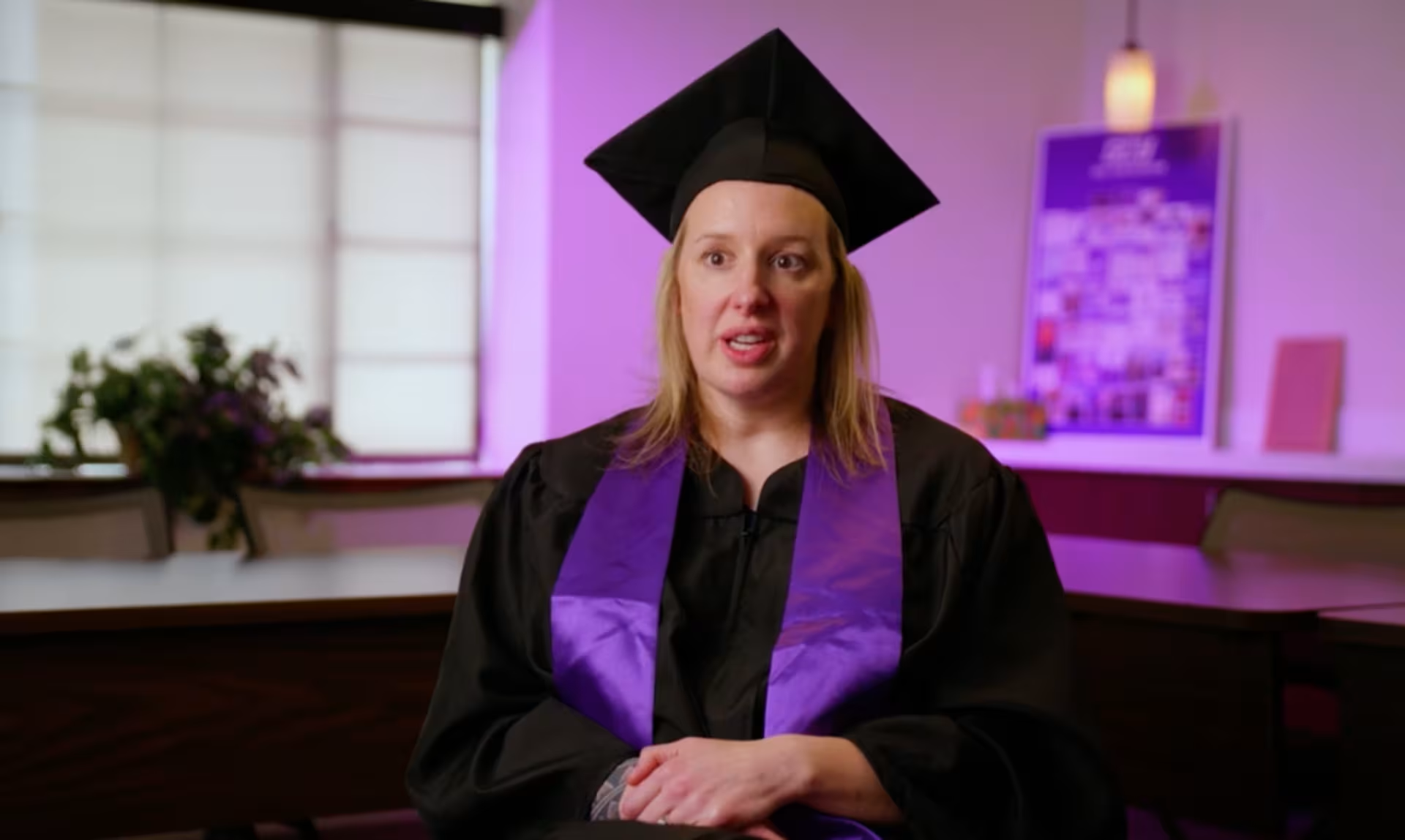
Earn your BS in Communication Sciences and Disorders at GCU and build foundational skills in speech, language, hearing and communication development.
Clinical, practicum and immersion hours completed locally.
- Obtaining SLPA licensure in any state is not guaranteed; students need to research their state’s specific licensing requirements.
- U.S. Bureau of Labor Statistics. (2025, Aug. 28). How to Become a Speech-Language Pathologist. Occupational Outlook Handbook. Retrieved May 2026.
- U.S. Bureau of Labor Statistics. (2025, Aug. 28). What Speech-Language Pathologists Do. Occupational Outlook Handbook. Retrieved May 2026.
- U.S. Bureau of Labor Statistics. (2025, Aug. 28). How to Become an Audiologist. Occupational Outlook Handbook. Retrieved May 2026.
- American Speech-Language-Hearing Association. (n.d.). Graduate Students. Retrieved May 2026.
Approved and verified accurate by the Communication Sciences and Disorders Program Lead of the College of Nursing and Health Care Professions on Aug. 14, 2026.