


Online Master’s in Secondary Education Degree (NITL)
Inspire High School Students
The Master of Education in Secondary Education (Non-licensure) program at Grand Canyon University is designed for individuals seeking foundational knowledge and practical strategies for teaching students in grades 6–12. This program provides initial coursework in secondary education without leading to teacher certification. While prior teaching experience or a background in education may be helpful, it is not required for admission.
Through engaging coursework and practice-based learning experiences, candidates will deepen their understanding of instructional planning, classroom management and adolescent development. If you are passionate about supporting secondary learners and expanding your expertise in content-area instruction, this non-licensure master’s program offers a flexible and enriching path forward.
Up to 12 credits or 1/3 of the total program requirements in transfer (whichever is less)
Credits: Fill out the Lopes Eval to find out what will transfer
Admission Requirements (Master's)
- Undergraduate Degree*
- 2.8+ GPA
OR 2.5+ Unweighted GPA and
- GMAT: 500
- GRE: 300 combined**
Admission requirements may differ based on degree level, program and modality, or transfer status. Some programs of study may require a higher GPA and/or other qualifying criteria for admission. Please review full admission and program requirements in the University Policy Handbook.
* Degree must be from an accredited college or program that has been approved by GCU.
** Combined verbal/quantitative, after August 2011 (1,000 combined verbal and quantitative, prior to August 2011).
Earn Your Master’s in Secondary Education Online From GCU
You may find educating young minds to be a rewarding and honorable profession. If you nurture a love of learning and embrace a strong desire to help others reach their full potential, this online(See disclaimer 1) degree can help you prepare for a career teaching in secondary education settings.
GCU’s online learning platform offers flexibility and convenience, allowing you to pursue your degree while balancing personal and professional commitments. With interactive coursework, access to knowledgeable faculty and a collaborative online community, you can engage in learning experiences from anywhere with internet.
This master's degree is designed for those who already hold a current teaching license, or those not seeking to obtain licensure. The program does not contain the in-classroom teaching experience necessary to obtain licensure. As a student in this program, you will, instead, complete 100 hours of observational and practice-oriented field experiences. These experiences are designed to help equip you with skills in leadership, instructional technology and research.
What Does It Mean to Major in the Secondary Education NITL Program?
The Master of Education in Secondary Education (Non-licensure) program is designed for individuals seeking to deepen their understanding of teaching and learning at the secondary level (grades 6–12) without pursuing a teaching license. This program does not lead to certification and therefore does not qualify candidates to teach in traditional public schools that require licensure. However, it may support opportunities in educational settings where a state-issued teaching license is not required, such as private, charter, online or international schools, or in roles related to curriculum development, tutoring or education support services. Individuals interested in obtaining licensure to teach in public schools should explore our MEd in Secondary Education (Initial Teacher Licensure) program, which is designed to prepare candidates to meet certification requirements.
Engage Students With Innovative Teaching Strategies
Engaging students effectively requires creative approaches that make learning interactive and meaningful. This program explores research-based methods to help increase participation, encourage critical thinking, adapt lessons to different learning needs and create effective learning environments that foster student engagement.
Early Adolescent and Adolescent Psychology
Curriculum, Instruction, Assessment and Evaluation Methods
Survey of Special Education and Structured English Immersion
Professional Growth and Advocacy for Secondary Educators
Build Expertise in Secondary Education Teaching
Teaching middle and high school students often requires innovative instructional teaching strategies, adaptability and a commitment to fostering student growth. The MEd in Secondary Education program can help equip you with the skills and knowledge needed to create welcoming and engaging learning experiences with confidence and expertise.
Through this program, you will develop the ability to:
Career Paths for Graduates With an MEd in Secondary Education
As a graduate of this master’s program, you may find work as a secondary education teacher, private or charter school teacher, international school teacher or online virtual instructor.
These jobs may include the following responsibilities:
Educating learners in grades 6–12
Directing educational programs
Developing curriculum
Offering after-school tutoring
Providing educational resources to those with learning differences and challenges
Offering curriculum support and assisting teachers
Developing and editing educational content
Delivering professional training programs
Coordinating youth education programs

Take Master’s Classes From an Accredited University
GCU has been institutionally accredited by the Higher Learning Commission since 1968 and is proud to prioritize quality education and comprehensive instruction. This program directly aligns with standards from the Interstate Teacher Assessment and Support Consortium (InTASC) and the International Society of Technology Educators (ISTE). The College of Education shares the university’s commitment to upholding the principles and standards established by our accrediting bodies.
Frequently Asked Questions
If you’re an educator looking to earn your online(See disclaimer 1) secondary education degree, you can find answers to many of your questions here.
Can you become a teacher with an online(See disclaimer 1) secondary education degree?
What does “secondary education” mean?
Is it worth it to major in secondary education?
What qualifications do you need to be a secondary school teacher?
Can a primary teacher become a secondary teacher?
Program Curriculum
Core Courses

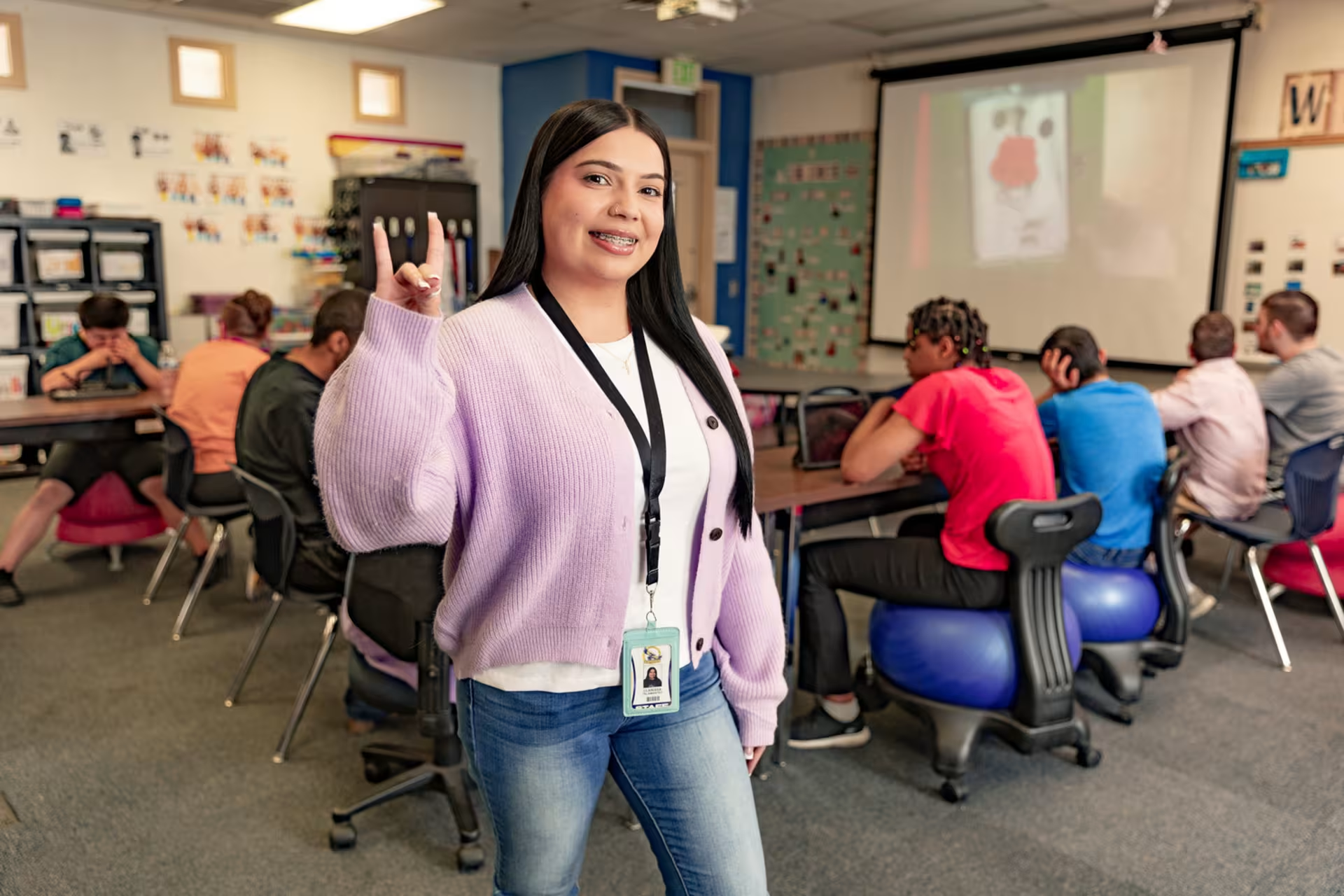
The Master of Education in Secondary Education can help equip you to lead middle and high school students. Take the next step in your teaching journey today!
If you are seeking licensure/certification, please refer to the "Accreditation and Compliance/State Disclosures” link for the specific program of interest’s website for your location and/or employment state’s licensure requirements, per 34 CFR 668.14(b)32 and 668.43(c).
Excluding observational and practice-based experiences and student teaching.
- COVID-19 has adversely affected the global economy and data from 2020 to 2023 may be atypical compared to prior years. Accordingly, data shown is effective September 2024, which can be found here: U.S. Bureau of Labor Statistics, Occupational Outlook Handbook, Middle School Teachers, retrieved March 2025.
- COVID-19 has adversely affected the global economy and data from 2020 to 2023 may be atypical compared to prior years. Accordingly, data shown is effective September 2024, which can be found here: U.S. Bureau of Labor Statistics, Occupational Outlook Handbook, High School Teachers, retrieved March 2025.
- U.S. Bureau of Labor Statistics. (2024, Aug. 29). How To Become a High School Teacher. Occupational Outlook Handbook. Retrieved March 2025.
- U.S. Bureau of Labor Statistics. (2024, Aug. 29). How To Become a Middle School Teacher. Occupational Outlook Handbook. Retrieved March 2025.