

Public policy does not end when a law is passed or a new policy is formally adopted. The policy must then be put into practice. Policy implementation is the process of translating an enacted policy into action, which may involve establishing procedures, assigning responsibilities, allocating resources, communicating requirements and monitoring how the policy is carried out, according to the Centers for Disease Control and Prevention.(See disclaimer 1)
Implementation is an important part of the broader public policy process, which moves an issue from identification and analysis through policy development, enactment and implementation. The process does not always follow a perfectly linear path, and evaluation and stakeholder engagement can occur throughout multiple stages.(See disclaimer 1) Understanding how implementation works can provide insight into how governments and public administrators turn policy goals into programs, services and actions that affect communities.
What Is Policy Implementation?
Putting public policy into practice requires more than formally approving a law, regulation or government program. Depending on the policy, implementation may involve creating administrative procedures, coordinating participating organizations, communicating requirements and delivering services to the people affected.

According to Adam Maynes, a government instructor at Grand Canyon University, implementation can be straightforward when a policy establishes clear expectations and guidelines. However, unclear instructions, limited resources or uncertainty about responsibilities can make implementation more difficult.
Maynes compares the process to completing a homework assignment. When students understand the instructions, have access to the necessary supplies and know what is expected, they are better positioned to complete the assignment. Similarly, effective policy implementation depends in part on whether those responsible have the direction and resources needed to carry out the policy.
Where Implementation Fits in the Public Policy Process
Policy implementation generally takes place after a public policy has been developed and adopted. It is the stage when government agencies, public administrators and other responsible parties begin putting policy decisions into practice. However, implementation is only one part of the broader public policy process.
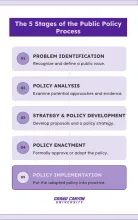
The public policy process typically involves several interconnected stages:
Although these stages provide a useful framework, the public policy process is not always linear. Monitoring and evaluation can occur throughout the process, and findings may lead policymakers to revisit earlier decisions or revise existing policies.
Maynes emphasizes that implementation represents an important transition in the policy process. While adoption may conclude a lengthy period of discussion and deliberation, putting the policy into practice creates new opportunities to identify challenges, assess effectiveness and determine whether changes are needed.
"Within the broader policy process, implementation is both the finish line and the starting point."
Policy Formulation vs. Policy Implementation
Policy formulation and policy implementation are two distinct but closely connected stages of the public policy process. Policy formulation focuses on developing potential solutions to a public issue, while policy implementation involves putting an adopted policy into practice. Both stages are important, but they involve different responsibilities, considerations and challenges.
During policy formulation, policymakers examine possible approaches to an issue, consider competing priorities and negotiate the details of proposed solutions. Maynes explains that this stage can involve extensive discussion as policymakers work through differing perspectives and determine how to translate their ideas into a clear policy.
Once a policy has been adopted, the focus shifts from deciding what should be done to determining how the policy's requirements will be carried out. Government agencies, public administrators and other responsible parties may need to establish procedures, allocate resources, communicate expectations and coordinate activities to support policy implementation.
Maynes emphasizes that clear policy language is particularly important during this transition. Those responsible for implementation must understand the policy's requirements and carry them out within their legal authority. Unclear instructions or insufficient resources can create challenges, even when the policy's intended goals are widely understood.
Who Is Responsible for Implementing Public Policy?
Public policy implementation is typically carried out by government agencies, public administrators and other individuals or organizations responsible for putting adopted policies into practice. Responsibilities vary depending on the policy, the level of government involved and the authority assigned to each participating organization.
At the federal level, agencies implement nationwide policies and administer programs within their areas of responsibility. For example, the Social Security Administration is responsible for administering federal Social Security programs. Maynes points to employees who assist individuals with Social Security benefits as an example of public servants implementing federal policy in their daily work.
State governments implement policies related to areas such as education, public health, transportation and professional licensing. They may also administer programs established through federal legislation. Local governments, including cities and counties, carry out policies involving community services, public safety, infrastructure and other local priorities.
Policy implementation may also involve individuals and organizations outside government agencies. Maynes emphasizes that while the specific responsibilities differ, those involved in implementation must understand and follow the applicable policy requirements. A federal employee administering public benefits and a school employee implementing education policies may have very different responsibilities, but both help translate public policy into action.
The Policy Implementation Process
The policy implementation process involves translating an adopted policy into coordinated actions, from interpreting its requirements and assigning responsibilities to carrying out activities and monitoring progress. Although specific requirements vary depending on the policy, clear communication, adequate resources and coordination among participating organizations can help support effective implementation.(See disclaimer 1)
Common steps in the policy implementation process may include:(See disclaimer 1)
- Interpret policy requirements: Review the adopted policy to understand its objectives, legal requirements and expectations for implementation.
- Develop an implementation plan: Identify the procedures, resources, timelines and activities needed to put the policy into practice.
- Assign roles and responsibilities: Determine which agencies, administrators or other stakeholders will carry out specific implementation activities.
- Communicate and coordinate: Share requirements with participating organizations and affected communities, and coordinate activities among responsible parties.
- Carry out the policy: Implement the required programs, services, procedures or enforcement activities according to the approved plan.
- Monitor progress and make adjustments: Track implementation, identify challenges and use findings to determine whether operational changes or further policy review may be necessary.
These steps provide a general framework rather than a fixed sequence. Some activities may overlap, and implementation plans may require adjustments as agencies encounter changing circumstances or new information. Effective implementation requires both an understanding of policy requirements and the administrative capacity to carry them out.
Common Challenges in Implementing Public Policy
Public policy implementation can encounter challenges even when a policy has been carefully developed and formally adopted. Moving from written requirements to practical action may reveal obstacles that were not fully anticipated during policy formulation. These challenges can affect how consistently a policy is carried out and whether it achieves its intended objectives.
Maynes identifies confusion about policy requirements as a common implementation challenge. When expectations are unclear or individuals interpret requirements differently, implementation may become inconsistent across agencies, organizations or communities. He also emphasizes that implementation depends on the actions of the people responsible for carrying out a policy, introducing potential challenges related to compliance and accountability.
Other common challenges in public policy implementation may include:
Identifying these challenges does not necessarily mean a policy has failed. Monitoring implementation can help public administrators recognize emerging problems, determine their causes and consider adjustments to improve how a policy operates.
Although challenges vary by policy and jurisdiction, understanding potential obstacles can help policymakers and administrators develop more practical implementation plans and respond when unexpected difficulties arise.
"Just because the policy states something and the law therefore must be followed, does not mean that those who implement it either agree with it and those are not inclined to following it directly out of protest, or are not going to take advantage of the situation to profit themselves in any way they see fit — often so deeply behind the scenes that nobody really notices."
How Policy Implementation Is Monitored and Evaluated
Policy implementation is monitored and evaluated through activities such as administrative reviews, audits, performance measurement and reporting.(See disclaimer 2) These processes help government agencies and public administrators determine whether a policy is being carried out as intended, identify implementation challenges and see whether the policy is achieving its objectives.
Although monitoring and evaluation are closely related, they serve different purposes. Monitoring focuses on tracking implementation activities and progress, while evaluation examines how well a policy is working and whether it is producing its intended results. Both can provide information that supports accountability and future policy decisions.
Maynes explains that oversight mechanisms may be built into a policy, with administrators or other responsible parties reviewing how it is implemented. The specific measures used depend on the policy's objectives. For example, a government agency administering public benefits may examine whether eligible individuals are receiving the benefits they are entitled to and whether services are being delivered according to established requirements.
Common methods of monitoring and evaluating policy implementation include:(See disclaimer 2)
Ongoing monitoring and evaluation help connect implementation with the broader public policy process. Rather than treating adoption as the final step, policymakers and administrators can use evidence from implementation to inform future decisions and potential improvements.
Policy Implementation Examples
Public policy implementation examples can range from administering federal benefit programs to enforcing local traffic regulations. Examining how these policies operate can help illustrate the responsibilities involved in implementation and the importance of monitoring whether a policy is working as intended.
These examples demonstrate that public policy implementation can involve different levels of government and a wide range of responsibilities. Although the activities differ, each example illustrates how adopted policies are translated into actions that affect individuals and communities.
Example 1: Implementing a Local Traffic Safety Policy
A stop sign provides a familiar example of public policy implementation. Maynes explains that a local government may authorize the installation of a stop sign at an intersection to address traffic safety concerns and help prevent collisions.
Once the decision has been approved, a local transportation department or other authorized agency may be responsible for installing the sign. Drivers are then required to follow applicable traffic regulations, while law enforcement officers may issue citations to those who violate them.
Implementation does not necessarily end once the sign is installed. Local officials may continue reviewing traffic patterns, collision data and driver compliance to determine whether additional safety measures are needed. Depending on their findings, they may consider changes such as modifying traffic controls or installing a traffic signal.
"The assumption is that drivers will adhere to that sign and stop at the intersection, preventing collisions."
Example 2: Administering Federal Social Security Benefits
Federal Social Security programs provide another example of public policy implementation. Congress establishes the governing laws, while the Social Security Administration administers programs and carries out responsibilities such as processing applications, determining eligibility and distributing benefits.
Maynes points to employees at local Social Security offices as examples of public servants who implement federal policy through their daily responsibilities. These employees help individuals navigate program requirements and access services established under federal law.
Implementation also involves administrative procedures, communication with beneficiaries and oversight intended to help ensure that eligible individuals receive benefits according to applicable requirements.
Example 3: Implementing State Education Policies
State education policies can establish requirements related to academic standards, curriculum, assessments and other aspects of public education. State education agencies, school districts, administrators and educators may each have responsibilities for carrying out these policies.
For example, when a state adopts new academic standards, education agencies and school districts may need to update instructional guidance, provide professional development and coordinate implementation across schools. Teachers then incorporate applicable standards into classroom instruction.
Schools and education agencies may also review assessment results and other information to evaluate how implementation is progressing and identify areas where additional support may be needed.
GCU's MPA: Government and Policy Degree
Understanding public policy implementation can help you develop a broader perspective on how government decisions move from proposed solutions to actions that affect communities. Whether you're interested in policy development, government administration or public service, examining how policies are implemented and evaluated can provide valuable insight into the responsibilities of public administrators.
Maynes emphasizes that studying public policy involves understanding the complexities of the entire process, from developing a policy to putting it into practice and assessing its effectiveness. Even policies with seemingly straightforward objectives may require extensive coordination, communication and ongoing evaluation.
"But for even one individual, you might be the final link in a policy making sense and working, or not."
GCU offers a Master of Public Administration with an Emphasis in Government and Policy degree that explores public administration, government operations and the policy process. Discover how graduate coursework can help you build knowledge of public service and the responsibilities involved in government administration. If you’re looking to first complete your undergraduate degree, consider the Bachelor of Arts in Government with a legal studies or public administration emphasis.
Prepare To Make an Impact in Public Administration
Explore GCU's government degrees and develop your understanding of public policy, government operations and public administration.