According to Healthline, mental health encompasses the entirety of your psychological state, such as your emotions, perceptions and identity. Behavioral health, on the other hand, refers to how your everyday behaviors can shape your mental and physical health. Behavioral health is often linked to mental health but doesn’t always involve it.(See disclaimer 1)
If you’ve done research on mental health, you may have seen the terms behavioral health and mental health used interchangeably. Although behavioral and mental health are related, it’s important to understand that they aren’t the same thing.
If you’re thinking of pursuing a career in mental or behavioral health, it’s important to understand the differences between mental health vs. behavioral health. To do this, you’ll first need to take a closer look at each area of health by itself.
What Is Behavioral Health?
Behavioral health refers to the way your behaviors and habits influence the well-being of your mind, body and soul. Your behaviors include your eating and drinking habits, exercise routines and addictive behavior patterns. Behavioral health also encompasses social interactions, coping strategies, cultural practices and reactions.(See disclaimer 1)
Behavioral health often, but doesn’t always, overlap with mental health. For example, a behavioral health professional might study the habits and lifestyle that may have contributed to a patient’s obesity. In this situation, mental health isn’t necessarily considered.
Behavioral health services are often provided by a team of professionals in various practices, including:
Treatment may include a wide variety of interventions, including group counseling, behavioral therapy and medical treatments.
What Is Mental Health?
Mental health encompasses a person’s psychological, emotional and social well-being.
According to Headspace, mental health can influence how a person:(See disclaimer 2 )
Your mental health can be defined by your current psychological state and your feelings, thoughts and perceptions. It encompasses everything from emotional resilience to empathy to morality and beyond. It also includes a person’s brain health and cognitive functioning.(See disclaimer 1)
Mental health treatments can help individuals manage psychological disorders and achieve a more balanced mental state. These treatments can include psychotherapy and medications.
Behavioral Health vs. Mental Health: Key Differences
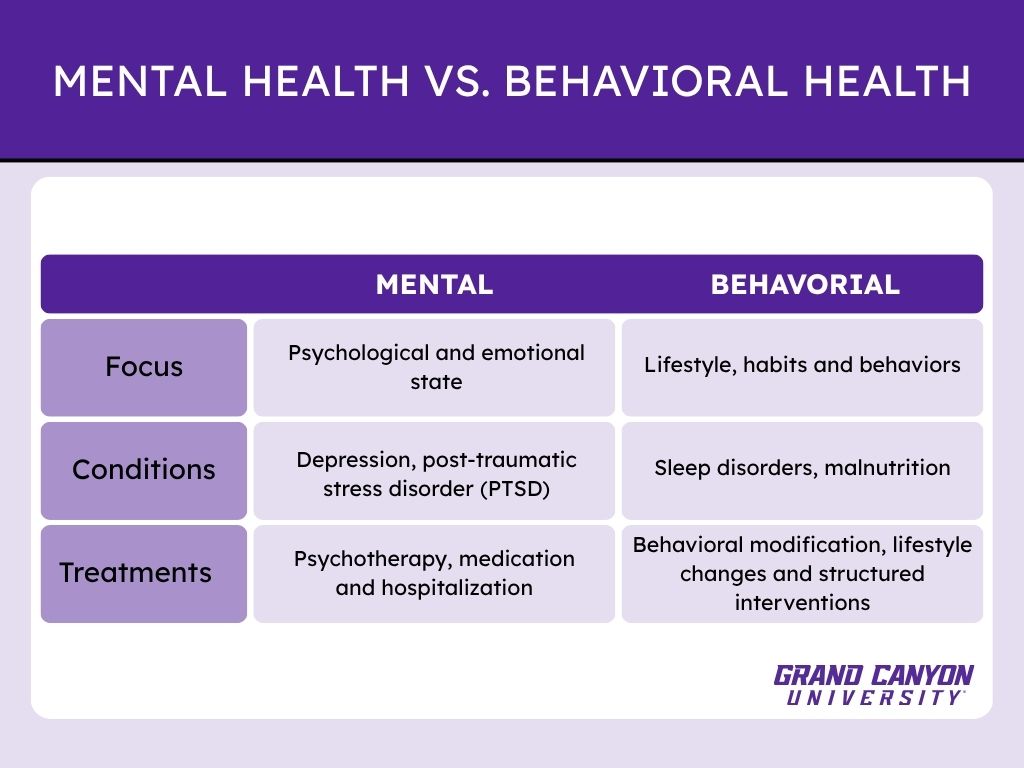
Now that you have a basic understanding of what mental health and behavioral health involve, you’ll be better prepared to understand the key differences between mental health vs. behavioral health. Keep in mind the main focus of each: Mental health focuses on a person’s psychological and emotional state, whereas behavioral health encompasses any and all behaviors that affect health.
Another main difference lies in the conditions treated under either category. Mental health professionals, for example, may counsel patients with depression, anxiety, bipolar disorder, trauma disorder or personality disorder. They may also work with clients who are struggling to cope with major life transitions, such as divorce, parenthood or retirement.
In contrast, behavioral health professionals may work with patients who need treatment for eating disorders, substance use disorders, sleep disorders and weight management. There is, of course, some overlap with mental health, as disordered eating and substance abuse also fall under the category of mental health.
The types of treatments are another difference between behavioral health vs. mental health. A behavioral health professional might use treatments such as counseling, medication, behavioral therapy (e.g., cognitive behavioral therapy or CBT), lifestyle changes and health interventions, such as smoking cessation or weight control. In contrast, a mental health professional will primarily focus on treatments such as psychotherapy and medication, as well as inpatient hospitalization in severe cases.
How Behavioral Health and Mental Health Work Together
At this point, you know that behavioral health involves the entire person — the mental, spiritual and physical. Mental health, meanwhile, encompasses identity, emotions, thoughts and feelings. Habits, biology and psychological state all affect and are affected by mental health.
Despite their differences, there is considerable overlap between behavioral and mental health. For example, a mental health disorder can lead to a behavioral health disorder, such as seeking to cope with general anxiety by overeating or drinking excessively.
Conversely, behavior can influence mental health. Behaviors that undermine stability can negatively affect your mental well-being or magnify an existing mental health disorder. For example, not getting enough sleep can result in mental distress.(See disclaimer 1)
On the flip side, positive behaviors can reduce the impact of a mental health condition.
Along with proper treatment, here are a few positive habits that can improve your well-being:(See disclaimer 1)
Careers in Behavioral Health and Mental Health Fields
If you’re fascinated by health science and want to focus on behavioral or mental health, there are a number of career options in the field to consider pursuing. These include:
Behavioral Health Specialists
A behavioral health specialist can provide a continuum of care to patients. They may conduct assessments, develop diagnoses and create personalized treatment plans, which may include lifestyle modifications along with therapy.
Behavioral Health Technician
What is a behavioral health technician’s job like? A behavioral health technician performs a varied range of tasks, which may include assisting with patient intake and discharge, recording vital signs, documenting patient behaviors and helping patients participate in therapeutic activities.
Counselors and Therapists
Counselors typically hold a bachelor or master’s level degree and obtain certification or licensure. Some examples of counselor titles include becoming a Licensed Mental Health Counselor, Licensed Professional Counselor, Licensed Chemical Dependency Counselor, or School Counselor. Counselors work with individuals, couples, families and small groups. They diagnose, conduct assessments, create treatment plans and implement interventions to help people gain insights and develop solutions to improve life satisfaction.
Counselors may focus on everyday life challenges, marriage problems, grief or career transitions. The term ‘therapist’ is used an overarching term for various mental health professionals, including but not limited to, Licensed Clinical Social Workers and a Licensed Marriage and Family Therapists.
Psychologists
Psychologists can conduct psychological evaluations and provide interventions for a wide range of mental health conditions. They can administer cognitive behavioral therapy, interpersonal therapy, psychodynamic therapy and other treatment techniques to help people overcome mental health challenges.
Social Workers
Social workers work with vulnerable and at-risk individuals and families with the goal of helping them cope with complex challenges, which can include poverty, abuse, chronic illness, addiction and discrimination. They provide crisis intervention, serve as advocates, diagnose mental and behavioral issues and deliver counseling.
Study Mental Health and Behavioral Health at GCU
As a student at Grand Canyon University, you can study behavioral and mental health. Explore the Bachelor of Science in Behavioral Health Science degree program, which offers a biblically rooted approach to exploring behavioral health concepts. You’ll study human development, abnormal and clinical psychology and counseling theories.
If you already have an undergraduate degree, you might consider furthering your studies with the Master of Science in Mental Health and Wellness, Master of Science in Clinical Mental Health Counseling or Master of Education in School Counseling. Examine evidence-based practices to support and empower those who are experiencing a wide range of challenges. Study topics in community health, group dynamics, professional ethics and beyond.
GCU’s mission is to provide each of our learners with a quality education that helps them develop career skills. Our identity as a Christian university enables each of our students, no matter their degree program, to work through a faith-integrated curriculum that emphasizes servant leadership, compassion and professional ethics.
Help Support Mental Health
Help people navigate mental health and behavioral challenges with the knowledge and skills gained through a behavioral or mental health degree at GCU.