

Exploring careers in the mental health field can be complex, especially when comparing professions such as Licensed Professional Counselor (LPC) and Licensed Clinical Social Worker (LCSW). While both roles support individuals, families and communities, they differ in educational pathways, professional focus, scope of practice and career opportunities.
This guide outlines these distinctions, drawing on insights from Dr. Melissa Galica, PhD, LPC and Rhonda Simmons, EdD, LCSW, both faculty members at GCU, who offer their perspectives on the versatility, advocacy responsibilities and collaborative nature of clinical counseling and social work.
LPC vs. LCSW Mental Health Careers
Mental health counseling and social work both aim to enhance well‑being and address life challenges. While Licensed Professional Counselors (LPCs) focus on mental health treatment through counseling techniques,(See disclaimer 1 )Licensed Clinical Social Workers (LCSWs) integrate mental health treatment with an understanding of social systems and community resources.(See disclaimer 2) Both pathways support individuals, families and communities, each with distinct strengths and training requirements.
What Is an LPC?
An LPC is a trained mental health professional who supports individuals, families and groups in enhancing emotional well‑being and managing challenges like addiction, relationship issues, stress and developmental or social communication challenges.(See disclaimer 1) They aim to resolve current problems while equipping clients with skills for long‑term mental health and preventing future issues.
LPC Education Requirements and Supervision
To become a Licensed Professional Counselor, individuals need a master’s degree in counseling or a related field, along with supervised clinical experience.(See disclaimer 1 )GCU offers the Master of Science in Clinical Mental Health Counseling that aligns with Arizona licensure requirements and covers essential topics, including counseling theories, group counseling, assessment and ethics. Students must also complete a supervised clinical practicum and internship for direct counseling experience.
LPC Scope of Practice and Typical Work Settings
LPCs offer mental health services to assist clients with emotional, behavioral and psychological challenges. Their roles include assessing needs, creating treatment plans and offering individual or group counseling. They address issues like stress management, relationship problems and substance use across various settings, including mental health centers, hospitals, schools and private practice.
What Is an LCSW?
A Licensed Clinical Social Worker (LCSW) is a trained professional qualified to provide mental health assessment, diagnosis, treatment and counseling, while supporting individuals, families and communities with a wide range of challenges. In addition to offering therapy, LCSWs address issues related to family dynamics, housing stability, health‑related needs and access to social services, making their scope of practice broader than counseling alone.(See disclaimer 2)
Advocacy is a core component of the role, even when clinicians primarily work at the micro level. As Rhonda Simmons notes, LCSWs “do a lot of advocacy,” which can include “advocating for a client or teaching a client to self‑advocate,” or even helping a client “write a letter to someone to advocate for themselves.” At the mezzo and macro levels, advocacy expands to group work, community engagement, and efforts aimed at policy change and reform.
LCSW Education Requirements
Clinical social workers who earn the LCSW credential complete additional training and supervision, enabling them to conduct clinical assessments, provide psychotherapy and offer treatment for emotional, behavioral and mental health issues.(See disclaimer 2) Clinical social workers must hold a master’s degree in social work, complete supervised clinical experience and obtain a state license to practice.
LCSW License Requirements and Supervision
To become a Licensed Clinical Social Worker (LCSW), individuals must:(See disclaimer 3)
LCSW Scope of Practice and Typical Work Settings
Licensed Clinical Social Workers conduct assessments, create treatment plans, provide psychotherapy and connect clients to resources. LCSWs work in various settings, such as schools, healthcare facilities and private practice. Private practice allows for more autonomy, flexible hours and specialized outpatient therapy options, including telehealth services for underserved populations.
LPC vs. LCSW Education and Training
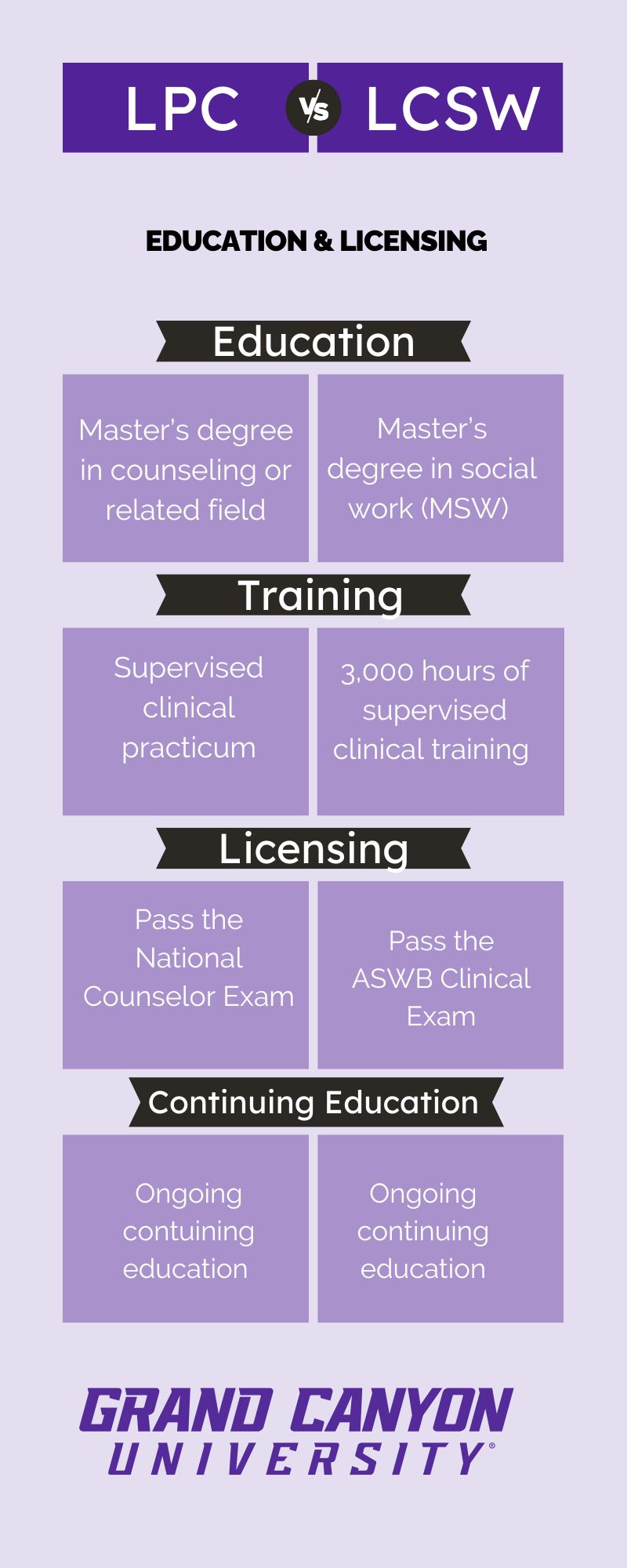
Licensed Professional Counselors (LPCs) and Licensed Clinical Social Workers (LCSWs) are both mental health professionals, but their training differs. LPCs earn a master’s degree in counseling, focusing on counseling theories and techniques, and complete supervised clinical training.(See disclaimer 1) LCSWs obtain a master’s in social work (MSW), emphasizing human behavior and social systems, followed by extensive supervised clinical hours.(See disclaimer 2 )
Exams and Continuing Education Requirements

LPCs and LCSWs must pass a national exam and fulfill state-mandated continuing education (CE) requirements to obtain and maintain their licenses. As Dr. Galica emphasizes, “When we’re talking about this, we always make sure that we tell students — prospective students, students in our programming, LCSWs and LPCs — check your state because every licensure is different. The number of continuing education hours you’re required to keep your license is different.” This reminder underscores the importance of understanding your state board’s specific expectations.
To become an LPC, candidates must pass a recognized counseling exam, such as the National Counselor Examination (NCE), complete supervised clinical experience and complete continuing education to stay updated on ethics and best practices.(See disclaimer 4) LCSWs require an MSW degree, supervised experience and must pass the Association of Social Work Boards (ASWB) Clinical Exam.(See disclaimer 5) They also need ongoing CE to maintain their licenses and stay informed about practices and ethical standards.
Independent Practice
Both Licensed Professional Counselors (LPCs) and Licensed Clinical Social Workers (LCSWs) can operate independent private practices after meeting state licensure requirements. LPCs are explicitly trained to provide counseling and psychotherapy, making them ideal for independent, therapy-focused practice.
LCSWs often work in hospitals, schools, human service agencies and community organizations, where their expertise in case management is valuable. While some move to private practice after gaining experience, many continue in integrated healthcare settings or community organizations.
A large shift to private practice began prior to the expansion of remote counseling and has continued to broaden opportunities for LCSWs to work in private, integrated or hybrid practice settings that were far less common in the past.(See disclaimer 6) But this doesn’t not mean working alone. Collaboration is essential. Although private practice can appear “very, very siloed,” Simmons emphasizes that LCSWs are not isolated because “collaborations are necessary.” Working with multidisciplinary teams enhances coordination of care, ensuring that “the bottom line is about the client” and how to best meet their needs.
LPC vs. LCSW Pros and Cons
Choosing between the Licensed Professional Counselor (LPC) and Licensed Clinical Social Worker (LCSW) paths requires weighing the benefits and challenges of each. Each license offers distinct strengths in clinical focus, work environments and independent practice opportunities, but they also present unique challenges, including supervision requirements and state-specific regulations.
Advantages of Becoming an LPC
Becoming a Licensed Professional Counselor (LPC) provides many benefits, including specialized training in counseling theory and therapeutic techniques.(See disclaimer 4) This preparation enables LPCs to deliver effective talk therapy to diverse populations.
LPCs often work in independent practice settings, such as outpatient centers and private practices, allowing them to build their client base and focus on their preferred types of therapy. Flexible work environments allow LPCs to also practice in clinics and telehealth. Additionally, LPCs can work in schools, providing support for all students, including those who are neurodivergent or have special needs. As Dr. Galica remarked, “The beautiful thing about LPCs is that we’re a jack of all trades. We can see everybody.”
Challenges and Limitations of the LPC Path
Becoming a Licensed Professional Counselor can offer rewarding opportunities but can also present challenges. The scope of practice varies by state, affecting the independence with which clinicians can diagnose and treat clients.(See disclaimer 7) Insurance reimbursement can be lower for LPCs, impacting earning potential.(See disclaimer 8) Additionally, licensing requirements differ greatly across states, complicating license portability.(See disclaimer 9) The path to licensure is rigorous, and maintaining it requires ongoing continuing education.
Advantages of Becoming an LCSW
The Licensed Clinical Social Worker (LCSW) offers a flexible career in mental health, recognized as an independent provider across all states.(See disclaimer 10) LCSWs can diagnose, develop treatment plans and provide therapy without supervision, facilitating professional relocation. Their diverse job settings include hospitals, schools and community agencies.(See disclaimer 2)
When discussing advantages of the LCSW role, Rhonda Simmons explains, "We can serve in many capacities. I may be in a private practice, that may be my primary role as a counselor or a therapist, but I may also serve as a case manager, a researcher or a mediator.” Her perspective highlights the profession’s versatility and LCSWs’ ability to tailor their careers to multiple interests and community needs.
Challenges and Limitations of the LCSW Path
Pursuing an LCSW credential can be both rewarding and demanding. Like Licensed Professional Counselors, LCSWs complete a master’s degree and fulfill supervised clinical experience requirements.(See disclaimer 11) In professional practice, LCSWs can be exposed to trauma through their work, making compassion fatigue or burnout a potential concern if adequate support and self‑care are not prioritized.(See disclaimer 12)
As Rhonda Simmons emphasizes, social workers “take on a lot of information” and “a lot of emotion,” which makes intentional self‑care essential. She encourages future clinicians to “pursue your opportunities” and “be open to new experiences,” while also remaining mindful that “burnout and vicarious trauma, compassion fatigue, those are real things.”
Ongoing continuing education is also required to maintain licensure,(See disclaimer 5) reflecting a shared long‑term commitment to professional development across mental health professions.(See disclaimer 11)
LPC vs. LCSW Salary and Job Outlook
Exploring career paths like Licensed Professional Counselors (LPCs) and Licensed Clinical Social Workers (LCSWs) reveals strong demand for mental health services, but the specifics differ by role.
Salary Comparison
According to the U.S. Bureau of Labor Statistics, the median annual wage for Substance Abuse, Behavioral Disorder and Mental Health Counselors, including LPC roles, was $59,190 in May 2024.(See disclaimer 13) In comparison, Social Workers, including LCSWs, earned a median of $61,330 in May 2024.(See disclaimer 14 )
Job Outlook for LPC vs. LCSW
Both professions are experiencing rapid growth, but LPC‑aligned roles are projected to grow even faster. Employment of mental health, substance abuse and behavioral disorder counselors is expected to grow 17% from 2024 to 2034, much faster than average for all occupations.(See disclaimer 15 )This equates to 81,000 new jobs over the decade. Employment of social workers, including LCSWs, is projected to grow 6% from 2024 to 2034, creating 44,700 new positions.(See disclaimer 16)
Day to Day Work Life LPC vs. LCSW
Although Licensed Professional Counselors (LPCs) and Licensed Clinical Social Workers (LCSWs) both provide mental health services, their daily routines differ in terms of treatment focus and work environments. Here’s what a typical day may look like in each profession.
Daily Work Life of an LPC
LPCs primarily provide therapy to help clients manage mental health challenges, develop coping skills and improve emotional well‑being. Their daily tasks often include:(See disclaimer 17)
Daily Work Life of an LCSW
LCSWs focus on therapy and social systems. They help individuals navigate everyday challenges and treat mental health conditions.
An LCSW’s responsibilities typically includes:(See disclaimer 18)
Types of Clients and Presenting Issues
Understanding who LPCs and LCSWs serve and what kinds of challenges they help clients address highlights the unique strengths of each profession. While both provide mental health support, their client populations and presenting issues often reflect differences in clinical focus and systemic involvement.
Licensed Professional Counselors typically work with individuals, couples, families and groups facing emotional, psychological or behavioral challenges.(See disclaimer 1) They are often sought for personal mental health issues rather than environmental factors.
Common LPC client populations include:(See disclaimer 1,19)
Licensed Clinical Social Workers provide psychotherapy, case management, advocacy and resource coordination for diverse and complex populations in settings such as hospitals, schools, social service agencies and private practice.
Common LCSW client populations include:(See disclaimer 2,20)
Which Path Is Right for You: LPC vs. LCSW?
If you’re deciding between the LPC and LCSW paths, consider these questions:
Do I want a clinical, therapy-focused role or a blend of therapy with social support and advocacy?
• Choose LPC for a primarily therapeutic caseload.
• Choose LCSW to provide therapy and help clients navigate complex systems and challenges.What types of clients do I want to serve?
• LPCs work with clients seeking counseling for emotional or psychological concerns.
• LCSWs assist clients facing layered challenges like poverty, trauma or family system stressors.Do I want flexibility to move across medical, community and government settings?
• LCSW training opens doors to hospitals, child welfare, hospice, behavioral health and integrated care teams.
• LPCs typically work in outpatient mental health centers, private practice, schools and community programs.Am I prepared for the differences in supervision requirements, licensing structures and graduate training?
• LPC programs focus on counseling theories and therapeutic techniques.
• LCSW programs emphasize mental health alongside policy, case management, resource systems and social justice.
Shape Your Future in Counseling or Social Work
GCU’s integration of faith and learning resonates deeply with the core values of both the LPC and LCSW professions. Step confidently into a career in mental and behavioral health by choosing the educational path that aligns with your purpose.
If you’re inspired to empower clients through focused therapeutic work, explore GCU’s mental health counseling programs to develop your clinical skills. If your passion leans toward addressing both mental health within broader social systems, consider GCU’s social work programs that can prepare you to advocate and support diverse communities. Your journey to making a real difference starts with the right preparation.
Prepare for a Purpose‑Driven Career
Learn how GCU’s counseling and social work programs can equip you to support others effectively.