


If you’re considering a career in education, you may have heard the term “student teaching” and wondered what it involves. Student teaching is one of the most important parts of becoming a licensed teacher because it gives aspiring educators the opportunity to apply what they’ve learned in real classrooms with real students.
Whether you’re just beginning to explore what teaching degree you need or preparing for your own classroom experience, understanding what student teaching is and what to expect can help you to feel more confident about the journey ahead.
We spoke with Julianne Brett, executive director of clinical practice at Grand Canyon University, to learn more about the importance of student teaching and how to prepare for this experience.
What Is Student Teaching?
Student teaching is a supervised classroom experience completed as part of a teacher preparation program. It allows teacher candidates to work directly in a school setting while gradually taking on the responsibilities of a licensed teacher.

“As someone who completed student teaching myself (many years and many lesson plans ago) and now, as the executive director of clinical practice, I can tell you this, student teaching is where you stop thinking about being a teacher and you start becoming one,” says Julianne Brett.
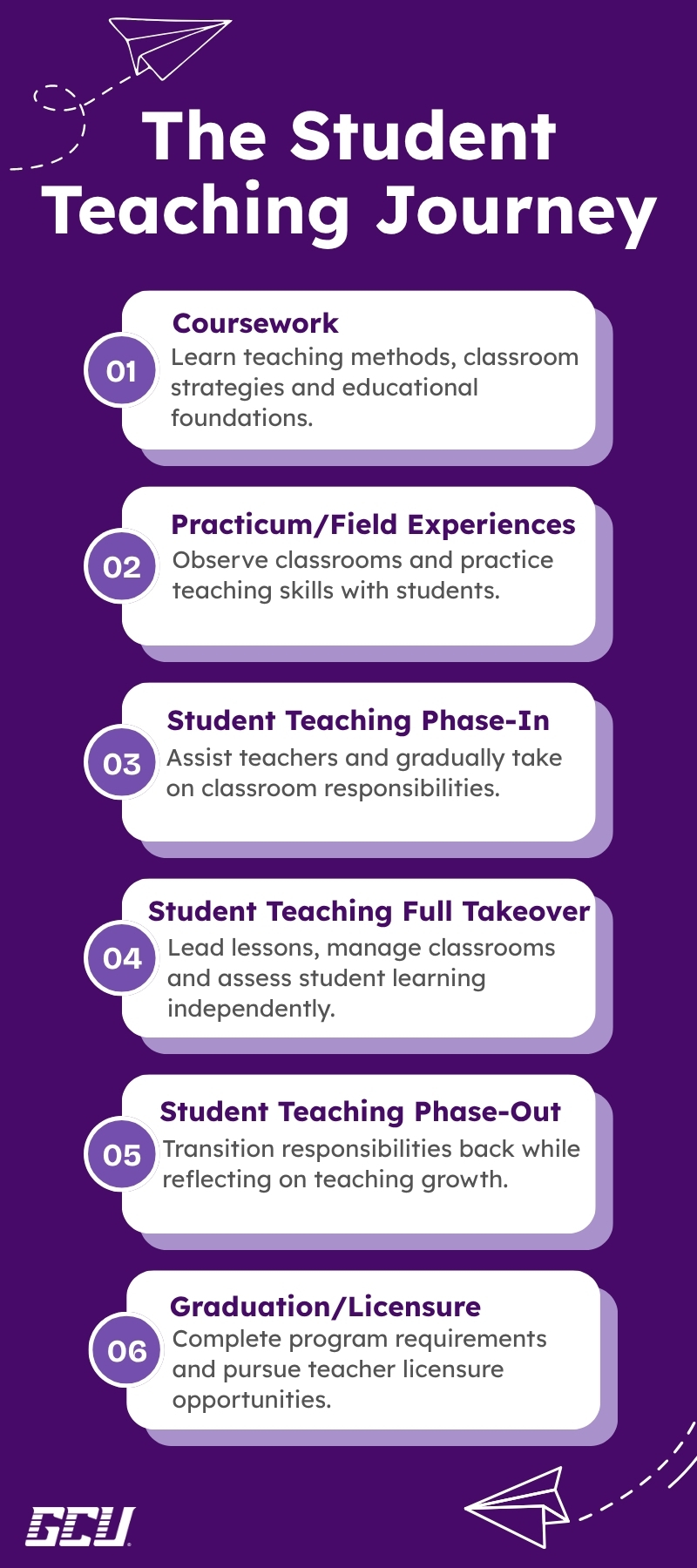
Student teaching is part of a larger process known as clinical practice. According to Brett, “clinical practice” is the umbrella term used for all the in-person classroom experiences that candidates complete throughout their program. This often includes practicum or field experiences earlier in a program as well as student teaching.
“Early in a program, practicum or field experiences give candidates the chance to observe in classrooms, work with students, and begin practicing their teaching skills alongside their coursework,” Brett explains.
"These initial experiences are critical for building confidence, testing strategies and developing a foundational understanding of the day-to-day realities of the educational community."
Student teaching typically takes place near or at the end of a degree program, and it serves as a full-time classroom immersion experience. Brett compares it to the clinical rotations completed by healthcare professionals because it is where aspiring teachers “bring theory into practice, supported and guided by mentor teachers and university supervisors.”
What Is a Student Teacher?
A student teacher is an education student completing their supervised teaching experience in a classroom setting. Teacher preparation programs often refer to students in the process of earning licensure as “teacher candidates.”
Student teachers work alongside experienced educators, often called cooperating or mentoring teachers, to gain hands-on teaching experience. Over time, they transition from observing lessons to leading classroom instruction and managing daily classroom responsibilities.
During student teaching, candidates develop essential teaching skills such as:
According to Brett, student teaching is valuable because “it’s during these experiences that candidates shift from learning to doing.”
How Does Student Teaching Work?
Student teaching is designed to gradually introduce candidates to the full responsibilities of teaching. While each placement may look slightly different depending on the school, district, grade level or subject area, most experiences follow a similar structure.
“I often explain student teaching as a bell curve that includes a phase-in period, a full-takeover period, and phase-out period,” Brett says. At the beginning of the placement, candidates spend time observing the classroom environment, learning school routines and building relationships with students and staff.
“In the first week or two, candidates are primarily observing, learning routines, getting to know students and figuring out how to work the copy machine,” Brett says. “They are soaking in the classroom systems, instructional flow and school culture.”
As the experience progresses, candidates gradually take on more instructional responsibility. This may begin with co-teaching lessons or leading small-group activities before advancing to full classroom instruction.
“Eventually, they reach the full takeover stage, where they are responsible for all the planning, lesson implementation, classroom management, assessment and the overall instructional experience from start to finish,” Brett explains.
Throughout the experience, cooperating teachers and university supervisors provide coaching, observations and feedback to support candidate growth.
Student Teaching Requirements
Requirements for student teaching vary by university and state, but candidates are generally expected to meet several academic and professional benchmarks before beginning their placement.
“Generally speaking, candidates must successfully complete all the required coursework, including the completion of all practicum/field experience hours,” Brett says.
Other common student teaching requirements may include:
At GCU, undergraduate candidates must maintain a minimum 2.8 GPA, while graduate candidates must maintain a minimum 3.0 GPA before beginning student teaching.
Brett also notes that GCU candidates must receive “formal review and clearance from both the field experience counselor and the student success counselor to confirm that all academic and practicum/field experience expectations have been met.”
How Long Student Teaching Lasts
The length of student teaching can vary depending on the degree program, state requirements and certification area. In many programs, student teaching lasts for one semester and is a full-time commitment.
“One of the biggest challenges that comes with student teaching is simply the time commitment,” Brett says. “Student teaching is typically a full-time, semester-long experience, so candidates really do need to plan ahead in very practical ways.”
Because student teaching often mirrors the schedule of a full-time teaching position, candidates may spend multiple days each week at their assigned school site for the duration of the semester.
"The College of Education here at GCU is unique because it is so extremely hands-on. You get to put into action what your professors are teaching you, and so once you find yourself in a real-life classroom, it feels like you’ve been there before."
How To Become a Student Teacher
To become a student teacher, individuals typically enroll in a teacher preparation program that leads to licensure. Throughout the program, candidates complete coursework and field experiences that prepare them for classroom instruction.
Before student teaching begins, candidates must complete the program requirements and formally apply for placement.
Brett encourages future educators to prepare for the experience early. “Think ahead and plan logistics early,” she says. “This includes setting tentative start and end dates, as well as planning for transportation, childcare and (particularly for our ground campus students) living arrangements.”
Candidates should also approach the experience professionally because it can help to open doors to future teaching opportunities.
“I often remind candidates that student teaching is often viewed as a semester-long job interview,” Brett says. “Districts and school sites pay close attention to how candidates show up, interact with students and staff, and contribute to the school community.”
What To Expect During Student Teaching
Student teaching can be both exciting and challenging. Candidates are expected to balance lesson planning, classroom instruction, feedback from supervisors and the day-to-day demands of working in a school environment. One challenge that many candidates face is learning how to receive and apply constructive feedback.
"Student teaching is still very much a learning experience, and growth is expected over time. Candidates should view feedback as a helpful roadmap to their success, rather than as criticism."
Brett encourages candidates to “ask questions, reflect on what’s being shared and try small adjustments along the way.” Candidates should also expect to collaborate regularly with cooperating teachers, administrators and university supervisors throughout the placement experience.
Benefits of Student Teaching
Student teaching provides aspiring educators with practical classroom experience before they become fully licensed teachers. It allows candidates to apply educational theory, strengthen teaching skills and gain confidence in leading a classroom.
“Student teaching is one of the most important ways future educators get ready for their first full-time teaching job. This is because it gives them daily, hands-on opportunities to practice the work of teaching in real classrooms with real students,” Brett says.
Student teaching also helps candidates to:
“A key piece of the experience is learning from qualified cooperating teachers,” Brett explains. “These experienced educators model best practices, provide ongoing feedback and gradually release responsibility so candidates can build competence and confidence.”
For many future educators, student teaching becomes the bridge leading from college coursework to a professional teaching career. “And finally,” Brett says, “while it is hard work, have fun and enjoy it!”
Earn Your Education Degree at GCU
At GCU, student teaching is intentionally structured to support teacher candidates every step of the way. From placement assistance through Teacher Placement Counselors to ongoing faculty guidance and supervision, candidates are supported through a strong clinical practice model that is designed to help them grow with confidence.
Brett shares, “We also encourage candidates to visit the College of Education’s Student Success Center, which serves as a centralized hub for resources on items such as certification exam prep, practicum/field experience and student teaching.”
Explore GCU’s teaching degree programs to learn how you can prepare for licensure and begin your journey toward a career in education.
Earn Your Teaching Degree at GCU
Explore teaching degree programs at GCU and prepare for your career in education.


