


A biblical studies degree can lead to several paths rooted in faith, knowledge and service. For those exploring the question what can you do with a biblical studies degree, the answer extends beyond traditional ministry roles to include opportunities in education, nonprofit work, counseling, missions and leadership.(See disclaimer 1) These programs are structured to equip learners with a strong foundation in Scripture, theology and historical context while also developing skills in communication, critical thinking and ethical decision-making.
Students may pursue either a full degree or a certificate pathway, depending on their goals. Both options provide valuable preparation for careers in biblical studies while supporting personal and spiritual growth. Many are drawn to this field for the opportunity to improve the lives of others in their communities.
Throughout this post, we’ll highlight different career possibilities and include insights from Dr. Brian Koning, assistant professor in the College of Theology at GCU, whose perspective helps bridge academic study and practical application.
What Is Biblical Studies?
Biblical studies is the academic exploration of Scripture, including its theological themes, historical background, original languages and methods of interpretation. Students examine how the Bible was written, how it has been understood across time and how its meaning applies in different contexts. This approach goes beyond personal reflection, emphasizing careful analysis, historical awareness and linguistic study.

Dr. Brian Koning, assistant professor in the College of Theology at GCU, explains that biblical studies is distinct from many traditional degree programs because of its deeper purpose. “A biblical studies degree is focused on preparing a Christian for a life of Christian service,” he says, noting that it goes beyond simple job training. While devotional study often centers on personal spiritual growth, a biblical studies program invites students into a more rigorous, thoughtful engagement with the text, equipping them to interpret and communicate Scripture with clarity and context.
The degree offers a broad and meaningful sense of direction. As Dr. Koning shares, it “prepares you to be the person God needs you to be in the place that He calls you to be,” rather than limiting graduates to a single career path.
Overview of Biblical Studies Degree Programs
Biblical studies degree programs provide a comprehensive understanding of Scripture while equipping students for thoughtful engagement in both ministry and professional contexts. Students typically explore the Old and New Testaments, hermeneutics (biblical interpretation), systematic theology, biblical languages such as Greek and Hebrew and church history. These areas of study help learners develop a well-rounded perspective on the Bible’s message, context and lasting significance.
In addition to academic coursework, our programs intentionally integrate spiritual formation with intellectual growth. Students are encouraged to deepen their personal faith while also sharpening their critical thinking and communication skills. This combination prepares graduates to clearly articulate biblical truths, engage in meaningful discussions and lead with integrity in a variety of settings.
At GCU, students can pursue a Bachelor of Arts in Christian Studies: Biblical Studies or a biblical studies certificate, offering flexibility depending on their goals. Whether completing a full degree or a shorter program, learners experience a balance of academic rigor and mission-driven learning. These programs are designed not only to build knowledge but also to cultivate purpose, preparing students to apply their education in ways that positively impact their communities and beyond.
Skills Associated With a Biblical Studies Degree
A biblical studies degree helps students develop a versatile set of skills that apply to a wide range of careers, both inside and outside of ministry. One of the most foundational is the ability to research and interpret complex texts. As Dr. Brian Koning explains, “the first skill that transfers very well…is the ability to think carefully.” Through the study of hermeneutics, students learn how to read closely, analyze meaning and draw thoughtful conclusions, skills that extend far beyond Scripture into everyday decision-making and professional environments.
Key skills developed in a biblical studies program include:(See disclaimer 1)
These competencies strengthen graduates’ ability to communicate effectively in many contexts. Whether preparing sermons, leading teams or presenting ideas in the workplace, they learn how to articulate complex concepts with clarity. Dr. Koning emphasizes the importance of this skill in today’s information-heavy world: “We need people who can read and think carefully about what they’re consuming rather than just, oh, I saw this on TikTok, therefore it has to be true.”
This training also translates directly into non-ministry roles. As Dr. Koning shares through the example of a former instructor, “I was trained how to read the Bible and how to read documents carefully. That transferred very easily when I moved over to this kind of legal sphere and prepared me well.” These transferable skills highlight how biblical studies can equip graduates to serve and lead effectively across a wide range of professional paths.
An additional skill gained from biblical studies is the ability to read the Bible in its original languages, Hebrew and Greek. Dr. Brian Koning notes that while knowledge of these languages is not essential for effective ministry, they serve as a valuable tool rather than a benchmark for spiritual maturity. “Think of it as it’s one more skill the Holy Spirit can use to help lead you to truth,” he explains.
Studying original languages enhances understanding of Scripture by raising new questions and offering fresh perspectives. It equips graduates with discernment to evaluate interpretations. As Dr. Koning notes, having this knowledge provides helpful “filters” to assess claims about what the Bible says in its original form, allowing individuals to navigate and challenge misleading or oversimplified arguments thoughtfully.
Careers in Biblical Studies Within Church and Ministry Settings
When exploring careers, many graduates feel called to roles where faith is central to their daily work. Biblical studies programs can naturally prepare students for a variety of traditional ministry paths. Biblical studies can help you prepare for servant leadership in ministry, education and missions as well as other religious and nonprofit settings.(See disclaimer 1) These roles rely on a strong theological foundation, along with the ability to lead, teach and care for others.
As Dr. Brian Koning explains, “biblical studies obviously is going to most naturally go to ministry of some sort.” However, he emphasizes that ministry can take many forms depending on a person’s calling and church context. “It could be senior pastors, it could be family, next generation youth ministers… It can be worship,” he says, highlighting the diversity of roles within the church itself.
Beyond traditional positions, graduates also pursue nontraditional ministry roles such as chaplaincy, Christian education and work within nonprofit or parachurch organizations.(See disclaimer 1) Dr. Koning notes examples like “Campus Crusade” or “Crisis Pregnancy Center[s],” where individuals serve communities in impactful ways outside the walls of a church building.
In many cases, biblical studies graduates are drawn to environments where their faith actively shapes their work. As Dr. Koning puts it, “most often…graduates in this field [go] toward something where faith is front and center,” whether in a church, nonprofit or another setting. A biblical studies degree provides both theological depth and practical ministry preparation, equipping graduates to lead with purpose.
Careers in Biblical Studies Outside of the Church
While many graduates pursue ministry roles, opportunities also extend well beyond the church into a variety of professional fields. The skills developed through biblical study, critical thinking, ethical reasoning and clear communication translate into meaningful work across industries.
In education, graduates may serve as Christian school teachers, curriculum writers or academic researchers, helping others engage deeply with Scripture and theology. Dr. Brian Koning emphasizes that even outside traditional ministry roles, faith often remains a guiding influence. Graduates frequently pursue careers “where faith is front and center,” or where it shapes their values and decision-making. In these contexts, biblical studies provide a foundation for ethical leadership, cultural understanding and meaningful engagement with others.
Ultimately, this degree can equip students not just for specific job titles, but for lives of service and leadership, wherever their vocation leads.
What Can You Do With a Certificate in Biblical Studies?
A certificate in biblical studies offers a flexible and practical way to build biblical knowledge without committing to a full degree program. Certificates are especially valuable for lay leaders, church volunteers, ministry workers, career changers or individuals who want to explore ministry before pursuing further education.
Dr. Brian Koning highlights that a certificate demonstrates meaningful preparation and foundational knowledge. “The value of that is it means you’ve taken certain courses in that area,” he explains. This can be especially beneficial for those already pursuing another career. For example, “let’s say you’re someone who is going for a CPA or you’re going into nursing, if you have that certificate, you can go to a church and say, I’ve taken courses in Old Testament, New Testament, theology.”
This background may allow individuals to step into leadership or support roles with confidence. Rather than starting from scratch, as Dr. Koning notes, “I’m not a person that’s starting from zero knowledge. I have some foundation to build on.” Practically, this can translate into leading small groups, teaching Bible studies or supporting church ministries in meaningful ways.
A certificate can also complement careers outside the church. Dr. Koning emphasizes that it helps individuals integrate faith into their professional lives: “I’ve thought through how Christianity should impact me as I’m living in the business world in terms of things like ethics and vocation.”
Biblical Studies Degree vs. Religious Studies Degree
While both fields explore faith and belief, there are important differences between a biblical studies degree and a religious studies degree. Biblical studies is more focused and intentional, centering on Scripture, theology, interpretation and ministry application within the Christian tradition. In contrast, religious studies takes a broader, more academic approach, examining world religions through cultural, anthropological and comparative lenses.
As Dr. Brian Koning explains, “biblical studies is going to be more targeted than religious studies.” He notes that religious studies is often “an academic discipline, investigating how religion functions within culture,” and can be viewed as a subset of anthropology. This approach does not require personal belief: “You don’t have to be an adherent to any specific faith, you’re just kind of looking at the role of faith in culture.”
Biblical studies, however, is more rooted in personal and spiritual formation. It focuses on Christianity (and Judaism in the context of the Old Testament) and “how that transforms people in specific faith contexts,” often with the expectation that students are engaging as believers. As Dr. Koning adds, this allows programs not only to “grow your minds” academically, but also “to develop your personal faith and relationship with God.”
Biblical Studies Experience at GCU
Our biblical studies degree programs combine a strong Christian foundation with practical engagement. As Dr. Brian Koning explains, “GCU offers a very interesting opportunity for a biblical studies student.” While the theology faculty is composed of committed Christians who have “all signed a statement of faith,” the student body is diverse. “We’re proudly Christian, but we say, come wherever you are, you’re welcome to come here,” he says.
This dynamic creates an experience that prepares students for life beyond the classroom. Rather than learning in isolation, students are exposed to a variety of perspectives that challenge them to think deeply about their beliefs. Dr. Koning notes, “real life is not in the church, in some ivory tower… real life is on the street with people who may hate you. They’re going to test you. They’re going to push back.” At GCU, students begin developing the ability to respond thoughtfully and communicate their faith with clarity and compassion.
This exposure is balanced with strong support. Students are not left to navigate these challenges alone, “you’ve got your faculty and a strong support network,” Koning explains. This combination of challenge and encouragement helps students grow both intellectually and spiritually, equipping them to engage the world with confidence, humility and purpose.
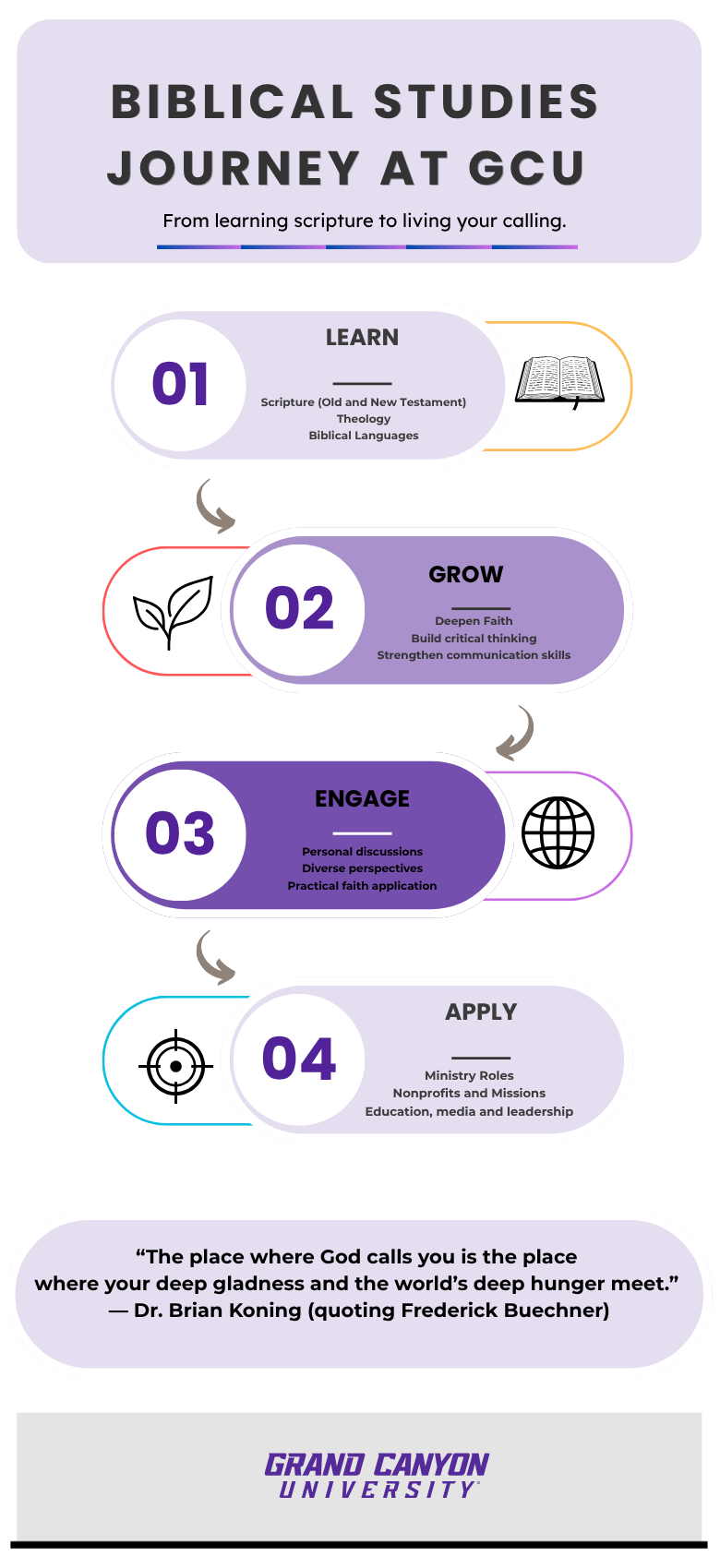
Explore Biblical Studies at GCU
A biblical studies education offers more than academic knowledge; it can help shape who you are and how you live out your faith. Whether you feel called to ministry, service or deeper theological understanding, this field can lead to a purpose driven life. As Dr. Brian Koning shares, “Biblical studies is a wonderful place to develop your faith and your mind to make you into the person God wants you to be.”
At Grand Canyon University, students can pursue this calling through programs designed to support spiritual growth alongside academic development. With mission-driven learning, dedicated faculty and a supportive community, GCU creates an environment where students are encouraged to grow intellectually while deepening their relationship with God.
Dr. Koning emphasizes the lasting impact of this kind of education: “View this as a way to develop your mind, develop your passion for God. It’s going to give you a very good foundation for going into whatever context you want.” Whether that path leads to pastoral ministry, education, nonprofit work, media or another field, biblical studies can equip you to lead with purpose and integrity.
He also reminds students that learning should be transformative: “what you’re learning should change you… love God and love your neighbor as yourself.”
To pursue a degree that challenges your thinking, strengthens your faith and prepares you for wherever you’re called next, explore biblical studies at GCU and take the next step forward.
Enhance Your Understanding of Ministry
Live out your pastoral calling at GCU.


