

MLT to MLS Online Degree
Develop Skills in Scientific Analysis and Modern Lab Techniques
The Bachelor of Science in Medical Lab Sciences (MLT to MLS) degree provides eligible students who have successfully completed a medical lab technician (MLT) program or certification with the opportunity to complete their bachelor's degree in medical lab sciences. This program builds on your existing knowledge, aiming to deepen your expertise in chemistry, microbiology, immunohematology and other related fields.

Online: $490 per credit [More Info]
Up to 90 credits, only 84 can be lower division
Credits: Fill out the Lopes Eval to find out what will transfer
Admission Requirements (Bachelor's)
- 16+ years old
- High School Graduate
- 2.8+ Unweighted GPA
OR 2.5+ Unweighted GPA and
- ACT: 19
- SAT: 1000*
Admission requirements may differ based on degree level, program and modality, or transfer status. Some programs of study may require a higher GPA and/or other qualifying criteria for admission. Please review full admission and program requirements in the University Policy Handbook.
*Math and reading only on a 1600 point scale (test date after 3/1/2016). SAT score of 1380 required for 2400 point scale (test date before 3/1/2016).
Enhance Your Understanding of Complex Diagnostic Procedures
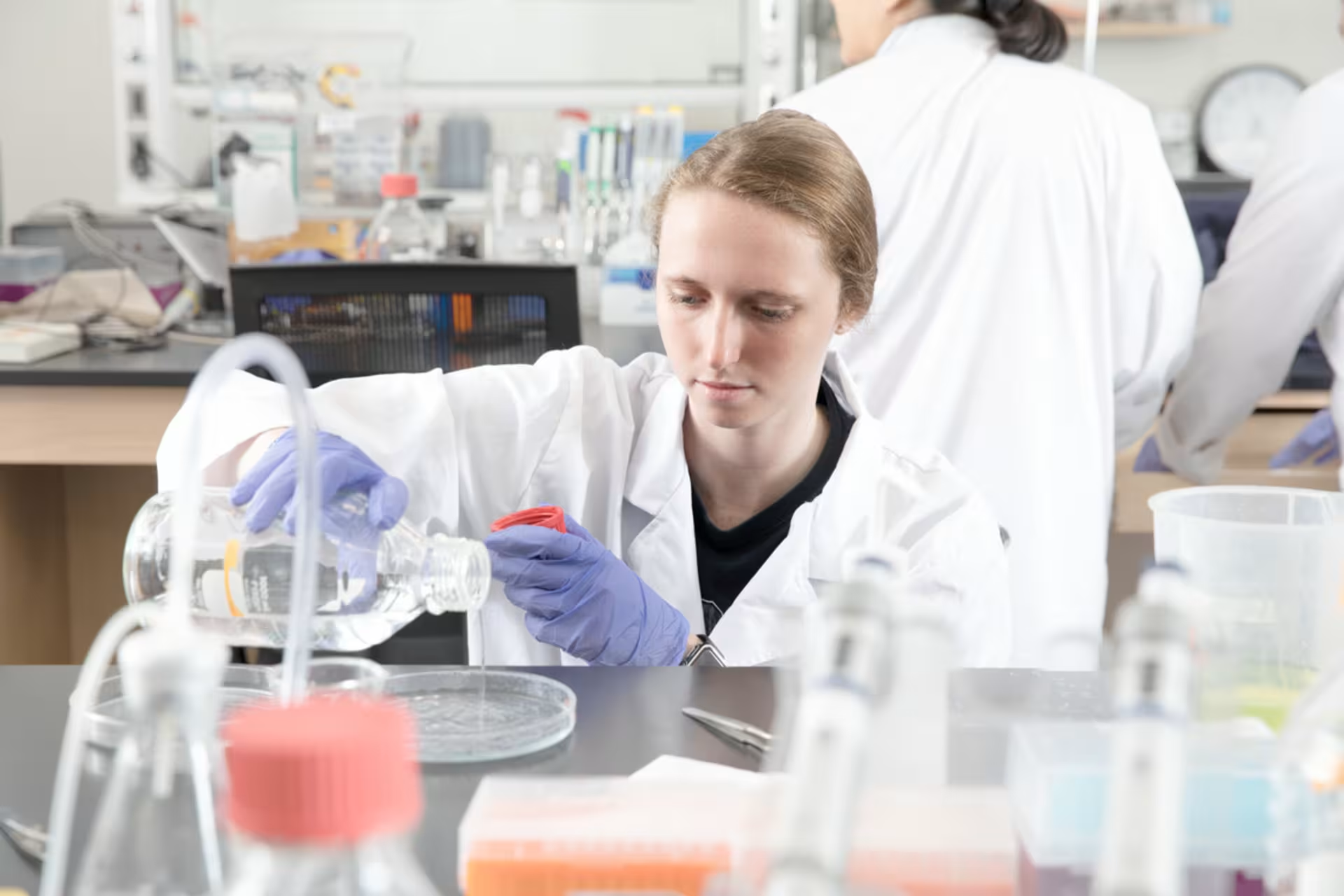
GCU’s MLT to MLS online degree guides students in developing advanced skills in laboratory testing, including disease classification, specialized procedures and the investigation of unexpected results. This program blends theory and application, offering opportunities to address laboratory research questions through original designs under the supervision of an experienced faculty or laboratory mentor.
As a student, you can benefit from a holistic education that contributes to personal and professional development. Our curriculum is designed through the lens of a Christian worldview, helping you find your purpose while pursuing a career in healthcare.

Earn Your MLT to MLS Online Degree With Flexibility
GCU’s online medical lab sciences degree is designed to offer a flexible learning format, so you can pursue your MLS degree while balancing personal and professional commitments.
Online Medical Lab Sciences Degree Coursework
The coursework in the medical lab sciences degree (MLT to MLS) program expands on the foundational technical skills of an MLT. In addition to introducing advanced competencies necessary for laboratory expertise, it incorporates several leadership-focused topics including quality assurance, workload management and budgeting.
The MLT to MLS online degree covers advanced skills in:
Career Opportunities for Graduates of the MLS Online Program
This MLT to MLS pathway can help prepare you to move from performing routine lab work to taking on more complex testing and analysis as a medical lab scientist. It may also open opportunities for supervisory, research and specialized roles in clinical and research laboratories.
Medical laboratory scientists work in a variety of settings, including:(See disclaimer 1,2)
Hospitals and doctors’ offices
Medical and diagnostic laboratories
Public health organizations
Fertility centers
Research facilities
Blood and organ banks
Median annual wage for clinical laboratory technologists and technicians in May 2024(See disclaimer 3)
New jobs estimated to open each year for clinical laboratory technologists and technicians from 2024 to 2034(See disclaimer 4)
Earn Your MLS Degree From an Accredited University
Grand Canyon University has been institutionally accredited by the Higher Learning Commission since 1968, demonstrating its commitment to developing future professionals. The medical laboratory science program at GCU is submitting the National Accrediting Agency for Clinical Laboratory Sciences (NAACLS) Initial Accreditation Application. Once the program has achieved “serious applicant” status, the students are eligible to take the American Society for Clinical Pathology (ASCP) Board of Certification exam.
Frequently Asked Questions
Explore answers to common questions about earning an online medical lab sciences degree.
Is an MLT to MLS program worth it?
How do I bridge from an MLT to MLS?
How hard is an online medical lab sciences degree?
What’s the difference between an MLS program and an MLT to MLS program?
Program Curriculum
General Education Requirements
Required General Education Courses
Core Courses

Take the next step toward becoming a vital part of patient care. Pursue a career in medical laboratory science with GCU’s MLT to MLS degree.
- U.S. Bureau of Labor Statistics (2025, Aug. 28). Occupational Outlook Handbook. Work Environment. Retrieved October 2025.
- Montiero, I. (2025, June 9). Medical Laboratory Technician: Duties, Salary and Skills. Indeed Career Guide. Retrieved October 2025.
- The earnings referenced were reported by the U.S. Bureau of Labor Statistics (BLS), Clinical Laboratory Technologists and Technicians, as of May 2024, retrieved October 2025. Due to COVID-19, data from 2020 to 2023 may be atypical compared to prior years. BLS calculates the median using salaries of workers nationwide with varying levels of education and experience. It does not reflect the earnings of GCU graduates as clinical laboratory technologists and technicians, nor does it reflect the earnings of workers in one city or region of the country or a typical entry-level salary. Median income is the statistical midpoint for the range of salaries in a specific occupation. It is very unlikely that a median salary will reflect an entry-level salary. It represents what you would earn if you were paid more money than half the workers in an occupation, and less than half the workers in an occupation. It may give you a basis to estimate what you might earn at some point if you enter this career. Grand Canyon University can make no guarantees on individual graduates’ salaries. Your employability will be determined by numerous factors over which GCU has no control, such as the employer the graduate chooses to apply to, the graduate’s experience level, individual characteristics, skills, etc. against a pool of candidates.
- COVID-19 has adversely affected the global economy and data from 2020 to 2023 may be atypical compared to prior years. Accordingly, data shown is effective August 2025, which can be found here: U.S. Bureau of Labor Statistics, Occupational Outlook Handbook, Clinical Laboratory Technologists and Technicians, retrieved September 2025.
- U.S. Bureau of Labor Statistics (2025, Aug. 28). Occupational Outlook Handbook. What Clinical Laboratory Technologists and Technicians Do. Retrieved October 2025.
- U.S. Bureau of Labor Statistics (2025, Aug. 28). Occupational Outlook Handbook. How to Become a Clinical Laboratory Technologist or Technician. Retrieved October 2025.