


Choosing the right dissertation topic is one of the most important decisions in your doctoral journey. This choice influences everything, from how you design your research to the type of contribution you’ll make to your field. In GCU’s social science research, dissertations generally fall into two broad categories: traditional and impact focused. Each serves a distinct academic purpose and requires a unique approach and structure.

To help you navigate these options, Dr. Nicholas J. Markette, EdD, Assistant Dean (above) and Dr. Kenneth C. Sherman, PhD, Research Program Chair (right), share their expertise and introduce Grand Canyon University’s innovative impact dissertation approach. This emerging approach is gaining traction due to its emphasis on practical applications and measurable outcomes, making research more relevant to communities and organizations.(See disclaimer 1) Their insights will guide you in understanding the taxonomy of dissertations and help you select the approach that aligns with your goals.
What Is a Dissertation and Why Does It Matter?
A dissertation is more than a lengthy academic paper; it marks the culmination of your doctoral journey by demonstrating the ability to conduct independent research. It addresses a significant question in your field, contributing new knowledge or practical solutions to advance scholarship and practice. Understanding its importance can help you approach this milestone with clarity and purpose.
For doctoral candidates, the dissertation serves several purposes:
Common Dissertation Types in Doctoral Programs
Doctoral programs offer various dissertation formats tailored to specific academic purposes. At its core, empirical research involves the systematic collection and analysis of original data to examine research questions that are informed by theory or conceptual frameworks. Traditional empirical studies generally fall into two broad approaches:
While traditional formats, such as the empirical approaches, aim to expand knowledge, impact-focused approaches, like the impact dissertation at GCU, emphasize practical application and measurable outcomes.(See disclaimer 1 )This reflects a growing trend in research that addresses known challenges and seeks practical solutions to these issues.
In the next section, we will take a closer look at the choices you must make when selecting your methodology, approach and design. We will also examine two key approaches: the traditional research dissertation and the impact dissertation, exploring how each serves different goals and what that means for your doctoral path.
The Dissertation Taxonomy: Making Your Choice
Dr. Markette and Dr. Sherman advise you to think of choosing your dissertation approach as moving through three nested decisions. Understanding this hierarchy will help you make intentional choices that align with your goals and the contribution you want to make.
- Methodology: Quantitative or qualitative
- Approach: Traditional or impact
- Design: The specific research design within your methodology
Each level builds on the previous one. You cannot choose a design until you've determined your approach, and you cannot choose an approach until you've identified your methodology.
Level One: Choosing Your Methodology
Your methodology determines the fundamental nature of the data you will collect and analyze.
Quantitative Research
Quantitative research collects data in the form of numbers. These numerical data can be analyzed using statistical methods, and the specific analytical approach depends on whether your design is experimental or non-experimental. Quantitative research is particularly useful when you want to measure variables, test hypotheses or examine patterns, differences, relationships or predictions between measurable variables across larger samples.
Qualitative Research
Qualitative research generally collects data in the form of words, though numbers may sometimes be included. This methodology allows researchers to explore descriptions, experiences, perceptions and meanings in depth. The analytical approach varies by design. For example, case studies and qualitative descriptive studies may use thematic analysis, while phenomenological studies may use a form of reduction to distill essential meanings from participant experiences.
Level Two: Choosing Your Approach
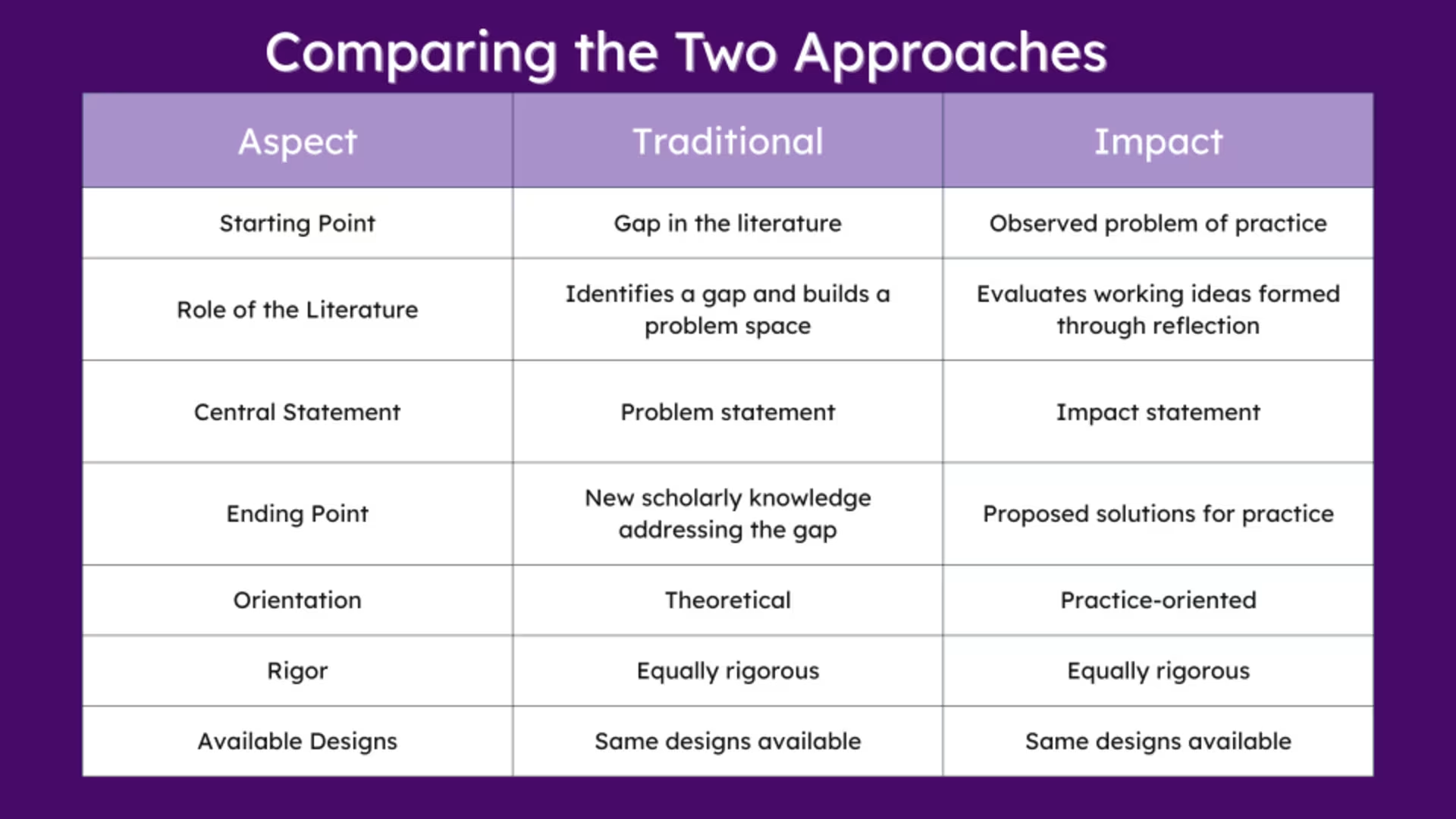
Once you’ve determined your methodology, you must choose between two approaches: traditional or impact. Both approaches maintain the same level of scholarly rigor and rely on the same empirical research methods and designs. The difference lies in how the research journey begins and ends.
The Traditional Approach
The traditional approach follows a path familiar to most doctoral students. The journey begins with an exhaustive and rigorous review of the literature. Through this review, the researcher identifies gaps in existing knowledge, areas where scholarly understanding is incomplete or where important questions remain unanswered. This exploration of the literature creates what is known as the “problem space.” From the problem space emerges the Problem Statement, which serves as the heart of the traditional dissertation.
The Problem Statement articulates what gap exists in the literature and presents the argument for why this gap warrants scholarly attention. This statement then drives the development of research questions and the selection of a specific research design. The traditional dissertation concludes by adding to the body of knowledge. In Chapter five, the researcher presents conclusions that address the identified gap and offers implications for additional research, theory and practice.(See disclaimer 1) The traditional dissertation is more theoretical in nature, contributing new scholarly knowledge to the academic conversation.
The Impact Approach
The impact approach, grounded in reflective practice takes a different path:(See disclaimer 1) The journey begins not with the literature, but with an observed problem of practice, a real challenge the researcher has witnessed or experienced in their professional context.(See disclaimer 1) Rather than starting in the library, the researcher starts in the field.
Next comes the reflective readiness process. Through structured reflection, the researcher develops working ideas to explain the potential causes of the observed problem. For example, a researcher might reflect on recurring challenges they have witnessed in their professional setting and begin to question how organizational practices, participant expectations, or prior decision-making patterns may be contributing to the issue. These working ideas emerge from the researcher’s professional experience and initial thinking about what might be driving the challenge they’ve observed.
Only after forming these working ideas does the researcher turn to the literature. The exhaustive and rigorous literature review serves to evaluate the working ideas, testing them against existing scholarship. This process leads to the impact statement, which functions as the problem statement within the impact approach and serves as the mechanism for creating research questions and choosing a design.
The impact dissertation concludes differently from its traditional counterpart. In Chapter five, the researcher uses Deweyan reflective practice to synthesize the results into proposed solutions that address the original problem of practice.(See disclaimer 1 )The impact dissertation is more practice-oriented, translating rigorous scholarly research into actionable recommendations for the field. The impact dissertation may have particular value to industry employers in education, healthcare and business since it results in proposed solutions for practice and produces scholar-practitioners trained in problem-solving.
Level Three: Choosing Your Design
Both the traditional and impact approaches offer the same design options. Your choice of design depends on your methodology and the nature of your research questions.
Research designs generally fall into two categories: quantitative and qualitative. Quantitative designs include experimental research, which tests cause-and-effect relationships through manipulation and control of variables, and non-experimental research, which examines variables as they naturally occur through surveys, correlational or comparative approaches.
Qualitative designs focus on understanding experiences and meaning and may include case studies, qualitative descriptive studies, narrative research, phenomenology and grounded theory, each offering different ways to explore how people interpret and experience phenomena.
Putting It All Together
Choosing your dissertation approach is a sequential process:
- Determine whether your research questions call for numerical data (quantitative) or word-based data (qualitative).
- Consider whether your research begins with a gap in the literature (traditional) or an observed problem in practice (impact).
- Select the specific design that aligns with your methodology and best addresses your research questions.
Both the traditional and impact approaches produce rigorous, scholarly dissertations. The traditional dissertation advances theoretical knowledge by addressing gaps in the literature. The impact dissertation advances practice by applying scholarly research to practical problems. Neither is superior to the other; they simply serve different purposes and begin from different starting points.
Making the right choice for you in method, approach and design, depends on both your research interests and your professional goals. The impact dissertation approach is ideal for learners who want to address a specific problem of practice and make a tangible difference in a practical setting. The traditional dissertation approach is suited for those who are driven to fill a knowledge gap and contribute to the academic conversation.
As you weigh your options, ask yourself whether your main research question comes from daily practice or from the research literature, and think about where you want your study to make the most significant impact. Understanding this taxonomy empowers you to make informed decisions about your doctoral research journey. Whether you choose to contribute to the scholarly conversation through traditional means or to bridge research and practice through the impact approach, you are engaging in meaningful work that advances your field.
How GCU Supports Your Dissertation Journey
Grand Canyon University’s College of Doctoral Studies provides comprehensive support throughout the dissertation process, from initial research ideas to final defense. Doctoral learners have access to the Doctoral Community (DC) Network, structured milestones, on-campus face-to-face residencies and personalized guidance from dissertation chairs and committees. For those pursuing the impact dissertation, additional resources support applying research to create change. Through mentorship, collaboration and clear structure, GCU supports learners every step of the dissertation journey.
Ready to take the next step in your academic and professional career? Explore Grand Canyon University’s online doctoral programs and discover how our flexible, research-driven approach can help you achieve your goals.
Explore Your Doctoral Path Today
Learn more about GCU’s flexible online doctoral programs and find the right fit for your goals.