
Technology is now woven into nearly every part of healthcare. From electronic health records and patient portals to clinical decision support tools, telehealth platforms, artificial intelligence and quality dashboards, healthcare professionals are increasingly expected to understand how data and digital systems influence care delivery.
For nurses, this shift is especially important. Nurses are often the clinicians who interact most consistently with health information systems at the point of care. They document assessments, administer medications using barcode technology, monitor patient trends, communicate across teams, educate patients through digital tools and identify workflow gaps that directly affect safety and quality.
Because of this, two terms often come up in conversations about healthcare technology: health informatics and nursing informatics. While they are closely related, they are not the same. Understanding the difference can help nurses, healthcare professionals and students choose the right educational pathway, career direction or leadership role.
What Is Health Informatics?
Health informatics is the broad field focused on how health data, technology, people and systems work together to improve healthcare delivery. According to the American Medical Informatics Association, it involves the use of information systems to collect, manage, analyze and apply health data across clinical, administrative, financial, population health and organizational settings.(See disclaimer 1)
A health informatics professional may work on projects related to:
Health informatics is not limited to one profession. It may include nurses, physicians, pharmacists, public health professionals, health administrators, data analysts, information technology professionals and quality improvement leaders. It is interdisciplinary by design, with the goal of helping healthcare organizations use information more effectively to improve outcomes, efficiency, access, safety and decision-making.
What Is Nursing Informatics?
Nursing informatics is a specialty within the broader field of health informatics. The American Nurses Association defines nursing informatics as a specialty that integrates nursing science with information and analytical sciences to identify, define, manage and communicate data, information, knowledge and wisdom in nursing practice.(See disclaimer 2)
In practice, this means nurse informaticists are not only concerned with whether a system functions, but whether it supports nursing judgment, patient safety, documentation integrity, communication and workflow at the point of care.
In simple terms, nursing informatics helps ensure that technology supports the work nurses actually do. But what does a nurse informaticist do?
Nursing informaticists understand:
They help translate nursing practice needs into technology solutions that are usable, meaningful and clinically appropriate.
Nursing informatics is especially important because technology that appears effective on a technical level may not work well in real nursing practice. A new documentation field, alert or workflow requirement may seem small in a meeting, but at the bedside, it can add time, disrupt care or create confusion. Nurse informaticists help bridge that gap.
Nursing Informatics as a Practice-Driven Specialty
One of the most important distinctions between nursing informatics and general health informatics is that nursing informatics is grounded in nursing practice. It is not simply about technology. It is about how technology supports nursing care, clinical reasoning, communication, coordination and patient outcomes.
Why is nursing informatics important? This practice-driven focus matters. Informatics nurses do not just enter data into a system, they use information to:
Nursing informatics supports these responsibilities by improving the flow of information through clinical environments.
Health Informatics vs. Nursing Informatics: Key Differences
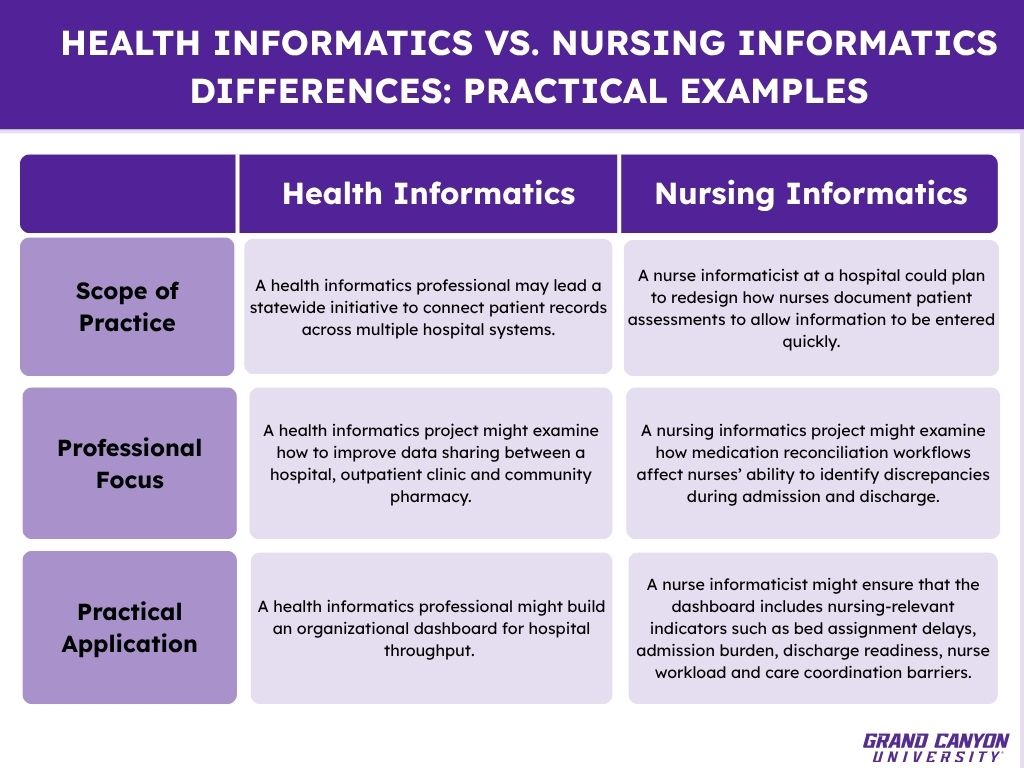
Both these fields are valuable. The difference is that nursing informatics brings the lens of nursing practice to informatics work. Health informatics and nursing informatics overlap, but they differ in scope, professional focus and practical application.
Scope
One of the most noticeable differences between health informatics and nursing informatics is the scope of practice; how and where each role applies its expertise within the healthcare system.
Health informatics takes a broad view of healthcare information systems across the entire organization or healthcare ecosystem. It may focus on data exchange, analytics, compliance, operational efficiency, population health, financial performance or system-wide digital strategy. The audience is often interdisciplinary and may include administrators, IT teams, clinicians, public health agencies and executive leaders.
Nursing informatics focuses more specifically on nursing practice and nursing-sensitive outcomes. It asks how information systems affect nurses, patients, families, workflows, documentation, care coordination, clinical judgment and professional practice. The audience includes bedside nurses, nurse leaders, nurse educators, advanced practice nurses, quality teams and interprofessional partners.
Professional Focus
Beyond scope, the two fields also differ in their professional focus; what problems they prioritize and how they approach solving them.
For example, a health informatics project might examine how to improve data sharing between a hospital, an outpatient clinic and a community pharmacy. In contrast, a nursing informatics project might examine how medication reconciliation workflows affect nurses’ ability to identify discrepancies during admission and discharge.
Practical Application
The differences become even more tangible when looking at how each field applies its work in real healthcare settings.
For example, a health informatics professional might build an organizational dashboard for hospital throughput. Meanwhile, a nurse informaticist might ensure that the dashboard includes nursing-relevant indicators such as bed assignment delays, admission burden, discharge readiness, nurse workload and care coordination barriers.
Another example could be a health informatics team implementing a new telehealth platform across a health system. A nursing informatics specialist might then evaluate how nurses triage virtual visits, educate patients, document remote assessments and escalate concerns.
Role-Based Examples of Health Informatics vs. Nursing Informatics
Understanding definitions is helpful, but seeing how these roles function in real healthcare settings can make the differences clearer. While both health informatics and nursing informatics professionals work with data and technology, their responsibilities differ across roles, settings and levels of decision-making.
At a system level, health informatics professionals often focus on building and managing the infrastructure that supports care delivery across organizations.
For example, a health informatics specialist in a hospital system may design a dashboard that tracks emergency department wait times, readmission rates, staffing patterns and patient satisfaction scores. A health informatics leader may also work with executive teams to improve data sharing across hospitals, clinics, pharmacies and community partners, helping create a more connected healthcare ecosystem.
In contrast, nursing informatics professionals focus on how those systems function in day-to-day clinical practice, especially for nurses and patients.
For example, a nurse informaticist may redesign electronic documentation templates so nurses can chart more efficiently while still capturing essential clinical information. They may also evaluate medication administration alerts to reduce alert fatigue while maintaining patient safety or support the implementation of clinical decision support tools for sepsis recognition, falls prevention, discharge planning or pressure injury prevention.
Nursing Informatics in Practice Across Nursing Roles
We can examine the differences between various nursing roles and a nurse informaticist by comparing practical examples of how they may work in their healthcare organizations.
Consider a few role-based examples:
- A bedside nurse may notice that a new electronic health record screen requires several extra clicks to document wound care. While this may appear minor, it can increase documentation time and reduce the likelihood that wound characteristics are captured consistently. A nurse informaticist can evaluate the workflow, gather feedback from staff nurses and work with the EHR team to revise the documentation process.
- A charge nurse may observe that patient acuity is not accurately reflected in staffing tools. A nursing informatics approach can help examine whether the right data elements are being captured and whether staffing dashboards are aligned with nursing workload.
- An advanced practice nurse may use clinical decision support tools to identify gaps in chronic disease management, medication reconciliation or preventive care. Nursing informatics helps make those tools more relevant to patient-centered care.
- A nurse manager may rely on unit-level dashboards to monitor falls, medication errors, pressure injuries, overtime and patient experience. A nursing informatics professional helps ensure those dashboards reflect meaningful nursing-sensitive indicators rather than disconnected metrics.
- A chief nursing officer may partner with nursing informatics leaders to evaluate how digital tools affect nurse workload, retention, quality outcomes and professional practice. At the executive level, nursing informatics becomes part of strategic leadership.
In each of these examples, the focus is not technology for its own sake. The focus is better nursing practice, safer care, stronger communication and more effective systems.
Why the Difference Matters
Understanding the difference between health informatics and nursing informatics helps clarify the unique contribution nurses bring to digital healthcare transformation. Healthcare organizations need broad informatics expertise, but they also need nursing-specific informatics leadership.
Without the nursing voice, technology can unintentionally add documentation burden, fragment communication, disrupt workflow or overlook essential elements of patient care. Nursing informatics keeps informatics work anchored in practice. It reminds healthcare leaders that every click, alert, data field, dashboard and decision-support tool has consequences for nurses, patients, families and care teams.
Which Informatics Path Is Best for You?
Choosing between health informatics and nursing informatics depends on your professional background, career goals and the kind of impact you want to have.
Health informatics may be a strong fit if you are interested in healthcare technology at a broad system level.
This path may appeal to individuals who want to work in:
It can also be a good option for professionals from varied backgrounds, including public health, business, information technology, medicine, pharmacy and healthcare leadership.
Nursing informatics may be a better fit if you are a current registered nurse who wants to improve how technology supports nursing care and clinical practice. Nurses who enjoy problem-solving, workflow improvement, education, quality improvement, systems thinking and interprofessional collaboration may find nursing informatics especially meaningful.
This path can be especially relevant for nurses who find themselves saying things like:
It can be a strong pathway for bedside nurses, nurse leaders, nurse educators, advanced practice nurses and doctoral-prepared nurses who want to influence healthcare technology in ways that protect patient safety and support professional nursing practice.
For nurse leaders, the distinction matters because informatics decisions are no longer only technical decisions. They are practice decisions. They affect staffing, documentation burden, communication, patient safety, regulatory compliance, quality outcomes and nurse well-being. Having nurses at the informatics table ensures that systems are designed with clinical reality in mind.
Choose Your Ideal Informatics Path at GCU
For nurses and healthcare professionals considering their next academic or professional step, the distinction between these two disciplines can also help guide program choice. Grand Canyon University’s MSN with an Emphasis in Health Informatics is designed for nurses who want to build expertise in healthcare data management, clinical systems, quality improvement and the use of informatics to improve patient care and healthcare systems.
GCU also offers an MS in Health Informatics, a broader health informatics pathway, which can help prepare graduates to apply informatics theories to emerging healthcare technology and delivery issues through the integration of policy, business management, nursing, medicine, information technology and information science. This pathway may be a strong fit for healthcare professionals seeking broader system-level preparation in data, technology, operations and healthcare transformation.
In either direction, informatics education teaches you how to lead thoughtful, ethical, evidence-informed changes in an increasingly digital healthcare environment.