

The Great Commission (Matthew 28:19-20) records Jesus’ final instruction to His disciples to make disciples, baptize believers and teach others to follow Him. More than a call to evangelism, it provides the foundation for Christian mission and discipleship. In this article, Dr. Shelly Hogan, a faculty member in GCU’s College of Theology, explores the meaning of the Great Commission and the role of sacred community in helping believers live out Christ’s mission.

The Great Commission took place after Jesus’ resurrection, when He appeared to His followers and prepared them for the mission ahead. In Matthew 28, Jesus met His disciples in Galilee and gave them His final instructions before His ascension. Before commanding them to make disciples, He declared, “All authority in heaven and on earth has been given to me,” (Matthew 28:18, NIV), establishing the foundation for the Great Commission. Sent under the authority of the risen Christ, the disciples were empowered to carry out His mission with the assurance of His ongoing presence.
Dr. Hogan notes that many Christians mistakenly view the Great Commission as a calling reserved for pastors, missionaries or other ministry professionals. However, she emphasizes that Jesus’ command was given to all believers. Pointing to the original language of the passage, Dr. Hogan explains that the command can be understood as “as you are going,” suggesting that disciple-making is meant to be woven into everyday life. “As you live life, be an example,” she says, encouraging believers to influence others through both their words and actions.
The Great Commission reflects God’s redemptive plan throughout Scripture, from His promise to Abraham that all nations would be blessed through him (Genesis 12:3) to Christ’s command to make disciples of all nations. As Dr. Hogan notes, a life transformed by Christ naturally influences others, making disciple-making an extension of faithful Christian living. The Great Commission is more than a closing statement; it is a command with specific instructions.
What Matthew 28:19-20 Means
The heart of the Great Commission is Jesus’ command to “go and make disciples of all nations” (Matthew 28:19, NIV). While evangelism is essential, the goal is not simply conversion but helping people become lifelong followers of Christ through discipleship and spiritual growth.
According to Dr. Hogan, this process should be a natural outgrowth of a believer’s relationship with God. Christians are called to share the gospel, teach biblical truth and demonstrate what it means to follow Christ through their daily lives. She emphasizes that disciple-making happens not only through formal ministry but also through ordinary relationships and interactions.
Christians are called not only to share the gospel but also to teach others to obey Christ’s commands. Dr. Hogan connects this calling to the Great Commandment, emphasizing that discipleship grows through loving relationships marked by encouragement, vulnerability and mutual support.
This emphasis on community reflects the biblical truth that believers grow spiritually through relationships with one another. As Dr. Hogan notes, disciple-making often takes place within “sacred community,” where Christians can be transparent, challenged and encouraged in their faith.
Finally, Jesus reassured His followers, “I am with you always, to the very end of the age,” (Matthew 28:20, NIV). His presence empowers believers to carry out this mission, providing strength, guidance and confidence as they make disciples.
The Purpose and Importance of the Great Commission
The Great Commission highlights God’s wish for everyone to hear the message of salvation through Jesus Christ. Christians are called not only to share the gospel but also to help believers develop into mature disciples who consistently follow Jesus.
Sharing the Gospel and Making Disciples
Jesus’ command to make disciples involves sharing the gospel and fostering deeper relationships with God through teaching, encouragement and spiritual growth. Believers exemplify their faith in daily interactions, inviting others to follow Christ.
Building Sacred Community
The Great Commission was never meant to be carried out alone. Dr. Hogan explains that believers grow in relationship with God and one another, developing their gifts within a community that provides encouragement, support and accountability. She describes this as a “sacred community,” where love, vulnerability and authentic relationships help believers grow in faith and fulfill Christ’s mission together.
Reflecting God’s Love Through Service
The Great Commission embodies love, obedience and service. According to Dr. Hogan, disciple-making should be rooted in the Great Commandment to love God and others. By serving and encouraging others, believers reflect Christ’s character and naturally live out the Great Commission.
Who Is Called To Fulfill the Great Commission?
Although Jesus first gave the Great Commission to His disciples, the call to make disciples extends to all believers. Dr. Hogan emphasizes that disciple-making is not reserved for pastors or missionaries but is a responsibility shared by every Christian. While believers may fulfill this mission in different ways, according to their unique gifts and opportunities, all are called to reflect Christ’s love and encourage others in their faith.
How the Early Church Carried Out the Great Commission
After Jesus’ ascension, the early church carried out the Great Commission by preaching the gospel, making disciples and growing through the power of the Holy Spirit. However, believers understood that disciple-making involved more than sharing a message. They devoted themselves to teaching, fellowship, prayer and community as they grew in their faith together.
According to Dr. Hogan, disciple-making is most effective within relationships, as God designed believers to grow alongside one another rather than in isolation. She describes this relational approach as a “sacred community,” where Christians encourage one another, practice accountability, study Scripture and support spiritual growth. Dr. Hogan notes that qualities such as love, patience, forgiveness and service are best developed and demonstrated in community.
As believers lived out their faith together, the gospel spread beyond Jerusalem through the ministry of the apostles and local churches. Their example shows how the Great Commission advances through discipleship, community and a shared commitment to Christ’s mission.
What the Great Commission Means for Christians Today
The Great Commission remains relevant today, calling Christians to share the gospel, make disciples and reflect Christ’s love in their daily lives. As Dr. Shelly Hogan explains, believers can fulfill this mission through both modern tools and meaningful relationships, staying rooted in the same principles that guided the early church.
A Global Mission in a Connected World
Modern technology enables the global sharing of biblical truth, much like the Roman road system did in the first century. Dr. Hogan notes that social media platforms can connect people to biblical teaching and Christian community regardless of geographical limits.
Dr. Hogan advises Christians to use technology thoughtfully, highlighting that it should support, not replace, deeper relationships essential for spiritual growth and accountability.
The Continuing Need for Sacred Community
Healthy Christian communities provide encouragement, accountability and opportunities for spiritual growth. They also help believers discern truth in a world filled with competing voices and messages.
While online connections can be valuable, Dr. Hogan notes that lasting transformation often develops through face-to-face relationships. As believers worship, learn and serve together, they model the type of disciple-making community seen throughout the New Testament. Today, Christians can fulfill the Great Commission by sharing the gospel with humility, compassion and respect across diverse cultures.
Challenges To Following the Great Commission Today
While the Great Commission remains central to Christian life, many believers face practical obstacles that make disciple-making more difficult. According to Dr. Hogan, one of the greatest challenges is not necessarily opposition to the gospel but the pace of modern life itself.
Busyness and a Lack of Margin
Dr. Hogan observes that many people have filled their schedules with work, activities and constant digital engagement, leaving little room for meaningful relationships. "I think one of the main challenges is busyness, that we don't have margin."
She notes that previous generations often spent time with neighbors, shared meals and gathered informally, while many people today are pulled in countless directions. As a result, opportunities for connection, discipleship and presence can be crowded out by packed schedules and digital distractions.
The Challenge of Being Fully Present
The Great Commission is ultimately relational. Making disciples requires investing time and attention in other people, yet Dr. Hogan believes many Christians struggle to be fully present.
"We don't take those moments to be and to be with one another." She explains that meaningful discipleship happens when people are genuinely present with one another, listening, encouraging and sharing life together. While technology offers many benefits, it can also create barriers when it replaces rather than supports authentic human connection.
Navigating a Digital World
Modern communication tools can help spread the gospel but also require discernment, making it important for believers to remain grounded in biblical truth and community. Dr. Hogan emphasizes that authentic Christian community provides an important safeguard, helping believers learn, grow and discern truth together.
The Need for Sacred Community
For Dr. Hogan, the antidote to many of these challenges is intentionally creating space for relationship and community. "There's no substitute for presence," she says.
She encourages believers to take small but meaningful steps, such as calling someone instead of sending a text, sharing a meal or prioritizing time with fellow Christians. These simple acts create opportunities for discipleship and connection.
Sacred community remains essential because disciples are rarely formed in isolation. Through shared experiences, accountability and encouragement, believers help one another grow in faith and continue Christ's mission together. As Dr. Hogan explains, online interactions can be valuable, but lasting transformation often comes from walking alongside people in everyday life and witnessing faith lived out firsthand.
Practical Ways To Live Out the Great Commission
Every believer can engage in Christ’s mission through daily acts of faith, service and discipleship. Dr. Hogan highlights that understanding God’s love is essential for shaping our relationships with others as we live out this mission. “Be rooted and grounded in that love and accept that you’re loved without excuse and without rationalization,” Dr. Hogan says.
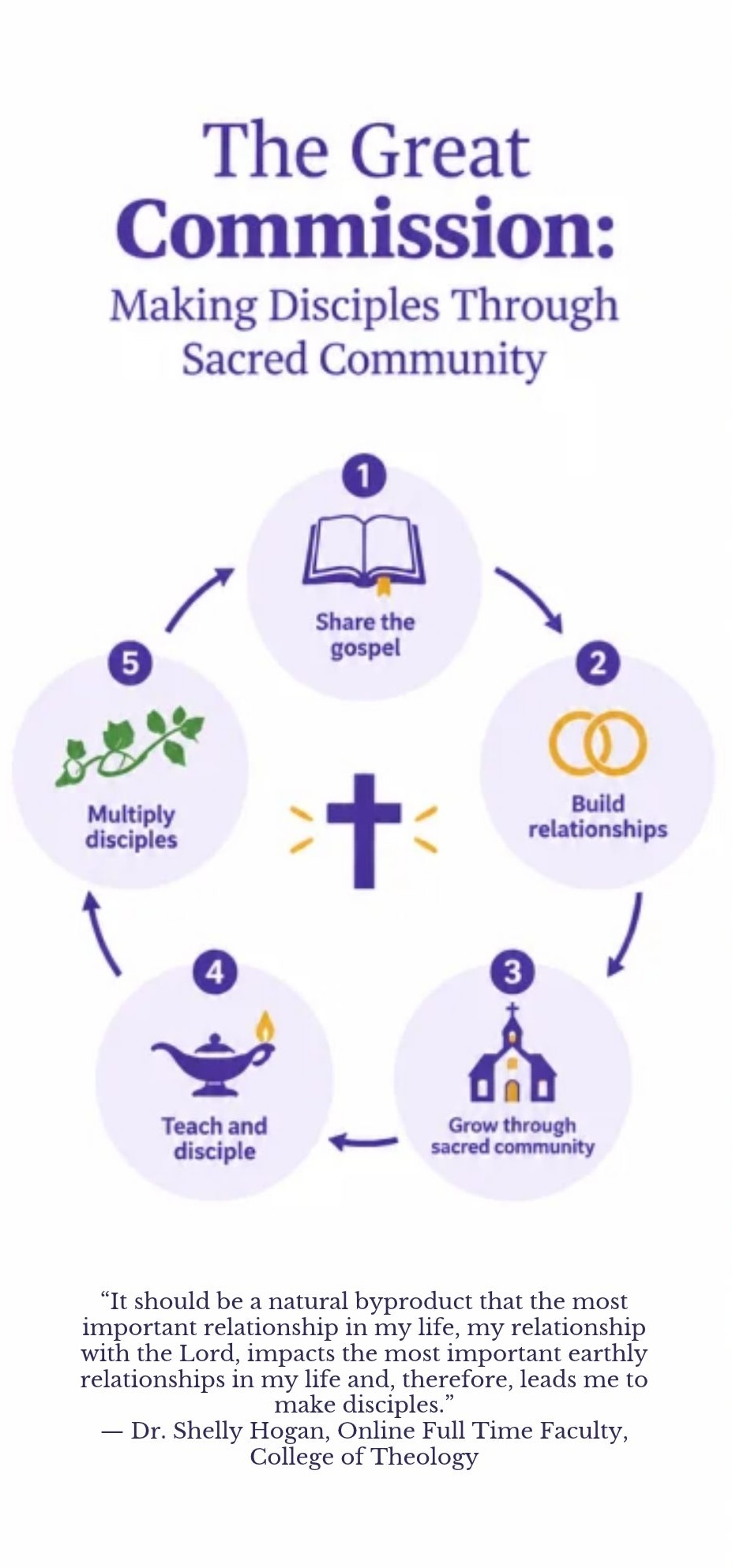
Here are several practical ways believers can live out the Great Commission:
Living Out the Great Commission Through Faith and Community
The Great Commission calls believers to make disciples through evangelism, discipleship and Christ-centered community. As Dr. Shelly Hogan explains, sacred community provides encouragement, accountability and support for spiritual growth. Through everyday interactions, service and local church involvement, Christians can participate in Christ’s mission. Those interested in exploring discipleship, ministry and biblical leadership may consider GCU’s Christian Studies and Global Ministry programs.
Live Out Christ’s Calling
Explore GCU programs that help equip you for discipleship, ministry and biblical leadership.