

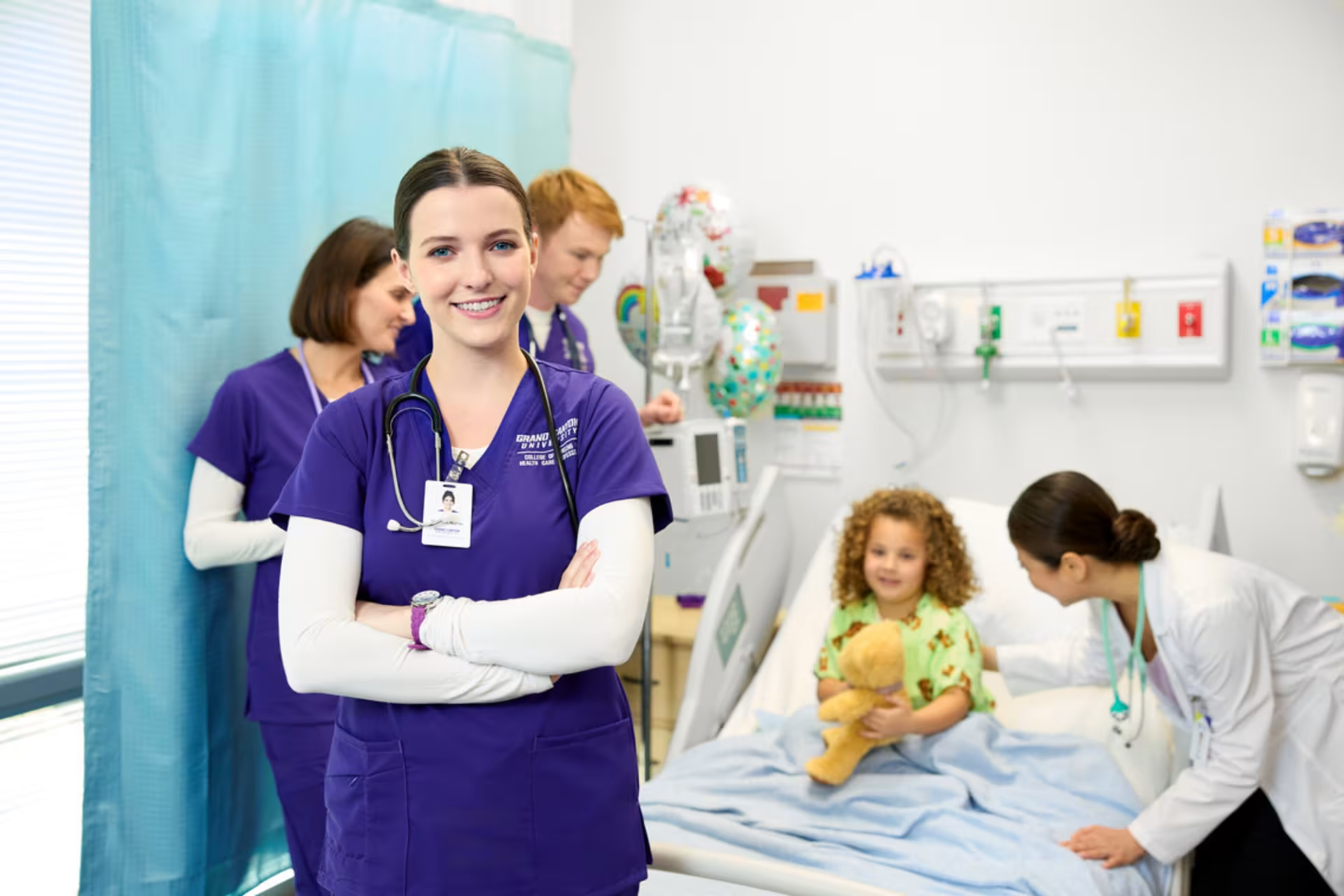
GCU’s Accelerated Nursing Program in Utah
Complete Your ABSN Program in Utah
GCU’s accelerated Bachelor of Science in Nursing (ABSN) program is an undergraduate nursing pathway designed for transfer students and career changers. The accelerated nursing program in Utah combines online(See disclaimer 1) coursework with in-person learning components for hands-on experience. Students who complete the program earn a Bachelor of Science in Nursing (BSN) and are prepared to seek licensure as registered nurses (RNs).
You can earn a BSN in as few as 16 months(See disclaimer 2) and be ready to pursue RN licensure. The curriculum develops nursing knowledge and skills across the continuum of care, including patient assessment, nursing diagnosis, care planning and implementation. You will also be taught professional ethics and decision-making as they prepare to provide nursing care and pursue RN licensure.
Where Can You Enroll in an ABSN in Utah?
Our nursing school in Utah is located in Sandy, approximately 20 minutes from Salt Lake City. Our ABSN location is conveniently close to I-15 and State Street.
150 Civic Center Drive
Suite 501
Sandy, UT 84070
View our Postsecondary State Authorizations and SARA and State Disclosures information for Utah.

What Should You Expect From an Accelerated BSN Program in Utah?
How the ABSN Program Works
The accelerated BSN program in Utah uses a hybrid learning format that combines online¹ coursework, in-person nursing skills labs and immersive simulation experiences and clinical rotations. Online courses build foundational nursing knowledge in areas such as pharmacology and pathophysiology.
You will also attend the ABSN learning site near Salt Lake City for nursing skills labs and immersive simulations, where you can apply nursing concepts and practice clinical skills in a hands-on learning environment. During clinical rotations, you are placed in nearby healthcare facilities, where you can gain experience providing patient care under supervision.

Cost of Attendance
Prospective ABSN students should speak with a university counselor to discuss the cost of attendance, which includes tuition and program fees. Financial aid may be available to those who qualify. Our university has established institutional scholarships to help make higher education more accessible.
What Is the Admission Process for GCU’s Utah ABSN Program?
Contact one of our university counselors to discuss your eligibility and receive personalized guidance on navigating the admission process. Admission requirements for the ABSN program can vary by state. A university counselor can help ensure you fulfill all the state-specific requirements, such as prerequisite coursework.

Accredited Program
The immersive simulation center for our accelerated BSN track has received accreditation in the area of teaching/education from the Society for Simulation in Healthcare (SSH), which indicates a high level of expertise in nursing simulation education.
GCU has been institutionally accredited by the Higher Learning Commission since 1968. The College of Nursing and Health Care Professions shares the university’s commitment to upholding the principles and standards established by our accrediting bodies. For more information on the accreditation of nursing programs and other university licensures, please visit our Nursing Accreditation and Regulations page.
Connect With an ABSN Counselor in Utah
With multiple nursing pathways available, GCU’s accelerated Bachelor of Science in Nursing (ABSN) program is designed for individuals with a non-nursing degree, transfer credits or no prior coursework. Reach out to one of our university counselors for personalized assistance with the admission process.
Number of start dates offered each year
Our specialized university counselors help make the admission process as seamless as possible. Working exclusively with prospective ABSN students, these counselors know the nuances of the program and provide personalized support throughout the admission process.
If you’re looking to gain admission into the ABSN program, follow these steps.
Talk to a university counselor
Connect with a university counselor to review your academic background, discuss your goals and determine your eligibility for the ABSN program.
Complete prerequisite courses and pre-admission interview
Complete any required prerequisite coursework and participate in a pre-admission interview to assess your readiness and fit for the program.
Apply to the ABSN program
Submit your application to the ABSN program and work with your university counselor to finalize your pre-enrollment plan, outlining your path to start the program.
Frequently Asked Questions About Utah ABSN Programs
Read the following frequently asked questions and answers to learn more about earning your nursing degree through our accelerated nursing program in Utah.
How do you become an RN in Utah?
Can I get an accelerated BSN in Utah if my degree is in another field?
Can I take the NCLEX-RN in Utah after completing an ABSN program?

Explore GCU’s accelerated BSN pathway in Utah and prepare to pursue a career as a registered nurse. Connect with a university counselor to learn more about eligibility, admissions and your next steps.
Clinical, practicum and immersion hours completed locally.
- Secondary Applicants must transfer a minimum of 60 of the required 123 credits or have completed a baccalaureate degree which includes nine prerequisite courses/labs and 10 general education courses prior to starting the core nursing courses, which can be completed in as few as 16 months. Direct Entry Applicants that do not transfer 60 credits but meet the minimum requirements can complete these credits through GCU prior to starting the core nursing courses. Depending on the state where student has enrolled or intends to complete the program, student may require additional courses. This may include, but is not limited to, additional general education courses, courses in the major, clinical courses, or a different course sequence. See the University Policy Handbook.
- U.S. Bureau of Labor Statistics. (2026, Aug. 27). How To Become a Registered Nurse. Occupational Outlook Handbook. Retrieved September 2026.
- Department of Commerce Division of Professional Licensing. (n.d.). Nursing. Retrieved September 2026.
Approved and verified accurate by the Associate Dean of the College of Nursing and Health Care Professions on Oct. 21, 2026.