


Bachelor's in Biomedical Engineering Degree
Advance Human Health and Make an Impact on the Healthcare Field
Biomedical engineering is a broad, interdisciplinary field that merges the studies of biology, medicine and engineering.(See disclaimer 1) It’s a career path that is well-suited to curious students who want to advance human health and improve the lives of others. The Bachelor of Science (BS) in Biomedical Engineering degree at Grand Canyon University is designed to equip future biomedical engineers who seek to make positive, meaningful contributions to the healthcare field.

Campus: $8,250 per semester [More Info]
Up to 90 credits, only 84 can be lower division
Credits: Fill out the Lopes Eval to find out what will transfer
Admission Requirements (Bachelor's)
- 16+ years old
- High School Graduate
- 2.8+ Unweighted GPA
OR 2.5+ Unweighted GPA and
- ACT: 19
- SAT: 1000*
Admission requirements may differ based on degree level, program and modality, or transfer status. Some programs of study may require a higher GPA and/or other qualifying criteria for admission. Please review full admission and program requirements in the University Policy Handbook.
*Math and reading only on a 1600 point scale (test date after 3/1/2016). SAT score of 1380 required for 2400 point scale (test date before 3/1/2016).
Your Path to a Bachelor of Science in Biomedical Engineering Starts at GCU
Biomedical engineering instructors aim to help prepare you with a strong foundation of practical skills applicable to your future careers. GCU promotes STEM career paths by offering you numerous high-tech resources, including numerous labs such as the biomaterials lab, the bioinstrumentation lab and the medical imaging lab. You’ll be able to access these STEM resources on your first day as a freshman, enabling you to put what you’ve been taught into practice.
In GCU’s degree programs, there is an emphasis on ethical decision-making and servant leadership. You are encouraged to explore topics through the lens of the Christian perspective.
Attend Biomedical Engineering Courses on Campus
This BS in Biomedical Engineering program is available through on-campus classes. As an on-campus student, you’ll participate in academic discussions with your peers and instructors. In-person learning can offer the advantage of direct interaction, allowing you to engage more effectively with instructors, peers and the course material. Further, GCU is proud to maintain enriching campus life, with many amenities, resources and activities available to our students.
Skills Taught in the BS in Biomedical Engineering Program

Combine your passion for engineering innovations with an enduring commitment to make a positive contribution to the world. You will have opportunities to work collaboratively with your peers as part of a team working toward a shared objective.
The STEM curriculum is enriched with coursework intended to teach the following topics and skills:
Biomechanics
Physiology and anatomy
Biomaterials
Biomedical design
Communication skills
Project management
Creativity
Analytical reasoning
Ethical problem-solving skills
Biomedical instrumentation and devices
Medical imaging
Biomedical Engineering Courses and Competencies to Expect
This biomedical engineering major is offered by the College of Engineering and Technology. In biomedical engineering courses, you will be taught ways to improve patient care by examining the principles of biomedical research and the design, development and manufacture of diagnostic and therapeutic devices. You’ll be expected to develop an understanding of related disciplines, including computer programming, physics and chemistry, while taking a deep dive into biomedical engineering essentials.
Biomedical Engineering Capstone
In addition to lectures and labs, you will complete a two-semesters-long capstone course series. You will work in teams to develop a researched project proposal that addresses a problem that may be solvable through biomedical engineering applications. The work you complete in your first semester is carried through to the second, in which you will have the opportunity to implement your design and present your applied research project prototype.
BS in Biomedical Engineering Curriculum
This biomedical engineering degree at GCU blends instructional coursework with hands-on learning experiences.
This biomedical engineering degree program features a curriculum that covers a broad range of content areas, including:
The function of human cells, tissues and systems, and the functions between systems of the body
How biocompatible materials can be used to replace or come in contact with living systems
How to draft regulatory-compliant documents pertaining to biomaterials
In-depth curriculum on medical imaging techniques and technologies
The design process of a medical device considering FDA regulation and medical product liability
Career Paths for Biomedical Engineering Degree Graduates
Prepare to pursue a career in biomedical engineering by exploring solutions to medical problems.
Some of the career paths that may be related to this biomedical engineering major can include:
Engineering managers
Bioengineers and biomedical engineers
Engineering teachers (postsecondary)
Median annual salary of bioengineers and biomedical engineers as of May 2022(See disclaimer 2)
Biomedical Engineering Industries
Biomedical engineers play a pivotal role in shaping the future of healthcare, making them essential across a spectrum of industries.
Biomedical engineers may be sought after in diverse industries, including:(See disclaimer 3)
GCU Offers ABET-Accredited Engineering Programs
The BS in Biomedical Engineering is accredited by the Engineering Accreditation Commission of ABET, www.abet.org, under the commission’s General Criteria and Program Criteria for Biomedical Engineering.
GCU has held continuous institutional accreditation by the Higher Learning Commission since 1968. The College of Engineering and Technology shares the university’s commitment to upholding the principles and standards established by our accrediting bodies.

Bachelor’s in Biomedical Engineering Degree FAQs
Biomedical engineering can be a complex field, and you may have some questions about the profession and the degree program. These frequently asked questions and answers may help guide you as you plan your intended career path.
How many years does it take to become a biomedical engineer?
Do biomedical engineers get paid well?
Is a bachelor's in biomedical engineering degree worth it?
Is biomedical engineering a good career?
Program Curriculum
General Education Requirements
Required General Education Courses
Core Courses

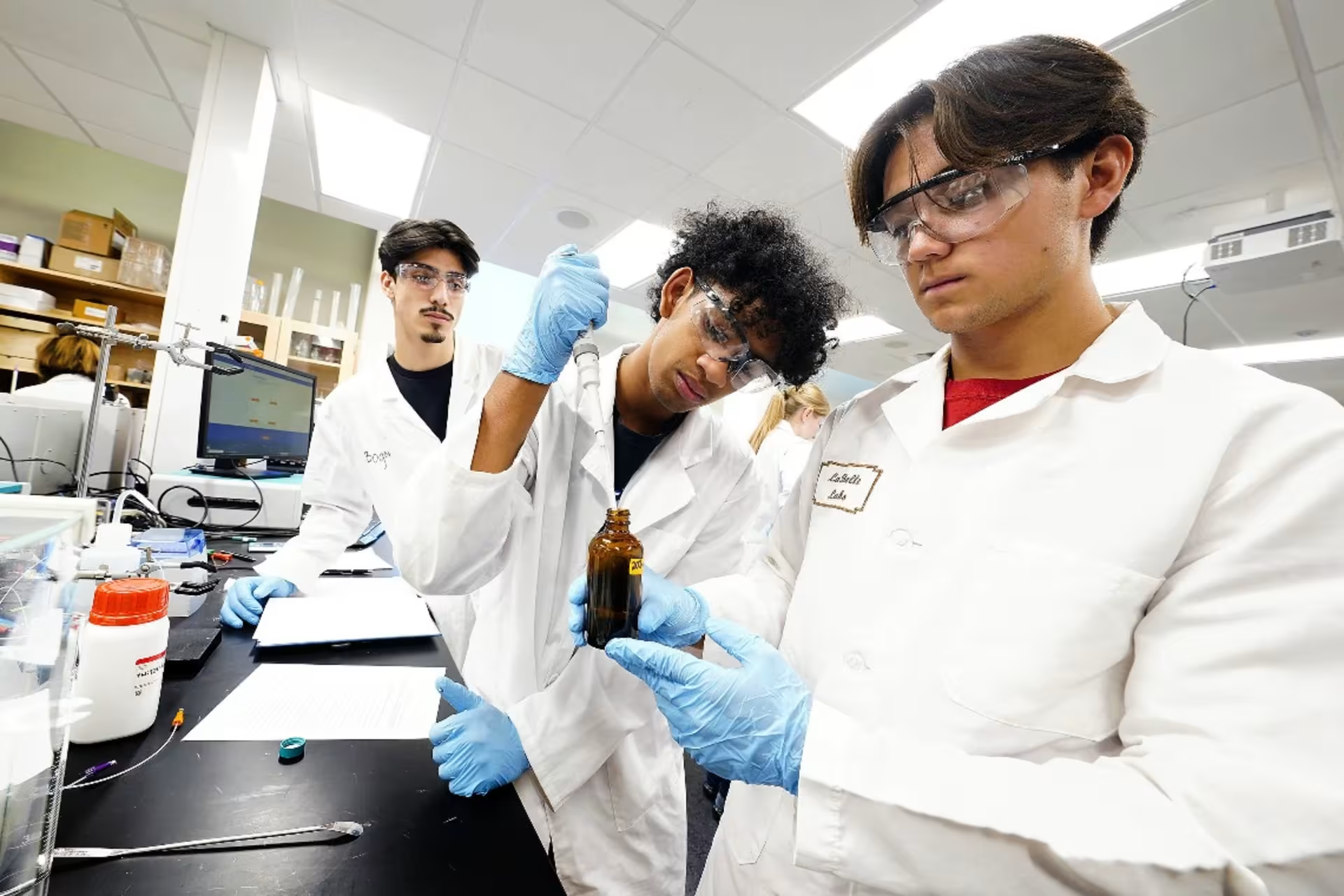
Explore ways of making positive contributions to medical advances. Earn your BS in Biomedical Engineering at GCU. Take the first step toward your future by filling out the form on this page to learn more about GCU’s biomedical engineering major.
- Coursera. (2023, June 16). What is Biomedical Engineering? Retrieved on Oct. 16, 2023.
- The earnings referenced were reported by the U.S. Bureau of Labor Statistics, Bioengineers and Biomedical Engineers as of May 2022, retrieved on Oct. 19, 2023. Due to COVID-19, data from 2020 may be atypical compared to prior years. The pandemic may also impact the predicted future workforce outcomes indicated by the BLS. BLS calculates the median using salaries of workers from across the country with varying levels of education and experience and does not reflect the earnings of GCU graduates as bioengineers and biomedical engineers. It does not reflect earnings of workers in one city or region of the country. It also does not reflect a typical entry-level salary. Median income is the statistical midpoint for the range of salaries in a specific occupation. It represents what you would earn if you were paid more money than half the workers in an occupation, and less than half the workers in an occupation. It may give you a basis to estimate what you might earn at some point if you enter this career. You may also wish to compare median salaries if you are considering more than one career path. Grand Canyon University can make no guarantees on individual graduates’ salaries as the employer the graduate chooses to apply to, and accept employment from, determines salary not only based on education, but also individual characteristics and skills and fit to that organization (among other categories) against a pool of candidates.
- Indeed Editorial Team. (2022, June 24). 7 Types of Companies That Hire Biomedical Engineers. Indeed. Retrieved on Oct. 16, 2023.
- Indeed Editorial Team. (2023, March 10). 12 Pros and Cons of Being a Biomedical Engineer (and What They Do). Indeed. Retrieved on Oct. 16, 2023.