


Change is a regular part of doing business. Organizations adopt new technologies, adjust strategies, restructure teams and respond to changing customer and workforce expectations. Yet identifying what needs to change is only part of the challenge. Business leaders must also help employees understand and adapt to a new way of working.
Change management provides a structured approach to this transition. For aspiring managers and business students, understanding how to manage change can help build leadership skills that apply across industries and organizational settings.
Why Change Management Matters in Business
Even a strong business strategy can fall short if the people responsible for carrying it out are not prepared to change. Effective organizational change management considers the human side of a transition alongside operational goals.
Dr. Raquel City-Carroll, Instructor with the Colangelo College of Business, explains, “Organizations may have a well-designed strategy, excellent technology, or a strong business case for change, but if employees do not understand the reason for the change or how it will affect them, the initiative can quickly encounter resistance.”
Clear communication can help employees understand what is changing, why it is necessary and what it means for their roles. Involving employees can also give leaders insight into potential problems while helping employees feel that their perspectives are valued.
"Effective change management is about helping people successfully transition from the current state to the desired future state."
Types of Change Management in Organizations
Organizational changes vary in scale and purpose. Dr. City-Carroll identifies several common types that business leaders may encounter:
Leadership strategies may differ depending on the organization, industry, culture and type of change. However, Dr. City-Carroll emphasizes that the fundamentals typically remain consistent: “Communication, Trust, Employee Involvement, Consistency, Transparency and Accountability.”
The Change Management Process
The change management process can vary among organizations and models, but leaders can approach change as an ongoing process rather than a single event. A general process may include:
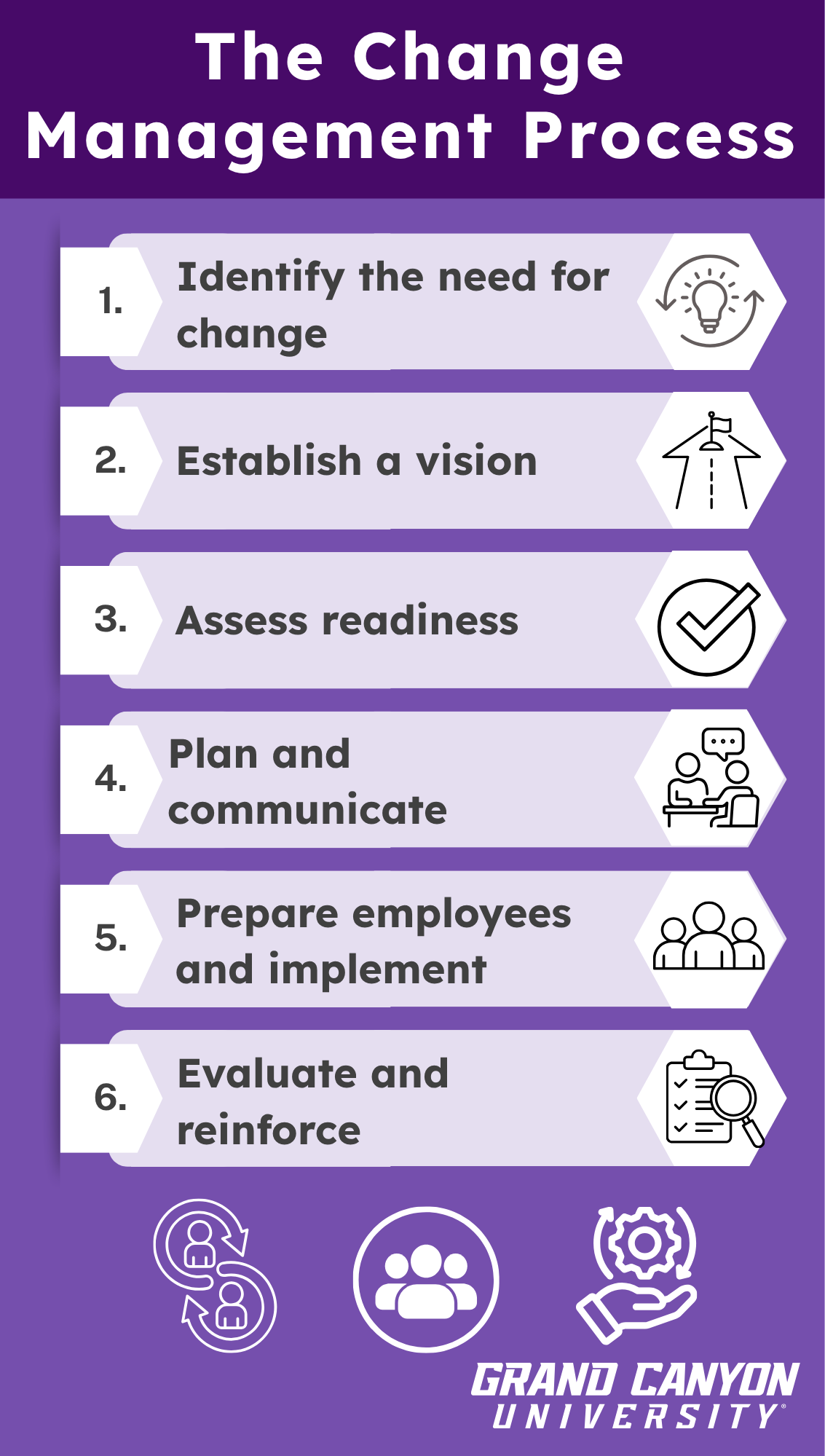
- Identify the need for change. Determine the problem or opportunity and consider what could happen if the organization maintains the status quo.
- Establish a vision. Define what the organization hopes to accomplish and what successful change could look like.
- Assess readiness. Evaluate whether employees and the organization have the skills, resources and support needed to make the transition.
- Plan and communicate. Identify affected stakeholders, resource requirements and how information will be shared.
- Prepare employees and implement. Provide appropriate training, coaching, feedback and opportunities for participation.
Evaluate and reinforce. Determine whether the change is producing the intended results and reinforce practices needed to sustain it.
Organizations may underestimate the preparation stage. According to Dr. City-Carroll, “Organizations often spend a tremendous amount of time identifying changes to be made and developing solutions, and not enough time preparing the organization and people to implement the changes.”
Key Principles of Effective Change Management
Successful change management starts with recognizing that employees are active participants in organizational change. Key principles include communication, trust, transparency, involvement, consistency and accountability.
Leaders also need to demonstrate the behaviors they expect from others. Employees may be less likely to adopt a change when leadership communicates one expectation but behaves differently.
“Employees tend [to] focus on what leaders do, not just what they say,” City-Carroll says. “If the change is not modeled by or supported by leadership (at all levels) the change will be difficult to sustain.”
Common Change Management Strategies
There is no single strategy for managing every organizational change. Leaders may combine several approaches based on the situation, including:
These strategies can help leaders move beyond simply announcing a change toward actively helping employees adopt it.
Change Management Examples in Business
Change management examples can be found across nearly every business function.
These examples illustrate why leaders should consider both the technical requirements of a change and the employees responsible for putting it into practice.
Change Management Challenges
Resistance, uncertainty, inconsistent communication and limited resources can complicate organizational change. Yet resistance itself can provide useful information.
“Resistance to the change should not automatically be viewed as something negative,” City-Carroll explains. “Sometimes employees resist because they see a legitimate problem that leadership has overlooked.”
Instead of immediately dismissing resistance, managers can listen for underlying concerns and determine whether employee feedback reveals a weakness in the plan. This requires leaders to remain adaptable as the change progresses.
How Managers Can Support Successful Change
Managers can play an important role in translating organizational goals into employees’ day-to-day experiences. Emotional intelligence can be particularly useful when employees are dealing with frustration, anxiety or uncertainty.
Leaders also benefit from communication, coaching, conflict management, adaptability and problem-solving skills. They do not necessarily need to have an immediate answer to every question. Instead, they can communicate what they know, acknowledge what remains uncertain and continue providing direction.
"Employees do not necessarily need a leader who has every answer. They need a leader who can provide direction, communicate honestly, listen, remain composed, and help people navigate uncertainty."
Change Management Best Practices
Aspiring leaders can begin preparing to manage change before they hold formal management positions. Classroom projects, internships, student organizations, volunteer activities and part-time jobs can provide opportunities to practice communication, collaboration, decision-making and problem-solving.
Continued learning is also important as businesses respond to developments in AI, technology, globalization, workforce expectations and economic conditions. Future managers may need to continually learn while helping their teams do the same.
Above all, change management should remain focused on both organizational objectives and the people responsible for achieving them.
"Change is inevitable, but how we lead through change makes all the difference. Change should not be viewed simply as a management problem, it is a leadership responsibility."
Prepare To Lead Through Business Change
Developing the ability to communicate, solve problems and lead through change can help prepare aspiring business professionals for management responsibilities. Explore GCU’s business degree programs to build your knowledge of business, leadership and management while learning from experienced faculty.
Prepare To Manage Change
Learn business and leadership principles that can help teams adapt and succeed through change.


