

If you're considering a leadership career in business, you may have come across two roles that often sound similar: project manager and operations manager. While both positions require strong communication, organization and leadership skills, they focus on different aspects of organizational success.
Both roles help organizations achieve goals, but they do so in different ways. Understanding project manager vs. operations manager differences can help you determine which career path aligns with your interests, strengths and professional goals.
We spoke with Ed Ramirez, business instructor at Grand Canyon University, to learn more about project manager vs. operations manager roles and how to choose the right path for your career.

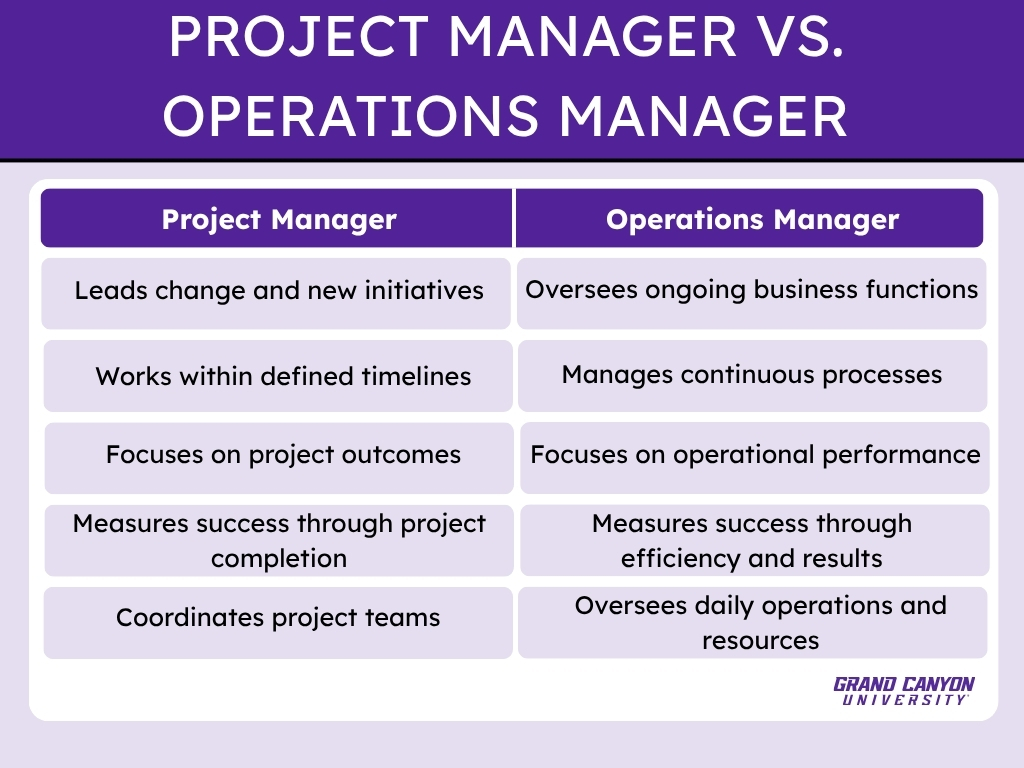
According to Ramirez, the simplest way to understand the distinction is this: "Project management is about making changes, while operations management is about running day-to-day activities and keeping business on track."
What Is a Project Manager?
A project manager leads temporary initiatives designed to achieve a specific objective. According to Ramirez, "Project managers lead temporary efforts with a clear start and finish. For example, launching a new product, implementing software or building a facility. Once the goal is achieved, the project ends."
Project managers are responsible for planning, coordinating resources, managing budgets and timelines, and guiding teams toward a defined outcome. Because projects often involve change, project managers must be comfortable navigating uncertainty, collaborating with multiple teams and adapting when challenges arise.
Ramirez notes that people who enjoy project management "often like change, variety and solving new problems. They are comfortable with uncertainty, enjoy working with different teams and stay focused on reaching a specific goal."
What Is an Operations Manager?
While project managers focus on temporary initiatives, operations managers oversee the ongoing activities that keep an organization functioning effectively.
As Ramirez explains, "Operations managers handle the day-to-day activities that keep the business running."
Their work focuses on maintaining processes, supporting employees, improving efficiency and ensuring business objectives are consistently met. Rather than working toward a defined end date, operations managers continuously evaluate performance and identify opportunities for improvement.
According to Ramirez, people who enjoy operations management "usually prefer improving existing processes and keeping things running smoothly. They tend to be detail oriented, organized and focused on efficiency and long-term performance."
Project Manager vs. Operations Manager: Key Differences
Many people confuse project management and operations management because both involve leadership, planning and collaboration. However, the roles serve different purposes within an organization.
A helpful example is the launch of a new mobile app. During development and implementation, a project manager would oversee planning, schedules, budgets and stakeholder communication. Once the app launches, the project concludes and the operations team takes over to ensure the app continues to work effectively for customers and employees.
As Ramirez summarizes, "In simple terms, project managers drive change, while operations managers maintain and improve ongoing performance."
Project Manager vs. Operations Manager Salary Comparison
Both career paths can offer competitive earning potential, though salary varies based on industry, location, experience and organizational size.
According to the U.S. Bureau of Labor Statistics (BLS), project management specialists earned a median annual wage of $100,750 as of May 2024.(See disclaimer 1) General and operations managers earned a median annual wage of $102,950 as of May 2024.(See disclaimer 2)
Skills Required for Operations vs. Project Manager
Project managers and operations managers share many foundational skills. Both require leadership, communication, problem-solving and the ability to work effectively with diverse stakeholders.
However, Ramirez believes the two roles often attract different mindsets. He offers a useful framework: "Project managers ask, 'What should we change or build?' while operations managers ask, 'How can we make this work better every day?'"
Project managers are often drawn to innovation, change and solving unfamiliar problems. Operations managers are more likely to focus on consistency, optimization and long-term performance.
At the same time, Ramirez points out that "the best professionals often have skills from both areas." He explains that many project managers benefit from strong operational knowledge, while many operations managers lead projects designed to improve business performance.
"As organizations continue to evolve, the line between the two roles often overlaps," Ramirez explains.
Career Path: Project Manager vs. Operations Manager
Both career paths often begin with a bachelor's degree in business or a related field, although professionals enter these areas from a variety of educational and professional backgrounds.
Professionals interested in project management careers often build experience by coordinating projects, collaborating across teams and developing skills in planning, budgeting, scheduling and stakeholder communication. As they gain experience, they may take on larger, more complex initiatives with greater strategic responsibility.
Those pursuing operations-focused careers typically develop expertise in business processes, resource management and organizational performance. Over time, they may assume broader responsibilities for improving efficiency, overseeing business functions and contributing to long-term organizational strategy.
One advantage of both career paths is their flexibility. According to Ramirez, career progression is rarely linear, and professionals often move between project-focused and operations-focused responsibilities as they expand their experience and leadership skills.
Certifications and Education
According to DegreeCalc, many employers prefer candidates who combine formal education with practical experience.(See disclaimer 3)
For professionals pursuing project management careers, certifications can help demonstrate expertise and commitment to the field. Ramirez notes that certifications such as the Project Management Professional® (PMP) credential are respected across many industries.(See disclaimer 4)
For individuals who are earlier in their careers, he recommends considering the Certified Associate in Project Management® (CAPM) credential. "The PMI-CAPM® is a great place to start since it covers the basics and doesn't require prior project experience,"(See disclaimer 5) he says.
Ramirez also emphasizes that credentials are most valuable when paired with practical application. "The best time to pursue a certification is when you have enough real-world experience to connect the concepts to situations you have faced."
He adds that “certifications can strengthen your knowledge, build confidence, and may help when applying for promotions, changing careers or exploring new opportunities. Employers typically look for a mix of practical results and recognized credentials."
Which Career Is Right for You?
Choosing between project management and operations management often comes down to the type of work you find most rewarding.
If you enjoy leading initiatives, managing change and pursuing clearly defined goals, project management may be a strong fit. If you prefer improving systems, increasing efficiency and supporting ongoing organizational performance, operations management may be more appealing.
Ramirez encourages professionals to think about where they naturally focus their attention. Project managers often concentrate on what an organization should build or change, while operations managers focus on how existing systems can perform better.
Understanding which approach aligns more closely with your interests can help guide your decision.
Pros and Cons of Each Role
Project management offers variety, exposure to different business functions and opportunities to lead change. However, it can also involve tight deadlines, shifting priorities and pressure to deliver results within specific constraints.
Operations management provides opportunities to make an impact on organizational performance and improve business processes over time. At the same time, operations leaders often carry responsibility for ongoing performance, efficiency and daily business outcomes.
Can You Switch Between Project Manager and Operations Manager?
Yes, you can switch between operations and project manager roles. "The skills developed in project management and operations management are highly transferable because the two roles overlap in many areas," Ramirez explains. "Both require leadership, communication, problem-solving, planning and the ability to work with different stakeholders."
Operations professionals often develop deep knowledge of business processes, customer needs and organizational workflows, which can be valuable when leading projects. Likewise, project managers gain experience in planning, budgeting, risk management and organizational change that can translate effectively into operations leadership roles.
According to Ramirez, "It’s common for professionals to move between the two roles during their careers because they complement each other. People who understand both how a business operates and how to drive change are often especially valuable to organizations."
For professionals early in their careers, he offers reassurance that either path can create future opportunities. "Whether you start in project management or operations, the experience you gain can create opportunities and support long term career growth."
Frequently Asked Questions About Project Manager vs. Operations Manager Careers
Choosing between project management and operations management often raises questions about responsibilities, career growth, salary potential and professional development. These frequently asked questions provide additional insights to help you better understand how the two career paths compare.
Is PMP useful for operations managers?
A PMP® certification may be beneficial for operations managers who frequently lead projects, manage change initiatives or collaborate with project teams.
“Certifications like PMI-PMP® can be valuable because they show you understand project management and are serious about the profession. In some organizations and industries, a PMP® is respected and may even be required for certain positions.(See disclaimer 4 )
Here at GCU, we offer a workshop designed to help students prepare for and apply for the CAPM® certification exam,” explains Ramirez.
Do project managers and operations managers work together?
Operations and project managers often work together. Project managers frequently partner with operations managers when implementing new systems, processes or organizational initiatives. Once a project is completed, operations teams often assume responsibility for maintaining and improving the resulting solution.
Develop Your Leadership Potential at GCU
If you're interested in managing projects, leading teams and helping organizations achieve strategic goals, GCU offers graduate programs that teach relevant leadership and business skills.
The Master of Business Administration (MBA) with an Emphasis in Project Management explores project planning, budgeting, scheduling and risk management alongside core business concepts. Students interested in leading people and driving organizational success may also consider the Master of Science in Leadership, which emphasizes ethical leadership, communication and organizational effectiveness through a Christian worldview.
Professionals looking to strengthen their project management knowledge without pursuing a full graduate degree may also be interested in the Graduate Certificate of Completion in Project Management, which provides focused coursework in project planning, execution and organizational strategy.
Explore GCU's business programs to find an academic path aligned with your professional interests.
Explore Project Management Degrees
Discover GCU's graduate programs in project management and leadership to build skills for supporting organizational success.


