
What happens to evidence after it’s collected at a crime scene, and how can anyone be sure it hasn’t been altered along the way? This is where the chain of custody becomes critical. In criminal justice, even the smallest mistake in handling evidence can impact a case’s outcome, potentially determining whether justice is served or compromised. Understanding why this process matters is the first step to appreciating its role in protecting the integrity of investigations.
In this blog post, we’ll draw on insights from Dr. Cornel Stemley, a GCU justice studies instructor and an experienced law enforcement professional, researcher and educator, to better understand how chain of custody works in the real world of criminal justice. We will explore both chain-of-custody evidence and the chain of custody for digital evidence to demonstrate how the concept applies across modern investigations.
Understanding Chain of Custody
Before diving into definitions and applications, it’s important to recognize that chain of custody is more than just paperwork; it’s a structured system that underpins the credibility of the entire investigative process.(See disclaimer 1) By establishing a clear and traceable path for evidence, it ensures accountability at every stage and builds trust in how evidence is managed and presented.
What Is Chain of Custody?
 In criminal justice, chain of custody refers to the formal, documented process that tracks evidence from the moment it is collected through every stage of handling, transfer, analysis and storage.(See disclaimer 1) More specifically, it is the unbroken trail that shows who collected the evidence, who handled it, where it was stored, how it was tested and when it changed hands. As Dr. Stemley puts it, “chain of custody is the documentation of who has had contact with or controlled the evidence,” with each interaction tied to a defined role in the investigative process. Each step must be carefully recorded to create a clear and verifiable history.
This documentation is not just procedural; it is essential to maintaining the integrity of the evidence. Dr. Stemley emphasizes that the goal is preserving “integrity in the evidence, in terms of its originality,” ensuring that it remains unchanged throughout its lifecycle. Courts rely on this record to confirm that the item presented is the same one originally collected and that it has not been tampered with or altered. Without proper chain of custody, even critical evidence may be challenged or excluded. For this reason, chain of custody serves as a safeguard that supports both the credibility of investigations and the admissibility of evidence in court.
Why Chain of Custody Is Critical for Evidence Integrity
Chain of custody is critical because evidence must be reliable to be used in legal proceedings. Any gap, inconsistency or missing documentation can raise doubts about whether the evidence was compromised.(See disclaimer 1) As Dr. Stemley emphasizes, the “end goal is court” and due process, meaning evidence must be preserved so it can be examined “in its original form” at the time of trial. This process helps prevent risks such as tampering, contamination, loss or even allegations of misconduct, all of which can weaken a case or lead to wrongful outcomes.
Forensic scientists and investigators play a key role in maintaining this integrity. From properly packaging and labeling evidence to securely transferring it between locations, each professional involved is responsible for preserving its condition and documenting every step. Dr. Stemley underscores that the objective is to ensure evidence “was not tampered with in any way” and that it retains its “true validity.” In both physical and digital contexts, strict adherence to chain-of-custody protocols ensures that evidence remains trustworthy as it moves through the legal system, ultimately protecting the fairness and accuracy of the justice process.
How the Chain of Custody Process Works
Understanding the chain of custody process helps illustrate how evidence moves through the criminal justice system while maintaining its integrity. From discovery to courtroom presentation, each step is structured to preserve accuracy, prevent interference and provide a transparent record that can stand up to scrutiny.
Step-by-step Chain of Custody Process
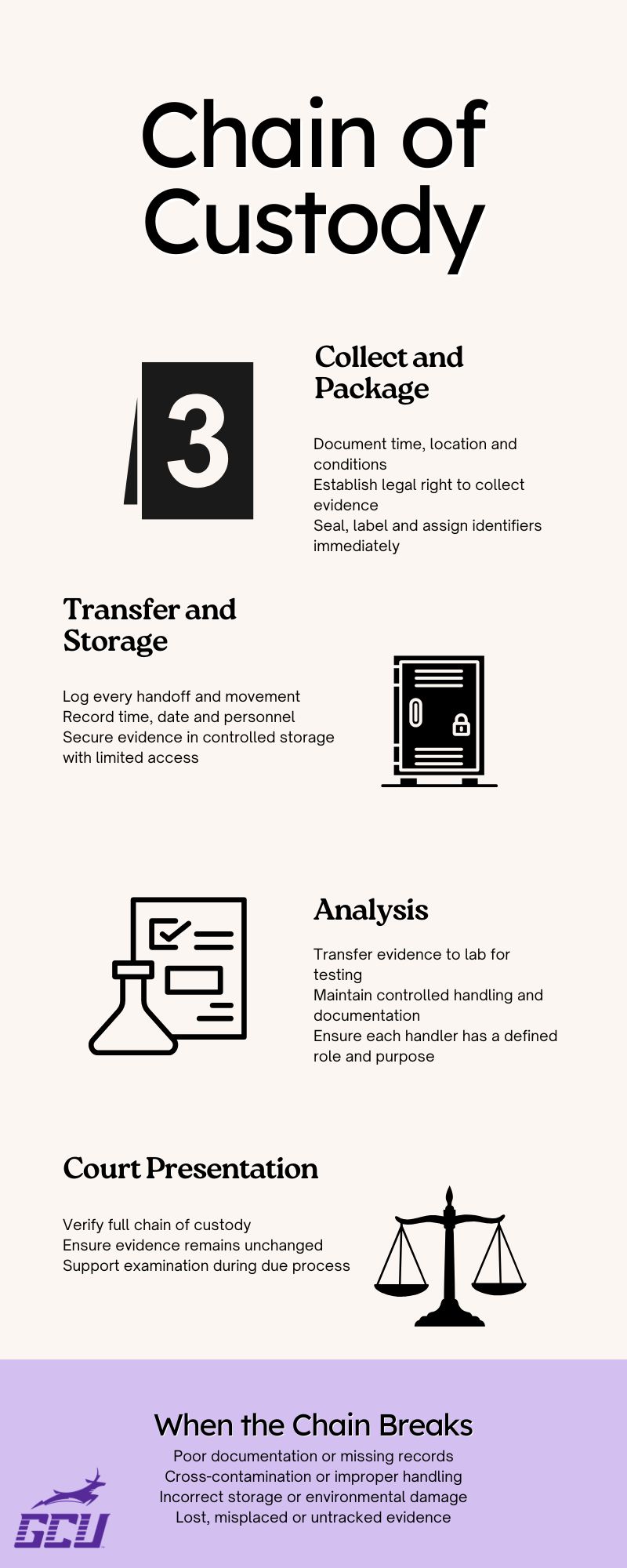
According to the National Institute of Justice, the chain of custody process follows a clear progression, with each stage carefully controlled and recorded:(See disclaimer 2)
After initial processing, the evidence continues through additional stages:
At every step, each transfer is documented and typically requires signatures, creating an unbroken and verifiable chain.
Documentation and Recordkeeping
Documentation is the backbone of the chain of custody. Investigators and forensic teams rely on detailed logs, standardized forms, barcodes and digital tracking systems to track evidence movement. Each interaction is time-stamped and often includes signatures, ensuring clear accountability.
This thorough recordkeeping is essential in court, where legal teams may scrutinize every detail to confirm proper handling. Strong documentation reinforces the credibility and admissibility of evidence, while gaps or inconsistencies can raise concerns. In fact, poor documentation may lead to questions about what happens if the chain of custody is broken, potentially weakening or even excluding critical evidence from a case.
When Chain of Custody Is Broken
A break in the chain of custody occurs when evidence is improperly handled, documented or preserved, casting doubt on its reliability, according to the National Institute of Standards and Technology.(See disclaimer 3 )Even small mistakes can have significant consequences in court. As Dr. Stemley explains, “documentation is probably the biggest one,” with errors in recording time, location or handling creating gaps that weaken the evidentiary trail.
One of the most common causes is contamination.(See disclaimer 2,3) This can happen when proper procedures are not followed, such as failing to use clean tools or changing gloves between items, leading to “cross-contamination when it’s not…clean.” Environmental factors can also play a role. For example, improperly storing evidence can damage it; placing a wet, bloody item in plastic rather than paper can lead to mold because it was not properly collected and preserved.
Chain of custody can also be compromised by human error or inadequate training. Individuals may move or handle items prematurely, or interact with digital evidence without proper expertise, unintentionally altering data. Dr. Stemley notes that even something as simple as accessing a computer incorrectly can “contaminate the time stamps” and compromise its integrity.
Additionally, mismanagement or loss of evidence can break the chain entirely.(See disclaimer 2,3) If an item is removed from storage and not returned or properly logged, it creates uncertainty about its whereabouts. As Dr. Stemley describes, evidence may be taken out for testing, but “never put back…now you have a lost item.”
Ultimately, breaks in the chain of custody often stem from lapses in procedure, whether through contamination, poor documentation or mishandling. These failures can undermine the credibility of the evidence and, in some cases, jeopardize the outcome of an investigation or trial.
Types of Evidence and Chain of Custody
Not all evidence is the same, and each type requires specific handling procedures to maintain its integrity. Whether physical or digital, proper chain of custody practices ensure that evidence remains reliable, traceable and admissible throughout an investigation. Understanding these differences helps highlight why careful handling and documentation are essential across all forms of evidence.
Physical Evidence
Physical evidence includes tangible items collected from a crime scene that can be analyzed or presented in court. Common examples include:
Each type of physical evidence requires careful handling, packaging and labeling to preserve its condition. For example, biological samples must be stored in breathable containers to prevent degradation, while sharp objects must be secured to avoid injury and contamination. Proper labeling ensures that each item can be clearly identified and traced back to its source.
Because physical evidence can be easily altered by environmental factors or improper handling, maintaining strict chain-of-custody procedures is essential. Even minor mistakes, such as incorrect packaging or missing labels, can compromise the integrity of the evidence and raise questions in court.
Chain of Custody of Digital Evidence
The chain of custody of digital evidence represents a specialized and increasingly important area of modern investigations. Digital evidence encompasses any data stored or transmitted electronically and may include devices such as computers and mobile phones, as well as data sources like cloud storage, surveillance footage and system logs.(See disclaimer 4)
Digital evidence includes:
Unlike physical evidence, digital data can be easily copied, altered or deleted without visible signs.(See disclaimer 4) This creates unique challenges for investigators, who must ensure that data is preserved in its original state. Specialized tools, forensic imaging and secure systems are often used to capture and track digital evidence.
Maintaining a reliable chain of custody for digital evidence requires both technical expertise and strict adherence to documentation protocols, setting the stage for the more complex considerations involved in handling digital information.
Chain of Custody of Digital Evidence: Challenges and Safeguards
As investigations increasingly rely on technology, digital evidence plays a critical role in modern criminal justice. However, unlike physical evidence, digital data poses risks that require specialized handling. Maintaining a reliable chain of custody for digital evidence involves both technical precision and strict procedural safeguards to ensure its integrity and admissibility.(See disclaimer 4)
Challenges of Digital Evidence Handling
Digital evidence is highly sensitive and can be easily altered, sometimes without leaving obvious signs. Investigators must account for several key challenges, including:
To address these risks, investigators use specialized techniques and tools. For example, forensic imaging creates an exact copy of a device, preserving the original data, while write blockers prevent accidental modification during analysis. Secure storage systems further protect evidence from unauthorized access.
Safeguards and Best Practices
To maintain integrity, digital evidence handling relies on strict safeguards and standardized practices.
Common methods include:
These safeguards ensure that digital evidence remains authentic and traceable. Like physical evidence, it must meet the same legal standards in court. Consistent documentation and secure handling reinforce credibility, helping ensure that digital findings can be trusted and upheld during legal proceedings.
What Happens if the Chain of Custody Is Broken?
Even with strict procedures in place, errors can occur. When the chain of custody is broken, it can raise serious questions about the reliability of evidence and the strength of a case. Understanding the potential consequences, and how courts evaluate these situations, highlights why detailed documentation and accountability are so important throughout the process.
Consequences of a Broken Chain of Custody
So, what happens if the chain of custody is broken? According to Legal Clarity, the impact can vary, but common outcomes include:(See disclaimer 8)
Even small errors can have major consequences. For example, if an evidence log is missing a signature during a transfer, the defense could question whether the item was altered during that gap. Similarly, mislabeled packaging or an incorrect timestamp might create enough uncertainty to cast doubt on the evidence’s authenticity. These hypothetical scenarios show how seemingly minor documentation issues can ripple into larger legal problems.
How Courts Evaluate Broken Chain of Custody Claims
Courts carefully assess claims that a chain of custody has been broken, rather than automatically dismissing evidence.
Judges typically consider:(See disclaimer 8)
Importantly, not every mistake results in exclusion. Minor errors may still allow evidence to be admitted, especially if there is no indication of tampering. However, even small inconsistencies can affect how much weight the evidence carries. Ultimately, maintaining a strong chain of custody helps prevent these challenges and preserves confidence in the justice process.
Best Practices and Professional Preparation
Maintaining a reliable chain of custody requires consistency, attention to detail and a strong understanding of established procedures.(See disclaimer 1 )Professionals across law enforcement and forensic science rely on proven methods to ensure that evidence remains secure, traceable and credible from collection to courtroom presentation.
Best Practices for Maintaining a Reliable Chain of Custody
To protect evidence integrity, agencies and professionals follow several key best practices:(See disclaimer 1,2)
Preparing for a Career in Forensic Science or Criminal Justice
Chain of custody is not just a procedure; it is a critical skill for professionals working in forensic science and criminal justice. Crime scene investigators, forensic scientists and laboratory technicians must all understand how to properly collect, document and safeguard evidence.
For those interested in entering these fields, education and hands-on training are essential. Degree programs, certifications and practical experience help build the technical knowledge and discipline required to manage evidence responsibly.
Median annual wage for forensic science technicians in May 2024(See disclaimer 9)
The GCU Learning Experience
Grand Canyon University’s forensic science and justice studies programs emphasize the hands-on skills needed to manage evidence and maintain a strong chain of custody properly. Students gain experience with evidence handling, documentation and chain-of-custody procedures, learning how to preserve both physical and digital materials. Through lab work and practical exercises, they develop the discipline required for accurate recordkeeping, careful analysis and ethical decision-making, skills that are essential in any criminal justice or forensic setting.
GCU’s approach also integrates exposure to modern investigative challenges, including the handling of digital evidence, helping ensure students are prepared for real crime scene investigation and evidence analysis. Experiences like the earlier referenced forensic lab video help illustrate how students actively practice collecting, labeling and documenting evidence in controlled environments similar to professional labs.
What sets GCU apart is its commitment to a Christian worldview, ethical responsibility and servant leadership. Students are encouraged not only to develop technical expertise but also to act with integrity and accountability in roles that directly impact justice and communities.
Understanding what chain of custody is and how to apply it is important for anyone pursuing a career in this field. To take the next step, explore GCU's Bachelor of Science in Forensic Science or the Bachelor of Science in Justice Studies. These programs can help you build the skills needed to handle evidence responsibly, protect the integrity of investigations and pursue a career in forensic science or criminal justice.
Where Evidence Meets Justice
Explore GCU programs and gain the skills needed to handle chain of custody of evidence with confidence.