
Crime shows often simplify the investigative process, showing evidence and conclusions surface quickly. In reality, solving a case requires patience, precision and a commitment to truth.
Effective investigations begin at the crime scene, where meticulous collection and analysis of evidence is crucial. This article explores the true nature of crime scene investigation (CSI) and its importance in law enforcement, featuring insights from Dr. Cornel Stemley, a faculty member at Grand Canyon University and a seasoned crime scene investigator. His decades in the field bring depth and authenticity to our exploration of the process.
"A crime scene is like a puzzle — you have an abundance of pieces there, and now you have to create the picture."
What Is Crime Scene Investigation?
Crime scene investigation (CSI) involves documenting and analyzing evidence to understand criminal events.(See disclaimer 1) Investigators use photography, sketches and careful collection of items like fingerprints and digital evidence, following strict protocols to preserve evidence integrity.
 While CSI is grounded in the scientific method, it also involves interpretation. As Dr. Stemley explains to his students, a crime scene is “like a puzzle — you have an abundance of pieces there, and now you have to create the picture.” Investigators must first identify these pieces and then determine how they fit together, how they “relate and correlate” to one another, and what they reveal about the people involved.
Dr. Stemley also describes crime scene work as uncovering a “hidden story.” Evidence serves as the medium through which that story is reconstructed; sometimes completely, and other times only in fragments. When the story is incomplete, investigators must “discover what’s already there” by viewing the environment through the lens of those who were present.
He likens this process to a movie that has already been written: if you removed the actors and left only the artifacts, could you recreate who was there and what occurred? “Every piece of evidence has a correlation or relationship to an individual,” he notes. The objects people touch, the choices they make and the traces they leave behind form a trail of interconnected details that allow investigators to rebuild the narrative of the event.
Ultimately, CSI merges science, critical thinking and storytelling to create a coherent, evidence‑based portrait of what occurred.
Common Misconceptions About CSI
Popular media have significantly shaped public perceptions of what crime scene investigation entails, often leading to misconceptions. Dr. Cornel Stemley points out that these misunderstandings typically arise from “having a false idea about what it truly takes to be a CSI or do CSI.”
Television shows condense complex investigative processes into a tidy, one‑hour storyline, which creates the impression that evidence is always apparent, technology offers instant results, and investigators adhere to a single, universal method. In reality, he emphasizes that “there are multitudes of ways of doing investigations. You may have five officers, and all five officers are going to do things differently.” Dr. Stemley encourages people to look past scripted TV portrayals: instead of focusing on the unrealistic timelines, consider “what principles did you take away from that show in regard to techniques” and the mindset behind investigative work. CSI is not a formula; it is a combination of training, judgment, adaptability and scientific curiosity.
Another common misconception is the belief that CSI has hard limits, that if something can’t be detected today, it cannot be detected at all. Dr. Stemley pushes back firmly on this idea. He reminds students that “we didn’t understand DNA until later, but DNA already existed.” Evidence often contains what he calls “invisible pieces,” details that current technology may not yet be sophisticated enough to identify. This doesn’t make the evidence useless; it simply means science hasn’t caught up yet.
Because of that, he stresses the critical importance of meticulous evidence preservation. “If officers did not preserve evidence back in the 1960s… then we would never have had anything to use for technology later.” Advances in forensic science have unlocked answers from traces that were once undetectable, leading to overturned convictions and the release of individuals wrongfully imprisoned.
As Dr. Stemley puts it, “think about what technology is going to be like in five years for evidence that we did not know was there.” Investigators must preserve evidence not only for what it can tell us now, but also for what science may uncover tomorrow. This long‑term mindset protects the possibility of future breakthroughs.
Why CSI Is Critical in Modern Law Enforcement?
Advances in digital technology and the rise of computer‑based crime have expanded how investigations are conducted, requiring investigators to account for electronic evidence alongside traditional crime‑scene methods.(See disclaimer 2)
As Dr. Cornel Stemley explains, “your criminals from the past are not the same criminals you have today.” Modern offenders are often “smarter, more intelligent, more intellectual,” and the types of crimes they commit look very different from those of earlier decades.
Technology is a major driver of this shift. With the rise of smartphones, digital communication, international mobility and technology‑enabled offenses, investigators must adapt their tools and methods accordingly. Dr. Stemley emphasizes that crime itself has transformed: “crime is being created differently because of technology.” As a result, CSI must keep pace, not just in identifying evidence, but in ensuring its scientific validity and integrity from the moment it’s discovered.
He stresses that CSI today requires the ability to “identify, process and detect” evidence at a level far beyond what was possible in the past. Modern forensic technologies, from advanced imaging techniques to sophisticated lab instrumentation, help investigators preserve and analyze traces that earlier generations may not even have recognized. Yet these tools only matter if evidence is handled correctly. Without integrity at the scene, what’s collected cannot stand in court or withstand scrutiny. That’s why CSI forms the critical bridge between what happened and how that story is presented: “we have to show how the story played out using the evidence that’s collected, utilizing technology.”
Another complexity of modern crime is the potential for manipulation. In a digital world, Dr. Stemley notes, “a criminal can manipulate the crime scene,” especially in technology‑based offenses. This makes rigorous, well‑documented CSI practices more important than ever. Preserving authenticity, safeguarding against tampering and educating the public on how evidence maintains its validity are all key responsibilities of today’s investigators.
CSI’s importance also extends into forensic laboratories, where specialists analyze evidence collected from the field. According to Dr. Stemley, professionals in these labs must continually advance their training to keep up with “new technology and new types of criminal modus operandi.” As offenders grow more sophisticated, forensic science must keep pace.
Perhaps most powerfully, CSI helps reveal “the untold story” hidden in the physical details left behind. Solving crimes requires collecting, preserving and interpreting every piece, visible or invisible, to reconstruct how events unfolded. “If you don’t understand the pieces that are there,” Dr. Stemley explains, “then you won’t have the storyboard.” Many cases solved today are the result of evidence preserved for years, even decades, earlier. As he points out, “we didn’t have that technology until later. But if we didn’t have the pieces, we wouldn’t be able to put them together later anyway.”
What Does a Crime Scene Investigator Do?
A crime scene investigator (CSI) is responsible for documenting, analyzing and preserving evidence in a way that maintains scientific integrity and supports the investigative process.(See disclaimer 1) While CSI work follows established principles, Dr. Stemley emphasizes that “everyone does things differently,” and investigative roles can vary significantly by agency. Large, mid-sized and small departments often have distinct procedures, and not every agency maintains a dedicated CSI unit.
In some agencies, investigators review and interpret evidence collected by crime scene technicians, while in others, investigators are responsible for both evidence collection and the broader investigation. Dr. Stemley notes that he knows investigators who have not processed a crime scene in their entire careers. In smaller or rural departments, such as one where he previously worked, “you are the first responding officer, you are the crime scene investigator, and you are the crime scene processor.”
Regardless of structure, an investigator’s core responsibility is to uncover meaning in the evidence by understanding its identity, location, role and transformation at the moment the act occurred — not before or after. This process involves forming hypotheses and theories while continually testing them, working to prove or disprove conclusions as new information emerges. Critical to this work is accurate documentation, analysis and preservation of evidence that aligns with key principles established by law enforcement subject matter experts, much like medical standards established and upheld by physicians.
Core Responsibilities at a Crime Scene
While techniques vary by agency and by investigator, Dr. Stemley explains that several core responsibilities consistently guide the CSI process.
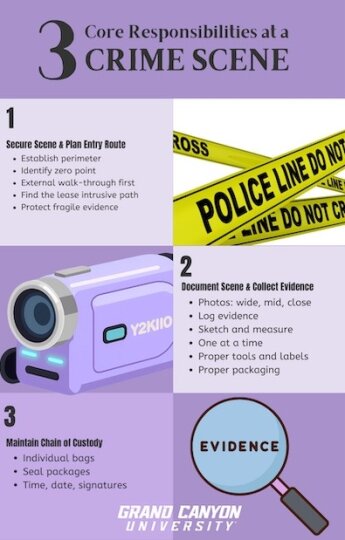
1. Securing and Assessing the Scene
The priority is establishing a secure perimeter, “the first thing you need to do as a first responding officer.” Investigators identify the scene’s zero point and determine if it’s a primary or secondary location. Before entering, a full external assessment is completed by walking the perimeter and logging visible evidence, starting with items like “#1: glove” or “#2: shoe.” To prevent contamination, entering the scene is avoided until all external observations and documentation are complete.
2. Documenting the Scene Thoroughly
Documenting the scene includes establishing a perimeter, capturing images at different distances, and creating sketches to map furniture and evidence locations. Investigators take continuous notes on potential evidence, such as fingerprints and fibers, and use triangulation from a zero point to obtain precise measurements to aid in scene reconstruction.
3. Planning the Entry Route
Investigators plan the least intrusive entry route to avoid disturbing fragile evidence, such as footprints and fibers. Adjustments to the route may be made if the layout changes or new evidence is found, always with caution and intention.
4. Collecting and Packaging Evidence
Each piece of evidence is managed individually, according to the evidence log. Investigators use specific tools and packaging materials for different items, and label them with their name, badge number, collection date and time, location and description. Proper sealing ensures evidence remains uncontaminated.
5. Maintaining Chain of Custody
Dr. Stemley stresses the importance of a meticulous chain of custody for evidence. Each item is individually logged during transfers, from the investigator to the patrol car, to the station and into the evidence locker, recording time, date and signature. Items are never submitted “in bulk,” ensuring each piece has its own custody record to maintain integrity for the court.
6. Conducting an Exhaustive Search
During the search phase of a crime investigation, multiple methods, such as grid, spiral, zone or line, may be employed depending on the environment. Investigators start with a hypothesis, and Dr. Stemley notes that it is equally important to conduct a cursory re‑check: “I always like to do a cursory view just in case I miss anything.” A scene is released only once investigators are confident that all evidence has been identified and collected, as he puts it, “Because when you give up the crime scene, you’re basically giving up the evidence.”
Collaboration with Detectives and Forensic Teams
Crime Scene Investigators rarely work in isolation, especially in larger departments. Effective CSI depends on strong communication between investigators, detectives, lab personnel and agency leadership. This is how collaboration typically works:
Dr. Stemley points out that while the principles remain the same, execution varies: “The way I process it will probably be different than someone else, but we make sure the same principle stays there.”
Why Collaboration Matters
Despite variations in CSI work by department, collaboration remains constant, with every team member contributing to an accurate and scientific understanding of the crime’s narrative.
What Do You Need To Be a CSI?
To become a crime scene investigator, individuals may follow either a law enforcement or a forensic science pathway. Most agencies require a relevant degree along with specialized training in evidence handling and investigative procedures.(See disclaimer 1,3) Some agencies hire sworn officers and provide internal training, while others recruit civilians with forensic science backgrounds.(See disclaimer 4)
In addition to formal education, Dr. Stemley emphasizes the importance of intellectual curiosity and mindset, of being willing to ask “why,” of exercising patience, of thinking outside the box, of reading across disciplines and of visualizing scenarios while remaining internally motivated. Selecting an education program that encourages conceptual understanding, interdisciplinary thinking and learning beyond memorization and grades is essential for developing the skills needed to process crime scenes with integrity.
Education and Degree Requirements
Most people enter the crime scene investigation profession through law enforcement/criminal justice or through forensic science.
Law Enforcement and Justice Studies Degrees
Many CSIs begin as police officers and earn degrees in criminal justice or justice studies, such as those offered by Grand Canyon University. This path is valuable in smaller departments where police officers often take on multiple roles. As Dr. Stemley described from his own early career, smaller or rural departments usually require officers to act simultaneously as first responders, investigators and crime scene processors.
Some CSIs focus on evidence analysis and crime scene processing through science-focused programs like GCU’s Bachelor’s and Master’s of Science in Forensic Science, which cover biology, chemistry and crime scene reconstruction.
Regardless of the path, candidates should build a foundation that integrates scientific understanding with investigative reasoning, as all agencies value candidates who recognize the legal significance of evidence and the importance of meticulous documentation and scene preservation.
Certifications and Specialized Training
Crime scene investigators often seek professional certifications and advanced training to enhance their skills and meet agency standards.
Some of the most recognized credentials in the field include:(See disclaimer 5)
Certification requirements typically involve education, field experience and exams. Additionally, CSIs may receive training in techniques such as bloodstain pattern analysis, latent fingerprint development, crime scene photography and evidence collection. Training can be offered by police academies, state crime labs and universities or conducted internally by smaller agencies. As Dr. Stemley explained, smaller departments often rely on adaptable training because one officer may serve multiple investigative roles. He noted that although officers learn standardized principles, “you modify the training to make sure you still keep with the process that requires you to do it, the integrity of the scene, but you have your own system.”
Continued education and certification renewal are essential for CSIs to keep up with advancements in forensic science, ensuring they can effectively process crime scenes, maintain evidence integrity and testify in court.
Median annual wage for forensic science technicians in May 2024(See disclaimer 6)
Skills That Make an Effective CSI
Effective crime scene investigators possess a combination of cognitive abilities, work‑related skills, and personal characteristics, such as analytical thinking, attention to detail, problem‑solving and clear communication, in addition to formal education and on‑the‑job training.(See disclaimer 1) According to Dr. Cornel Stemley, CSI work demands a blend of patience, curiosity and the ability to see both the big picture and the most minor details at the same time.
Dr. Stemley emphasizes that a successful CSI is “someone who has patience and someone who’s very detail oriented,” someone who notices things others overlook and is willing to move slowly and methodically through a scene. Because CSI work often involves sifting through dozens of small, seemingly insignificant pieces of evidence, he says it also requires a person who is constantly asking why: Why is this item here? Why does this detail matter? Why does this piece fit the way it does?
Curiosity plays a significant role in the job. Investigators must be “always interested in knowing more,” willing to question assumptions, and ready to follow leads that may not reveal their meaning immediately. Dr. Stemley often tells students that if they enjoy puzzles, reading or piecing together complex stories, they may be naturally suited for this work. Crime scenes, after all, are much like unsolved narratives. “Remember I told you it’s like an unsold story,” he says. “You see a crime scene, but it’s a scene within a movie that is hidden, and now you’re able to take and write the story.”
Visualization is another key skill. CSIs must be able to walk into a space and mentally reconstruct what may have happened based on physical clues. Dr. Stemley draws on his background as a military broadcast journalist, where he learned to build storyboards and visualize scenes. That same ability, to imagine the timeline of events and test those ideas against the evidence, is essential in forensic work. “Someone willing to be intellectual and be a visionary,” he says, can sift through possibilities: This possibly happened — now let me test the theory to see if the physical evidence is there. When the evidence confirms the hypothesis, “it starts to be a domino effect.”
CSIs should approach their work like archaeologists, preserving evidence such as fibers, impressions and blood droplets, which serve as the historical record of the event. As Dr. Stemley puts it, “You have to be willing to preserve the artifacts… because that is the history you take into the courts.” Assembling fragments of history enables investigators to reveal hidden stories with scientific support and careful reconstruction.
Ultimately, CSIs should exhibit patience, attention to detail, persistence and creativity, combining analytical rigor with imaginative reasoning to transform evidence into a straightforward narrative of truth.
How GCU Can Prepare You for a Career in CSI
Grand Canyon University offers rigorous programs that combine practical insights from experienced faculty with campus resources and flexible learning options to prepare students for various roles in policing.
These programs benefit from faculty like Dr. Cornel Stemley, who brings extensive experience in law enforcement, crime scene processing and investigative work to the classroom. As the lead in the law enforcement side of the justice studies program, he designs and teaches courses, advises the Law Enforcement Club, contributes to GCU’s Global Behavioral Analysis and Security Analysis research lab and mentors students pursuing investigative careers. As he puts it, “I kind of do a little bit of everything,” offering students direct access to someone who has been on the ground in real crime scenes and understands the demands of the field.
GCU strengthens this expertise through academic programs tailored to crime scene investigation, including a Bachelor of Science in Justice Studies or a Master of Science in Criminal Justice with a law enforcement focus. For those interested in the scientific side, GCU provides bachelor’s and master’s degrees in forensic science, covering evidence analysis, chemistry, biology and laboratory techniques. These programs can equip graduates for roles in the field and forensic laboratories.
Outside of formal coursework, GCU offers opportunities for students to enhance investigative skills through clubs such as the Law Enforcement Club and behavioral analysis groups. These organizations, supported by experienced faculty, provide practical activities, networking events, guest speakers and skill‑building workshops focused on criminal behavior analysis. In addition, students participate in field experiences that include visits to law enforcement and forensic agencies, allowing them to see behind‑the‑scenes operations and connect classroom learning to practical investigative practice.
GCU provides flexible on-campus and online programs for students, including working professionals and military members. The curriculum, led by experienced faculty like Dr. Cornel Stemley, focuses on contemporary forensic knowledge and practical application.
Uncover the Hidden Stories Behind the Evidence
Start your journey through one of GCU’s CSI‑aligned degree programs and prepare to help solve cases through science‑based investigation.