

Artificial Intelligence (AI) is no longer a distant concept reserved for tech labs and sci-fi films — it’s a driving force behind innovation and collaboration across industries. From streamlining hospital diagnostics to powering smarter retail experiences, AI is shaping how businesses operate and how people live.(See disclaimer 1) For professionals looking to pivot into this field, understanding how AI works — and where it works — is key.
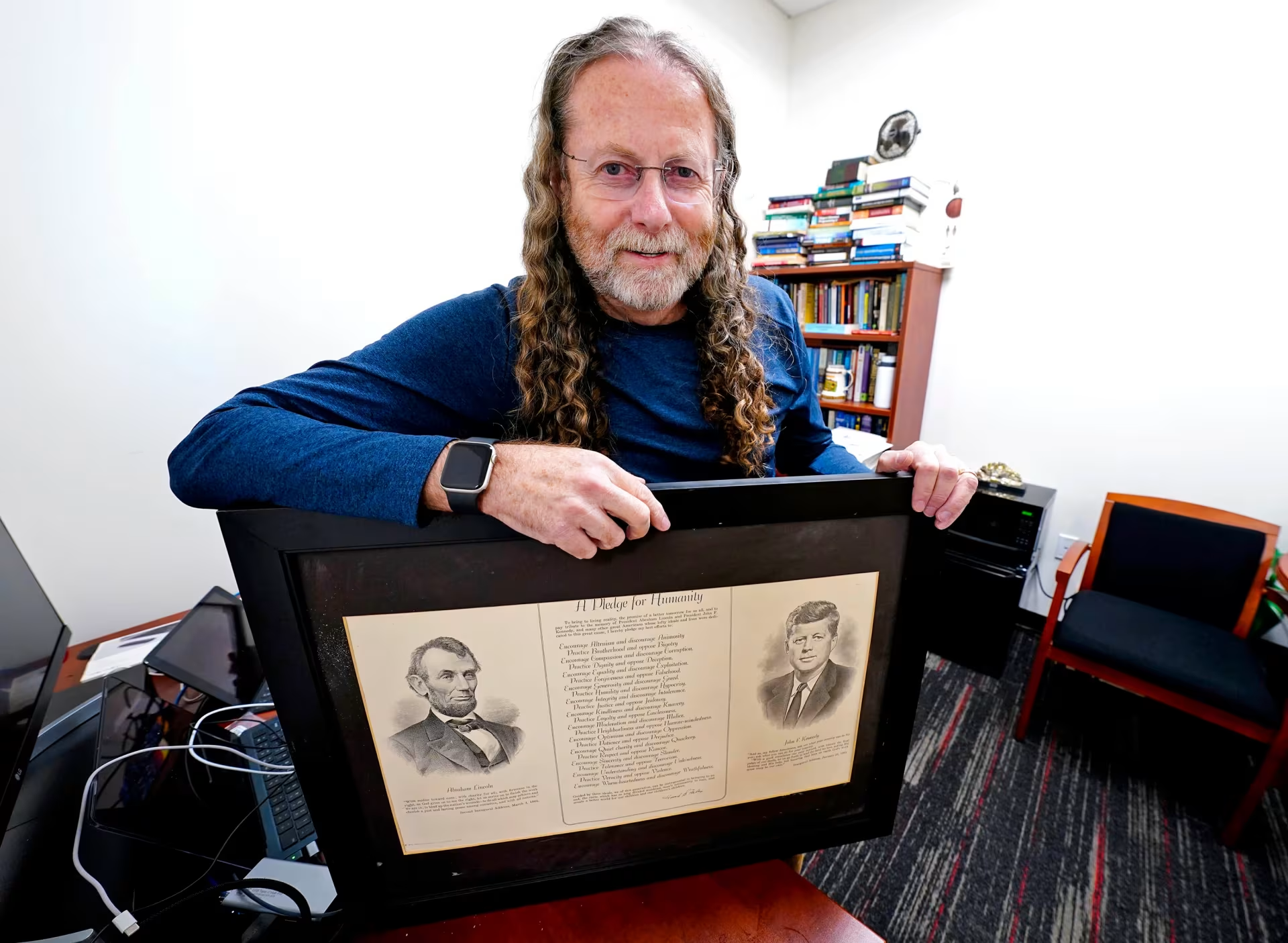 | “AI will reshape nearly every field, from medicine and education to how we choose our next Netflix show. My hope is to play the role of translator — helping humans and machines understand each other better.” — Dr. Isac Artzi, Associate Professor, College of Engineering and Technology
|
At Grand Canyon University, AI is taught not just as a tool, but as a collaborative force. According to Dr. Artzi, GCU graduates are taught to be the bridge between technology and humanity, using AI to help people work faster, make better decisions and build smarter tools for everyday jobs.
What Is Artificial Intelligence?
AI is the field of computer science focused on creating systems that can perform tasks that normally require human intelligence. AI is about teaching machines to learn from data and make decisions. As AI continues to evolve, its applications ar e rapidly expanding across industries — reshaping how work is done and creating new opportunities for innovation and impact.
“AI is simply the latest wave of transformation…if handled correctly, it can be a true collaborator and a partner that enables us to explore, create and solve problems in new ways,” says Dr. Robert Loy, assistant dean in the College of Engineering and Technology at Grand Canyon University.
How Does Artificial Intelligence Work? The Building Blocks of AI
AI works a lot like teaching a computer to learn from experience — similar to how people do. Instead of programming it with rigid instructions, we feed it large sets of examples and it learns to recognize patterns, make decisions and solve problems on its own. This process is called machine learning and it’s powered by algorithms that improve as they’re exposed to more data.
Dr. Artzi, a faculty member who leads AI courses at GCU, explains that “students build prototypes, test models and sometimes break them in gloriously educational ways! It’s equal parts lab and dojo — you train, you practice, and you occasionally get thrown on the mat by a stubborn dataset.”
These data sets act as the training ground, helping AI systems understand everything from customer behavior to medical diagnoses. More advanced systems use neural networks, which mimic the brain’s structure to handle complex tasks like language translation or image recognition. With these tools, AI is already reshaping industries — and a Master of Science in AI can help prepare students to build, apply and lead these innovations across fields like healthcare, finance and technology.
For graduate students considering a master’s in AI, the real question is where can an AI career take me? Let’s break it down.
How AI Expertise Is Shaping the Future of Work
AI is becoming a core part of daily workflows across a wide range of tech-focused roles. In programming, for example, AI tools can help streamline tasks like writing, testing and documenting code, while also enhancing data accuracy and helping teams define the value of new software features. These capabilities don’t just boost productivity — they reshape how work gets done. And the impact isn’t limited to software development. AI is increasingly supporting professionals in fields like finance, law, manufacturing, retail and beyond.(See disclaimer 2)
However, Dr. Artzi explains that “balancing innovation with human dignity is a skill I use daily. For example, the future of counseling isn’t a chatbot with a clipboard — it’s AI amplifying what good therapists already do best.”
Healthcare Industry
AI is reshaping healthcare by improving diagnostics, streamlining workflows and enabling personalized treatment. From analyzing medical images to predicting patient outcomes, AI tools are helping providers deliver faster, more accurate care.(See disclaimer 2) According to the BLS, the need for tech-driven roles in healthcare is expected to grow as AI adoption accelerates.(See disclaimer 2)
Example: Studies show AI-powered blood tests use machine learning to detect early-stage ovarian cancer with 92% accuracy, enabling breakthrough early diagnosis through identifying key biomarkers.(See disclaimer 3)
Finance Industry
AI is transforming everything from fraud detection to credit scoring and algorithmic trading. Banks and fintech firms use machine learning to assess risk, personalize financial advice and automate customer service.(See disclaimer 4)(See disclaimer )Predictive analytics can also help institutions forecast market trends and optimize investment strategies.
Example: PayPal integrated an AI-based fraud detection system using machine learning and neural networks, leading to a 53% drop in fraudulent transactions, a 27.5% decrease in chargeback disputes and a 17% reduction in issuer declines for a ticket purchasing company called Tickeri.(See disclaimer 5)
Law
Legal professionals are using AI to streamline research, review contracts and manage case documentation.(See disclaimer 6) Tools like legal AI assistants can help summarize transcripts and analyze case law — freeing up lawyers of repetitive tasks.(See disclaimer 6) Adoption is growing, especially in civil litigation, personal injury and family law practices.(See disclaimer 2,6)
Example: The 2025 Legal Industry Report states that attorneys are increasingly using AI to support business operations alongside legal work.(See disclaimer 7) The report shows that 54% use AI to draft correspondence, 14% apply it to analyzing firm data and case matters and 47% are particularly interested in tools that extract insights from financial data.(See disclaimer 7)
Retail Industry
In retail, AI powers personalized shopping experiences, smart inventory management and demand forecasting. Retailers often use AI to analyze customer behavior, recommend products, optimize pricing and even plan delivery routes.(See disclaimer 8) AI-driven tools can also help reduce waste and improve supply chain efficiency.
Example: A grocery chain used AI to forecast demand for perishables, cutting food waste by 20% and boosting sustainability while saving costs.(See disclaimer 9)
Manufacturing Industry
AI is at the heart of smart factories. It enables predictive maintenance, quality control through computer vision and real-time decision-making on the production floor. Many manufacturers also use AI for generative design, robotics and supply chain optimization — boosting productivity and reducing downtime.(See disclaimer 10)
Example: U.S. manufacturers like Toro are using AI to streamline supply chains and respond to trade changes in real time. The AI supply chain market is expected to grow from $2.7 billion to $55 billion by 2029.(See disclaimer 11)
Cybersecurity
AI is enhancing cybersecurity by automating threat detection, analyzing anomalies and accelerating incident response. According to the Bureau of Labor Statistics, the need for Information Security Analysts is projected to grow 29% from 2024 to 2034, much faster than average.(See disclaimer 12 )This surge is driven by the increasing frequency of cyberattacks and the need for innovative, AI-powered defenses to protect sensitive data and networks.(See disclaimer 13)
Example: JPMorgan Chase uses AI-driven tools to monitor its vast digital infrastructure for vulnerabilities and threats.(See disclaimer 13) These systems prioritize patching efforts based on severity and likelihood of exploitation, helping the bank stay ahead of cyberattacks.(See disclaimer 13)
Autonomous Systems and Industries
AI is the backbone of autonomous technologies, from self-driving cars to industrial robotics. In manufacturing, AI enables predictive maintenance, quality control and process optimization. In transportation, it supports navigation, obstacle detection and real-time decision-making.(See disclaimer 14) These systems rely on computer vision, sensor fusion and deep learning to operate safely and efficiently.(See disclaimer 14)
Example: Tesla’s Autopilot system uses AI to enable semi-autonomous driving.(See disclaimer 15) It processes data from cameras, radar and ultrasonic sensors to make real-time decisions like lane changes, adaptive cruise control and emergency braking. Tesla vehicles have logged billions of miles using Autopilot, providing continuous learning to improve safety and performance.(See disclaimer 15)
“Every generation has seen disruptive technology: personal computers in the 1980s, the internet in the 2000s and IoT in the last decade. AI is simply the latest wave of transformation, and like the others, people will adapt. Sometimes adaptation will be smooth and lead to progress; other times it will bring challenges or missteps. I hope to be a voice of reason, calming fears that AI isn’t going to "take over," while also helping people see that AI is more than just a tool.”
— Dr. Robert Loy, College of Engineering and Technology
Pursue AI Careers with an MS in AI
“Our AI program helps students lead with both skill and integrity in diverse fields,” said Dr. Artzi. GCU encourages a growth mindset, empowering students to explore AI with confidence and creativity. He said, “Start small, stay curious and don’t be afraid of breaking things — it’s how most of us learn. Begin with Python, dabble in a Kaggle dataset and remember — no one became an AI expert overnight.”
Although AI technology can compete with human-centered decision-making at its core tasks, demand for human intelligence is still expected to remain very strong.(See disclaimer 2 )With a Master of Science in Artificial Intelligence (AI), you're not just learning technology — you're learning to shape it. A degree in AI can help equip you not just to keep up — but to position yourself to potentially lead in a world shaped by intelligent systems. If you’re interested in building your foundational skills before pursuing graduate studies, explore the Bachelor of Science in Artificial Intelligence to gain essential knowledge in AI principles and technologies.
Step Forward Into Intelligent Possibilities
AI is changing every industry. Use your potential to drive that change with a master’s degree in AI from GCU.