

Quantum computing is one of the most exciting frontiers in technology — and yes, it’s part of the future. While still in its early stages, researchers believe it could transform fields like cryptography, drug discovery and artificial intelligence.1 So, when will quantum computing be available and what can students do now to prepare? Let’s break it down.

"Quantum computers are coming but they won’t replace the computers we already use. The quantum concepts and the mechanics of moving from 0 and 1s processors to a qubit are still in their infancy. I think we are looking at mainstream in the next 15-30 years.”
— Dr. Robert Loy, Assistant Dean, College of Engineering and Technology
What Is Quantum Computing (In Plain English)?
Quantum computing is like a new kind of super-brain for computers. Traditional computers use bits — tiny switches that are either 0 or 1. Quantum computers use qubits, which can be 0 and 1 at the same time. This trick, called superposition, lets them explore many possibilities at once. Add entanglement, where qubits stay connected even when far apart, and you get machines that can solve problems too big for today’s computers.
Your laptop is great for everyday tasks like emails and spreadsheets. Quantum computers, on the other hand, are built for heavy lifting — things like optimizing global supply chains, cracking encryption or simulating molecules for new medicines. They won’t replace your laptop anytime soon, but they’ll change how we tackle the world’s hardest problems.
Realistic Outlook: Where It Stands Today
Quantum computing is moving forward, but it’s still in the early stages. Right now, most quantum computers live in research labs or are part of small pilot projects. They’re powerful in theory, but in practice, they’re loud and prone to errors, which makes scaling them for everyday use a big challenge.
"I don't believe most people will ever own a quantum computer. Instead, they’ll access them through the internet — kind of like how we use the cloud today — via shared resources through some kind of portal or web service."
Still, progress is underway: companies like IBM and Google are developing more capable systems, and experts predict that by this year, quantum computers could begin solving specific problems more effectively than traditional machines.(See disclaimer 1) The future likely isn’t “all quantum”— it’s a hybrid world where quantum and classical computers work together.(See disclaimer 2)
That said, major technical hurdles still stand in the way. One of the biggest hurdles is reliability — current machines often make errors. To fix this, researchers are working on error correction, which means combining many fragile qubits into a stronger “logical qubit” that can handle mistakes better.(See disclaimer 3)
The potential payoff may be huge: McKinsey estimates the quantum market could grow from about $4 billion in 2024 to nearly $100 billion by 2035(See disclaimer 3) — if scientists can solve problems like error correction, scaling up systems and keeping them stable.(See disclaimer 4 )In short, progress is happening, but there’s still a long road ahead.
Looking ahead, the most likely scenario is a hybrid quantum–classical future.(See disclaimer 4,5) This model combines quantum subroutines — such as optimization, sampling and molecular simulation — with classical computing systems that handle data processing, control tasks and error mitigation.(See disclaimer 5 )Such hybrid architectures are already being tested in academic and HPC environments.(See disclaimer 5 )
When Will Quantum Computing Be Available?
Quantum computing won’t replace classical computers soon — but it will augment them by tackling complex, specialized problems.(See disclaimer 1)
Businesses may begin to see measurable returns from quantum technology.(See disclaimer 1 )
Near-Term Outlook
Quantum computing isn’t just a distant dream — it’s already here in early forms. Right now, companies like Amazon let you try small quantum computers over the cloud. For example, their service Amazon Braket, offers access to various quantum hardware, including gate-based devices from IonQ and Rigetti, and even quantum simulators — all you need is an AWS account and some code.(See disclaimer 6) These machines typically have 50–100 qubits and still make errors, but they’re perfect for testing new ideas.(See disclaimer 6)
Today’s focus is on hybrid approaches that combine quantum and classical computing to tackle problems in areas like chemistry and optimization.(See disclaimer 6) This is the first step toward a future where quantum computing could play a major role in solving complex challenges.
We asked: “Which industry do you believe will gain the most from quantum computing first, and why?”

“Aside from the military, the most computationally intensive disciplines are weather forecasting and market trends forecasting, using thousands of variables to build holistic mathematical models that assess the interactions across all possible factors affecting the market."
— Dr. Isac Artzi, Associate Professor, College of Engineering and Technology
What’s Next In Quantum?
Looking ahead to the next few years, quantum computers should start showing real benefits in certain fields — like developing new materials, improving chemical processes, streamlining supply chains and financial modeling.(See disclaimer 1,7) These early quantum systems could help companies in chemicals and materials make hundreds of millions of dollars.(See disclaimer 7) By around 2030, businesses may begin seeing a clear return on investment from quantum technology.(See disclaimer 1,7)
Where Quantum Is Headed Long-Term
The true leap forward will come with fault-tolerant quantum computers:
Benefits, Challenges and Industry Impact of Quantum
Quantum computing is poised to transform industries by solving problems that are too complex for classical computers. Here’s where it shines:
"Industries that solve complicated puzzles like medicine, finance or logistics will use quantum computers first because they’re great at trying lots of possibilities at once."
Challenges and Risks
Quantum computing faces significant obstacles before reaching widespread adoption.(See disclaimer 1) Technically, systems struggle with noise, decoherence and the need for complex error correction. On the practical side, high costs, limited talent and vendor lock-in can create barriers for organizations. Security is another concern, as quantum capabilities threaten current encryption standards, making post-quantum cryptography essential.
Dr. Loy says, “The hardest part is that quantum computers make mistakes very easily. Keeping them stable and accurate is much harder than just making them faster.” It’s important to separate real progress from hype — many breakthroughs remain experimental, so critical evaluation is key. According to Dr. Artzi, “Another major obstacle is the need to keep the quantum core at very cool temperatures. This requires a considerable amount of uninterrupted energy supply. The slightest tremor of a building or increase in temperature causes computation errors.”
Industry Use and Impact
Quantum computing is expected to impact several key industries in the near future.
According to the U.S. Bureau of Labor Statistics, roles tied to advanced computing — such as computer and information research scientists — are among the fastest-growing occupations, reinforcing the value of quantum skills for the future job market.(See disclaimer 11)
Interested in Learning Quantum Computing?
For students eyeing a career in this field, learning to integrate quantum and classical tools may be essential as these systems move from lab to practical applications. Quantum computing might sound intimidating, but getting started may be easier than you think.
"Quantum computing requires superior mathematical ability and a good grasp of the principles of quantum theory. Students should start with quantum theory and study the Schrödinger equation, which establishes the foundation of the behavior or a particle, which is simultaneously a wave. The entire mindset of classical computer logic requires a reboot in the quantum world."
Dr. Loy says, “You don’t need to start with quantum physics today. The most important skills are math, problem-solving and learning how computers process information in the traditional digital format.” Whether you’re curious about the basics or aiming for a career in this evolving field, here’s what you need to know — prerequisites, tools, learning paths and potential job opportunities — all in one place.
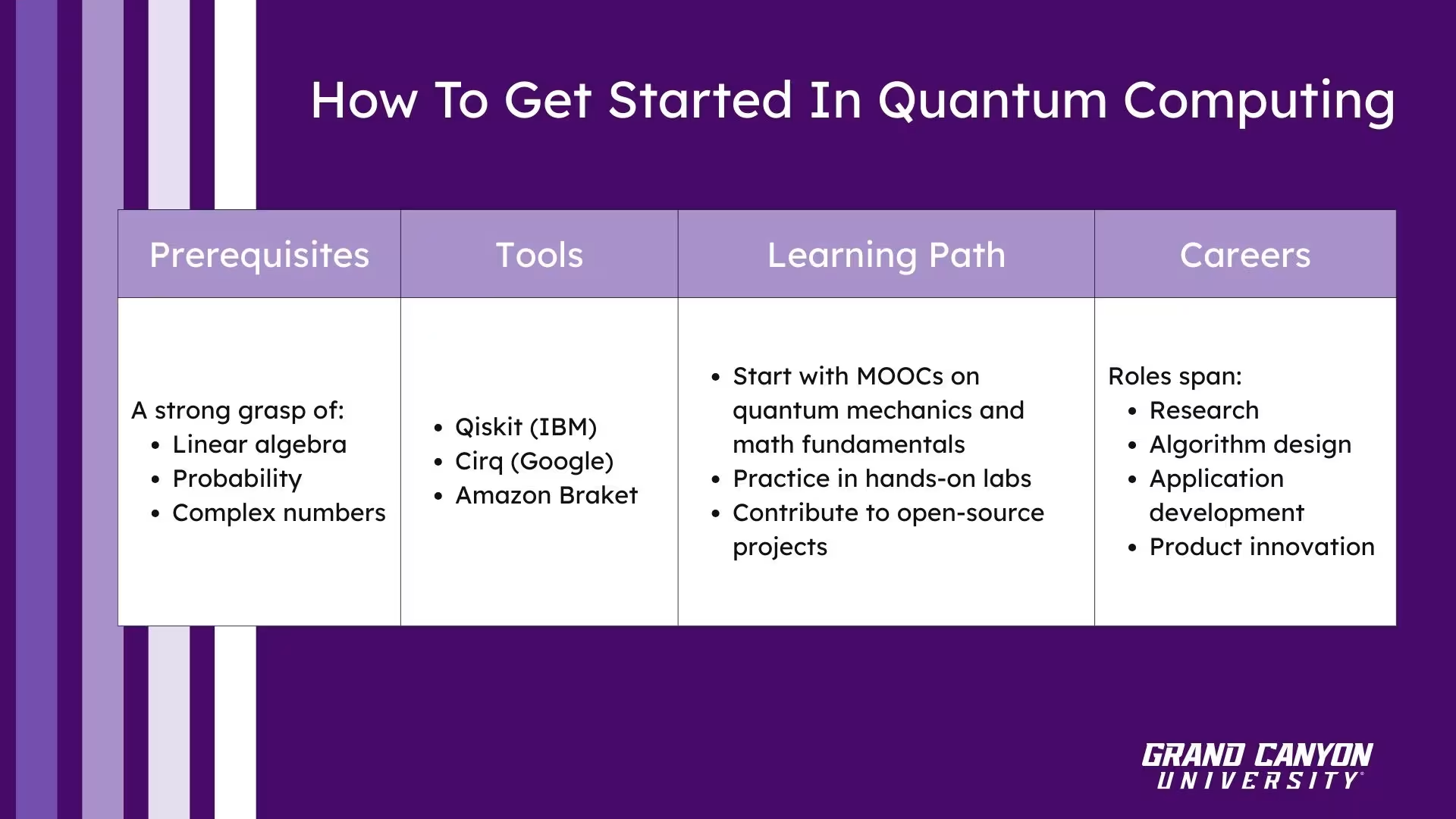
Let GCU help guide you on how to learn quantum computing. Our BS in Computer Engineering degree introduces quantum mechanics, a foundation in the principles that power next-generation technologies. This program is designed to help you prepare for emerging fields such as quantum computing, AI and cybersecurity. Start building the skills that will shape the future of tech.
Be Part of Quantum Computing
From drug discovery to AI acceleration, quantum computing will redefine what’s possible. Begin your journey now and explore the opportunities ahead.