
If you’ve ever looked at a job posting and wondered how to get experience for a job when you don’t think you have any, you’re not alone. It can be discouraging to see “experience required” on many job postings, especially when you have just started wondering how to get a job after college.
However, experience isn’t limited to paid positions or long-term roles. An “entry-level” job refers to an opportunity for candidates to apply foundational skills rather than demonstrate years of professional experience. Experience can include the knowledge, skills and hands-on learning you’ve gained throughout your college career; coursework, group projects, presentations, research opportunities and campus involvement can all contribute to your professional development.
As you begin thinking about how to get a job after college, remember that your experience is already taking shape. The key is learning how to recognize it, build on it and confidently communicate it in your job application with no or limited professional experience.
In this blog, you’ll learn how to pinpoint the experience you already have, how to further build upon it and how to approach a job application with no experience.
What Counts as “Experience” in Entry-Level Hiring?
When starting your job search, it’s helpful to understand what “entry-level” jobs mean. Entry-level roles are designed for early-career candidates who are still developing their professional backgrounds and building the right skills to include on a resume. Employers hiring for these roles aren’t expecting years of experience. They’re looking for a strong blend of foundational, soft and transferable skills, including your ability to learn, your work ethic and how you apply the skills you’ve already started building.(See disclaimer 1)
Employees who are classified as less experienced or entry-level, including inexperienced employees, are also more likely to develop a diverse set of skills. Because they are fresh to the industry, employers may seek out these candidates for their trainability. They may take on a variety of tasks and projects that help them build a broader skill set than someone who is already specialized and has been taught specific practices.(See disclaimer 2)
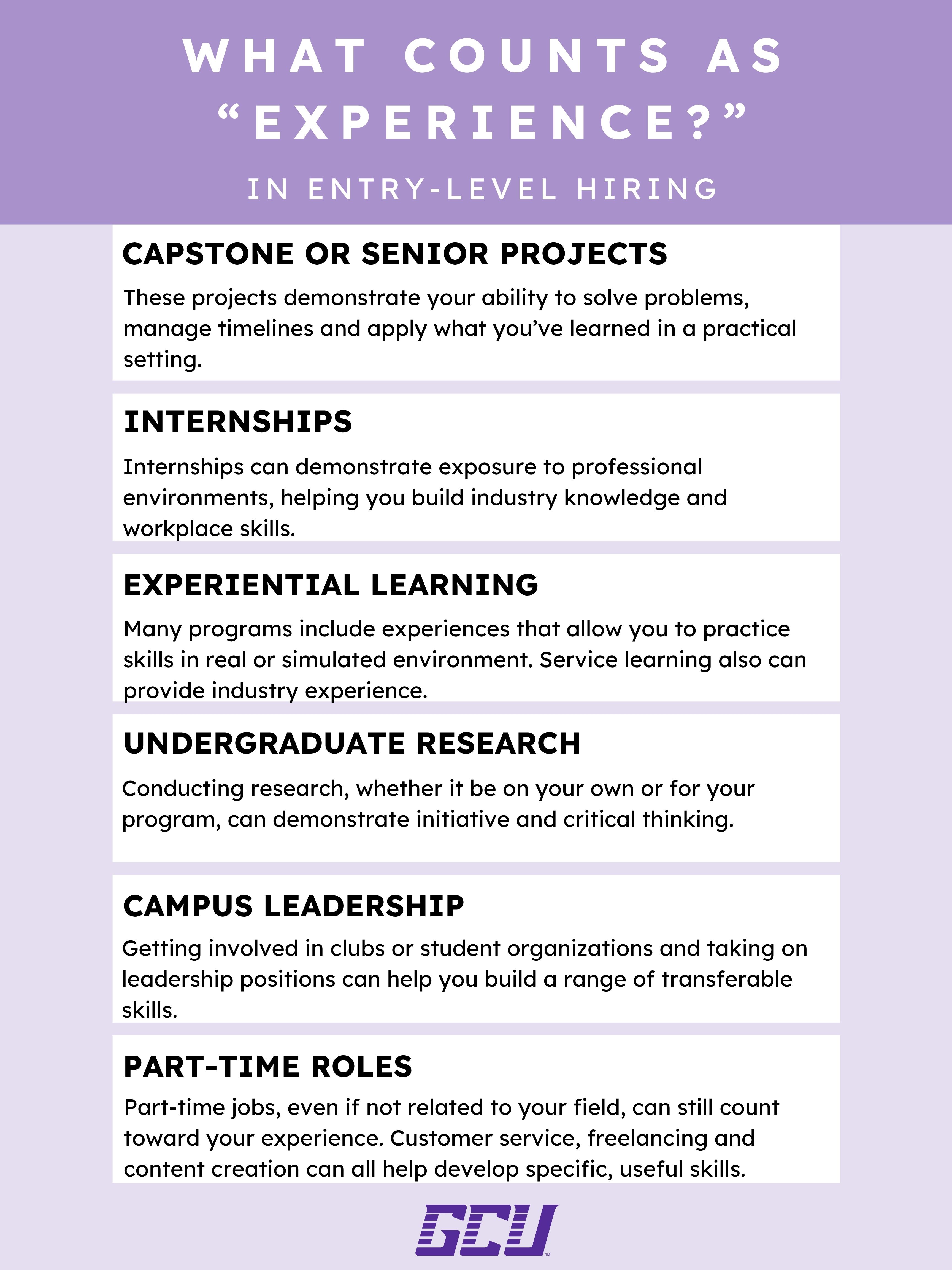
If you’ve completed any of the following during your time in college, or even prior to, you may already have relevant experience you can add to your resume:
Capstone or Senior Projects
Sometimes universities may partner with companies for capstone classes. Industry-partnered capstone projects in engineering programs may involve tackling a problem or design challenge posed by a company or nonprofit organization.(See disclaimer 3)
Internships
Internships, both in-person and virtual, can provide direct exposure to professional environments. Even short-term or part-time experiences can help you build industry knowledge, develop workplace skills and begin building your professional network.

Many universities host events to connect students with prospective employers and explore internship opportunities. Jennifer Singleton, Career Center operations manager, notes that throughout the year, GCU offers “over 100 opportunities to connect employers to our amazing students,” including Career Readiness Week. “This week is aligned with mid-semester to help students get ahead of post-grad success — to help students prepare for the job or internship search,” and help move them from “I’m studying this” to “I can turn this into a job,” Singleton shares.
Experiential Learning in Your Degree Program
Many programs, like healthcare, business and teaching, include hands-on opportunities, such as client projects, labs, practicums or service learning. These experiences give you an opportunity to practice skills in real or simulated environments, which may help you feel more confident and prepared for your first role.
 John Kaites, dean of the Colangelo College of Business at GCU, shares how the business college integrates this experiential learning. “Business education is approached with a conviction that business can serve as a force for good,” he states. “Through experiential learning, we intentionally integrate faith, learning and work, enabling students to apply knowledge and values in real-world contexts and to lead with purpose, integrity and a commitment to service.”
Undergraduate Research
Participating in undergraduate research can show initiative and critical thinking. Research opportunities such as conducting literature reviews, analyzing data, working in a lab or presenting findings can be valuable experiences to reflect on.
Campus Leadership
Getting involved on campus through clubs, student organizations or leadership roles can help you build transferable skills like communication, teamwork and organization. These roles often include activities such as planning events, mentoring peers or contributing to student government, all of which can demonstrate responsibility and initiative.
Part-Time Jobs
Even if a job isn’t directly related to your field, it can still provide you with valuable experience. Customer service, tutoring, freelancing or even content creation can help you develop skills like problem-solving, adaptability and time management. Student worker positions on campus can also help build your professional skills.
There are also many opportunities for service learning that can enhance students’ understanding of their field and their experience.
"Some participated for credit, some for fun, but most to contribute to a greater cause that blesses the less fortunate and relieves those in need."
The Ingram Honors College participates in community service regularly to give back to the community and to provide students with hands-on experience.

"I love service, service is the best way we can reach people. There are so many different ways to serve outside of campus that’s important and valuable. You are working with other students, and the intentional community that it builds is awesome. You don’t get that anywhere else."
How Can a Degree Program Help Build Relevant Experience?
One way to uncover the experience you’ve already gained is to take a closer look at the work you’re already doing in your degree program. Your coursework is designed to help you build relevant skills that can translate directly into entry-level roles after graduation. Many programs at GCU emphasize applied learning, helping you practice concepts in meaningful ways.
Your curriculum likely includes a variety of assignments and experiential learning opportunities that go beyond reading and testing. These experiences allow you to apply what you’re learning, develop critical thinking skills and gain practical exposure to your field.
For example, you may complete:
In many cases, your coursework closely reflects the types of responsibilities you may encounter in your future career. For example, a business student might develop a marketing plan or analyze financial data, while a nursing student completes clinical hours focused on patient care. Education students gain experience through student teaching and lesson planning and technology students may build coding projects or troubleshoot systems.
Each of these experiences can help demonstrate to employers that you are developing the skills needed for the field, even when applying for a job with limited or no experience.
Turn Coursework Into Career-Ready Experience
To make the most of what you’re learning, it’s important to document and communicate your work in a way employers understand.
By being intentional about how you track and present your coursework, you can strengthen your resume and feel more confident when approaching a job application with limited or no job experience.
Your academic experience is more than coursework: it’s a foundation you can use as you take the next steps toward getting a job after college.
Build Experience Through Internships and Career Services
Another important step in gaining experience for a job is taking advantage of the support and opportunities available through career services. Many colleges and universities offer career-focused resources to help students prepare for the workforce, build professional skills and connect with potential employers. These resources can be especially helpful when exploring internship opportunities and applying for jobs.
If you’re not sure where to begin, consider connecting with career services early in your academic journey. You don’t have to wait until your final year; starting early can help you build experience over time and feel more prepared when it’s time to apply.
Here are a few ways to get started:
Why Do Internships Matter?
Internships can be an effective way to gain experience while still in school. Whether you complete a semester-long internship, a summer role, a micro-internship or a virtual opportunity, each experience can help you build skills, explore your field and expand your professional network. Even short-term or part-time internships can make a meaningful impact. They show employers that you’ve taken initiative to gain experience and can apply your knowledge in a professional setting.
Career Services at GCU
If you’re wondering how to get experience for a job or how to get a job after college, career services can be a valuable partner in your journey. GCU’s Career Services offers support to help you take the next step toward your professional goals. From personalized guidance to career readiness resources, the team is available to assist you throughout your academic journey and beyond.
GCU’s Career Services can help you:
"Resume building, networking and interviews — those were all super helpful. Not only just to get some experience under my feet, but also to kind of understand the motivations behind recruiters. You're not going to learn by thinking about it or by even consuming content about it. You're going to learn by actually getting your hands wet and doing what you want to learn. I was someone who had very, very high dreams, but I didn't know how to make them concrete and actual. GCU definitely made that possible for me."
Campus Involvement To Build Transferable Skills
In addition to coursework, campus involvement can play an important role in gaining job experience. Whether you participate in a club, student government or an honors college, these experiences can help you develop skills such as leadership, communication, teamwork and organization. Volunteering and service opportunities can also provide a sense of responsibility while allowing you to make a positive impact in your community. Volunteer experience is a big deal to employers and for good reason; it shows off skills like leadership, teamwork and communication that make you a strong candidate.(See disclaimer 4 )
How To Present Campus Experience on Your Resume
When creating a job application with no experience, it’s important to present your campus involvement in a professional way. Focus on what you contributed, the skills you used and any outcomes you helped achieve.
For example, organizing an event, leading a team or coordinating a project can all demonstrate your ability to take initiative and work collaboratively. When adding this information to your resume or application, instead of listing Member of student club, you might write: Collaborated with a team to plan and execute campus events, increasing student participation. Whenever you can quantify your results on a resume and share them in an interview, it can not only help an employer see your value, but also help build your confidence by reframing your thoughts on the abilities you possess.
Here are some additional tips to consider when adding campus experience to your resume:
This can help you show employers that you’ve been actively building skills throughout your college experience, supporting your path toward getting a job after college.
How To Approach the Application Process
When applying for a job with no experience, focus less on job titles and more on the skills and outcomes you bring. Employers hiring for entry-level jobs are often looking for candidates who can demonstrate a strong array of skills, not an extensive work history.(See disclaimer 1)
Start by reviewing the job description and identifying key skills or qualifications. Then, match those requirements to your own experiences, whether they come from class projects, internships or campus activities. This approach can help you create a stronger, more targeted job application with no experience.
Here are some tips to help you approach your job application with confidence:
As you continue learning how to get experience for a job, remember that applying is part of the process. Each application is an opportunity to refine how you present your skills and move one step closer to your first role.
How To Build a Resume With No Work Experience
Building a strong resume is an important step that accompanies applying for a job with no work experience. The key to making your resume stand out is to focus on what you have done and present it in a way that highlights your skills and potential and demonstrates your qualifications.
When creating a resume for entry-level jobs, consider including sections such as:
How you describe your experience on your resume matters. Focus on what you accomplished and the skills you used.
Example
Instead of saying: Completed group project
Try saying: Collaborated with a team of 4 to develop a marketing strategy, applying research and communication skills to present recommendations
This approach helps employers better understand your contributions and abilities, even in a job application with no experience.
Some additional helpful resume tips include:
If you are enrolled at GCU and need additional guidance on resume-building, GCU Career Services can support you with development, helping you present your experience in a professional and effective way as you prepare to get a job after college.
Take the Next Step: From Classroom to Career
As you prepare for your post-college job search, it’s important to remember that you are not starting from scratch. The work you’ve completed throughout your degree program has already helped you begin building valuable experience. Each class, project and opportunity has contributed to your skill set, helping you develop the knowledge and abilities that can help you qualify for work in your field.
At GCU, our online or on-campus programs are designed to support your journey by helping you grow as a communicator, leader and critical thinker while developing skills aligned with your career goals. Along with our purpose-built programs, we also offer numerous clubs and student organizations, experiential learning and research opportunities to build knowledge, gain experience and make meaningful connections that can support your transition into the professional workforce.
Take the next step toward gaining valuable experience while in college by finding the right bachelor’s degree program for you and continue moving toward your first career with confidence.
From Coursework to Career Confidence
Turn your college experience into skills that help you land your first job.