

Along with the bachelor's degree, an associate degree is one of two main categories of undergraduate programs that confer degrees. Students who have earned a high school diploma or their GED may apply to associate degree programs, which require fewer credits for completion compared to bachelor's programs.
Is an associate degree worth it when considering your career goals and academic interests? It isn’t always easy to determine which degree is best aligned with your intended future. It can be helpful to take a deeper dive into questions such as, What is an associate degree like compared to a bachelor’s degree? and Can you transfer an associate degree to a bachelor’s degree? Then, reflect on your aspirations to make the best choice for your future.
Exploring an Associate Degree?
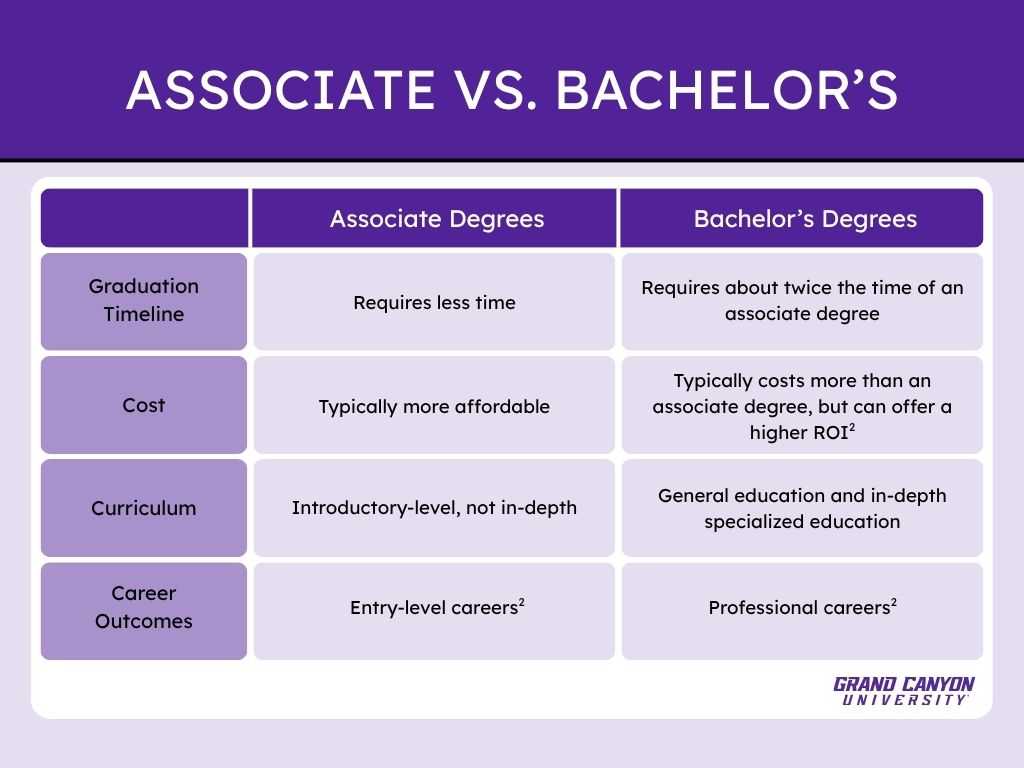
An associate degree is similar to a bachelor’s degree in that it is designed for undergraduate students (high school graduates or GED earners). However, for full-time students, it takes less time to complete an associate degree because of the reduced credit requirements.
The curriculum provides an introduction to the chosen field. It focuses on teaching entry-level skills and competencies. Due to the limited credit requirements, an associate degree does not typically take a deep dive into the nuances of the field.
Associate degrees are typically offered by community colleges or junior colleges. They may be available to on-campus students. There are also online associate degrees available.
There are three main categories of associate degrees, each of which has its own purpose or goal:
AA and AS degrees generally prepare students to transfer to a bachelor’s degree. With an AA degree, students typically take a set of liberal arts or humanities courses alongside courses in their area of concentration. AS degrees cover technical or scientific subjects.(See disclaimer 1 )
An AAS is an applied degree that typically focuses on developing technical skills for specific careers. They are recommended for students who are preparing to go directly into the job market from community or online college, as they are not typically designed to transfer to a four-year program, although there are exceptions.(See disclaimer 1)
Online Associate Degree Programs: What To Know
Like bachelor’s degrees, associate degrees are often available in flexible formats, such as in-person, hybrid and online associate programs. Online and hybrid options can suit the needs of working adults who need flexibility.
An online learning modality can be beneficial in other ways. Some online programs may offer lower tuition rates. Furthermore, because an associate degree requires fewer credits for completion, it can offer a faster pathway into the workforce.
It’s worth noting, however, that there are many online bachelor’s degrees, as well as those available in a hybrid or evening class format. Although they take more time to complete, bachelor’s degrees may offer advantages for those interested in pursuing professional careers according to College Transitions.(See disclaimer 2)
Is an Associate Degree Worth It?
For a balanced perspective, consider the pros and cons of each option. Some of the potential advantages of an associate degree include lower costs and a shorter time commitment. For some careers, an associate degree is the education required.(See disclaimer 2)
There are also some drawbacks to earning an associate degree. In some fields, graduates may find that opportunities for advancement are limited. Some positions require a bachelor’s degree for entry.(See disclaimer 2) According to College Raptor, if you decide to pursue further education later on, you’ll need to earn a bachelor’s degree before progressing to a graduate degree.(See disclaimer 3 )
According to the U.S. Bureau of Labor Statistics (BLS), each level of education you complete may be more desirable to employers and may help you develop more skills.(See disclaimer 4) Some employers also screen candidates during the hiring process, excluding those without a bachelor’s degree from consideration.(See disclaimer 2)
According to the BLS, the number of job openings projected over the next decade is more favorable for bachelor's degree holders. From 2024 through 2034, there are expected to be about two million job openings annually for individuals with an associate degree, some college or a non-degree award. In comparison, there are expected to be about 3.3 million job openings that require a bachelor's degree during that same time period.(See disclaimer 5)
Can You Transfer an Associate Degree to a Bachelor’s?
It’s often possible to transfer an associate degree to a bachelor’s program, and in fact, some students may enroll in online associate programs with the intention of transitioning to a bachelor’s degree later on. Policies do vary by school and program, however.
There are some key considerations when assessing a possible transfer. Schools may only accept transfer credits when they were earned at an accredited institution. Upon receiving a transfer application, the school will review the courses taken to determine if they are comparable enough to the courses offered at their school. If so, the credits have course equivalency and may transfer.
AA and AS degrees generally transfer well as general education credits. AAS degrees may not transfer as readily.(See disclaimer 1)
How Transfer Pathways Work
Transfer pathways differ from school to school, and it’s best to seek personalized guidance from the admission counselor at the school you’re considering transferring to. In general, however, an associate degree might fulfill roughly half or less of the requirements of a bachelor’s degree. You might enter your new school as a junior, for instance.
Grand Canyon University is one example of a university that welcomes transfer students. At our College Transfer Center, students can receive a personalized transfer plan. You can speak with a university counselor to determine how many of your credits might transfer to your new program.
Associate vs. Bachelor’s Degree: Which Is Right for You?
One way to determine if an associate's degree or a bachelor’s degree is right for you is to compare them directly. Consider the following:
Why Consider Going Straight to a Bachelor’s Degree?
If you already know that college is the right choice for you, you may be better served by enrolling directly in an online or on-campus bachelor’s degree. You’d enjoy continuity, as you wouldn’t have to first earn an associate degree and then transfer to another school to earn your bachelor’s. This would also eliminate the potential for losing credits if not all of them transfer.
Applying to a bachelor’s degree may also offer more options to choose from. At GCU, for example, you can choose from more than 160 bachelor’s degrees in online, hybrid and in-person formats (as of March 2026). Degrees are available in a diverse range of fields, including business, engineering, counseling, nursing and more.
How GCU Supports Transfer Students
If you do decide to earn an associate degree first, GCU is a transfer-friendly school that will support you through the process. Transfer credit acceptance varies by program. Our dedicated transfer specialists will review your transcripts and offer personalized guidance.
At GCU, you may be eligible to apply to scholarships designated specifically for transfer students. Military service members and veterans may also transfer up to 30 credits from military training and experience.
Next Steps: Choosing Your Education Path
Explore your options today to figure out what works best for you. Remember to consider factors such as your:
No matter how and which degree you choose to earn, higher education has the potential to open the door to your future.(See disclaimer 2,3)
Apply to GCU Today
GCU offers a variety of bachelor’s degrees to suit the needs and goals of every student. Fill out the form on this page to connect with a university counselor and explore the process of applying and transferring your credits to GCU.
A World of Possibilities Awaits You
Discover the many bachelor’s degree options at GCU.