


Why do siblings look alike but not exactly the same? Why do some health conditions run in families? How are scientists developing new treatments for inherited diseases? The answers to these questions begin with genetics.
Genetics is the study of genes, heredity and genetic variation in living organisms. Genetics helps explain how inherited traits are passed from parents to offspring and how differences in DNA contribute to the unique characteristics of every individual. Beyond understanding family traits, genetics plays an important role in medicine, agriculture, biotechnology and scientific research.
Learning about genetics can help students understand how living organisms function while opening the door to careers in biology, healthcare and research.
We spoke with Dr. Galyna Kufryk, professor in GCU’s College of Natural Sciences, to learn more about the field of genetics and how a degree from GCU can help you prepare for this career path.
Genetics Definition and Why It Matters
Genetics influences nearly every area of the life sciences. From diagnosing inherited diseases to improving crops, understanding genetics provides a foundation for many careers and scientific discoveries.
A Simple Definition of Genetics
At its core, genetics is the branch of biology that studies genes and how inherited characteristics are passed from one generation to the next. Genes contain instructions that influence many physical traits and biological processes, from eye color and blood type to how cells grow and function.
Scientists also study how genes interact with each other and with environmental factors. While genetics helps explain inherited characteristics, it also provides insight into disease risk, evolution and the diversity of life on Earth.
Today, genetics supports work in fields ranging from disease prevention and environmental conservation to forensic investigations and agricultural innovation.
Genetics as the Study of Heredity
Heredity refers to the process through which parents pass genetic information to their children. The terms genetics and heredity are often used interchangeably, but they are not the same. Heredity describes the transmission of traits, while genetics is the broader scientific discipline that examines heredity, genes, DNA, chromosomes and genetic variation.
By studying heredity, scientists have learned how traits are inherited, why some diseases run in families and how genetic changes contribute to biological diversity.
How Genetics Works
To understand genetics, it helps to start with the building blocks of life. Heredity is associated with chromosomes, which are composed of deoxyribonucleic acid (DNA) bound to proteins.
Genes and Genetic Information
Genes are segments of DNA that contain instructions for building proteins, the molecules responsible for carrying out many essential functions in the body. Every person inherits two copies of most genes, one from each biological parent. Simply put, genes act as the body’s instruction manual, helping direct how cells develop, function and communicate throughout life.
According to experts Francis Collins and Leslie Fink, although humans share more than 99% of their DNA, small differences in genes contribute to the unique characteristics that make each individual different.(See disclaimer 1) These variations can influence physical appearance, certain health risks and how the body responds to medications or environmental factors.
DNA and Chromosomes
DNA, is the molecule that stores genetic information. It is often described as a double helix, resembling a twisted ladder.
DNA is organized into structures called chromosomes. Humans typically have 23 pairs of chromosomes, with one chromosome in each pair inherited from each biological parent.
Within these chromosomes are thousands of genes that provide instructions for growth, development and normal body function. According to the National Human Genome Research Institute, scientists estimate that humans have approximately 20,000 protein-coding genes, although much of the genome also contains regulatory DNA that influences when and how genes are expressed.(See disclaimer 2)
How Traits Are Passed From Parents to Offspring
Traits are inherited through combinations of genes received from each parent. Some traits, such as blood type, are largely determined by a single gene. Others, including height or skin color, are influenced by many genes working together, as well as environmental factors.

Dr. Galyna Kufryk explains that genetics is built on a strong understanding of biology and chemistry. Studying how traits are inherited requires examining not only individual genes but also the complex interactions between genes and their environments.
One important concept in genetics is the flow of genetic information. In simple terms, DNA is transcribed into RNA, and RNA is translated into proteins. These proteins then carry out many of the functions necessary for life.
Key Concepts in Genetics
Several core concepts help scientists explain how genetic information is inherited and expressed. Learning these terms can make it easier to understand genetic research, inherited traits and the biological differences that exist within populations.
Inheritance and Heredity
Scientists study inheritance patterns to understand how traits and genetic conditions appear within families. These patterns help identify disease-associated genes, improve genetic counseling and advance medical research.
Genetic Variation
No two people, except identical twins, have exactly the same genetic makeup. Genetic variation gives every population a unique genetic makeup. It provides the diversity that allows species to adapt over time while also influencing individual differences in health, appearance and responses to environmental factors.
Genotype and Phenotype
Two important genetics terms are genotype and phenotype. A person’s genotype refers to the specific genetic information they inherit. A person’s phenotype refers to the observable characteristics produced by those genes, often influenced by environmental factors as well.
Understanding the relationship between genotype and phenotype helps researchers study inherited diseases, predict certain biological traits and better understand human development.
Examples of Genetics in Everyday Life
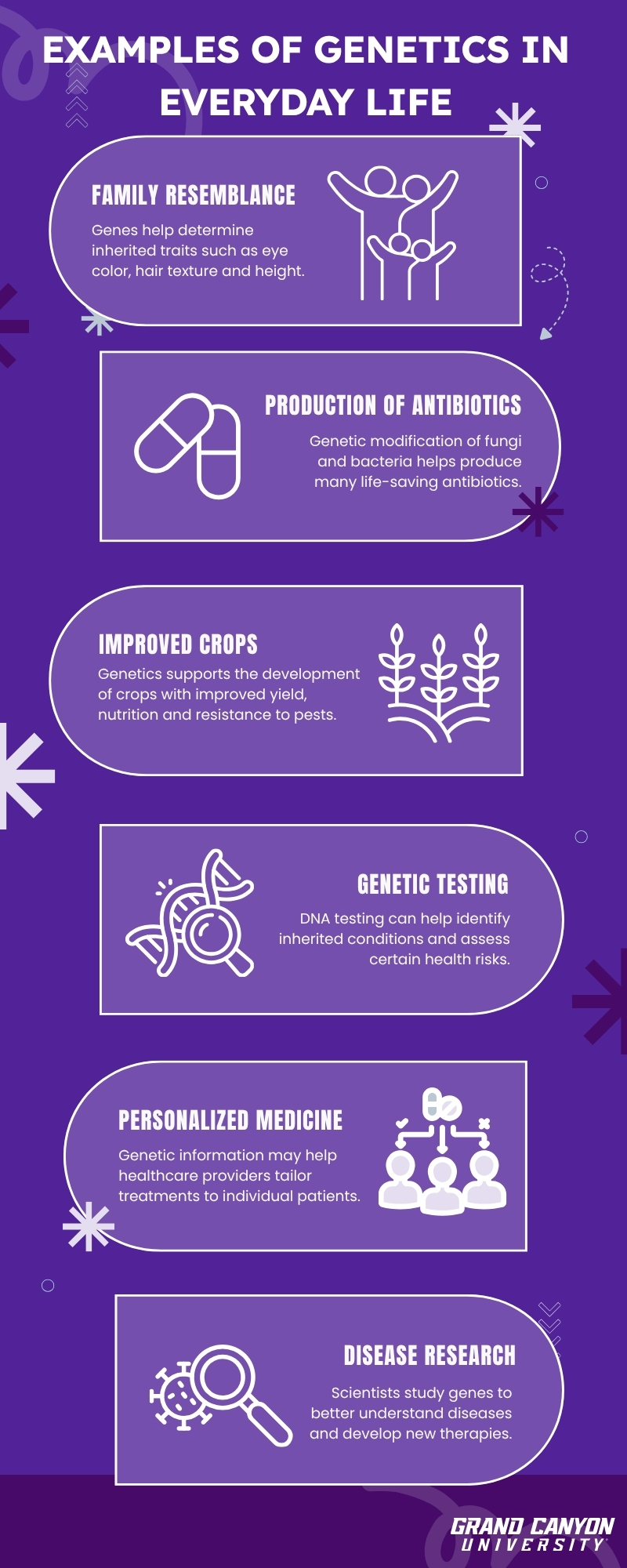
Genetics is not limited to laboratories or research facilities; it influences many aspects of everyday life. Family resemblance, inherited health conditions and advances in agriculture and medicine all demonstrate how genetics shapes the world around us.
Physical Traits and Family Resemblance
Many people first encounter genetics by noticing similarities within their families. Hair texture, facial features and even dimples may be influenced by inherited genes.
However, genetics is rarely as simple as inheriting one trait from one parent. Most characteristics result from combinations of many genes interacting together, which explains why siblings often resemble one another without looking identical.
Genetic Conditions and Health
Genetics also influences human health. Some inherited conditions are caused by changes in a single gene, while others involve multiple genes combined with environmental factors. Genetic testing helps identify inherited disorders, assess disease risk and guide treatment decisions.
Dr. Kufryk has witnessed significant advances in the field throughout her career. She shares, “Genome sequencing and proteome analysis became readily available, and modern software for sequence comparison and analysis was developed. This laid the foundation for the advances of genetics in the last few decades.”
These advances continue to expand scientists’ understanding of disease while creating new possibilities for diagnosis, treatment and personalized medicine.
Genetics in Plants and Animals
Genetics extends far beyond human biology. Scientists apply genetic principles to improve crop production, develop disease-resistant plants, protect endangered species and better understand animal populations.
Dr. Kufryk points to the production of antibiotics as an example of genetics influencing everyday life in ways many people may not recognize. She explains, “In human history up until about the 1950s, infections were the leading cause of death in all age groups.(See disclaimer 3) With the advent of antibiotics, bacterial infections for the most part are under control, and currently they are causing only 13.6% of all human deaths worldwide.(See disclaimer 4) Commercial production of antibiotics would not be possible without genetic modifications of the species that produce these drugs: fungi and bacteria.(See disclaimer 5)”
She adds, “Most people do not realize that genetics plays a key role in the production of antibiotics, and thereby it literally changed the course of medicine and human history.”
This example illustrates how genetics contributes to advances that affect public health on a global scale.
Major Types of Genetics
As scientific knowledge has expanded, genetics has developed into several specialized fields that focus on different aspects of heredity and genetic variation. Together, these branches help researchers answer questions ranging from how individual genes function to how species evolve over time.
Classical Genetics
Classical genetics focuses on patterns of inheritance first described through the work of Gregor Mendel. By studying how traits are passed between generations, scientists established many of the foundational principles that continue to guide genetics today.
Molecular Genetics
Molecular genetics examines genes at the molecular level. Researchers study DNA, RNA and proteins to understand how genes function, how mutations occur and how genetic information influences cellular processes.
This field plays a central role in gene editing, genetic testing and biotechnology.
Population and Evolutionary Genetics
Population genetics studies how genetic variation changes within groups of organisms over time. Evolutionary genetics examines how natural selection, mutation and other evolutionary processes shape species across generations.
Together, these fields help scientists understand biodiversity, species adaptation and the evolutionary history of life on Earth.
Genetics and Modern Science
Advances in genetics continue to drive discoveries across healthcare, biotechnology and scientific research. New technologies allow scientists to study genes with greater precision, leading to innovations that improve our understanding of biology and human health.
Genetic Research and Discovery
The field of genetics has advanced rapidly over the past several decades, thanks to improvements in technology that allow scientists to analyze DNA and proteins more efficiently than ever before.
These technological developments continue to accelerate scientific discovery and deepen researchers’ understanding of genetics across medicine, biology and biotechnology.
Genetics in Medicine
Modern medicine increasingly relies on genetics to better understand inherited diseases and develop targeted treatments. Researchers continue exploring ways to use genetic information to improve diagnosis and develop more personalized approaches to care.
"In my opinion, gene editing and gene therapy have the greatest impact on modern medicine and genetic research."
These emerging technologies continue to shape the future of healthcare while expanding scientists’ ability to study and treat genetic conditions.
Genetics and Biotechnology
Biotechnology applies genetic knowledge to develop products and technologies that benefit society.
Examples include producing medications, improving agricultural crops, developing vaccines and engineering microorganisms for industrial applications.
As Dr. Kufryk explains, genetics has applications across numerous disciplines, including medicine, agriculture, environmental protection, biotechnology and bioengineering. These broad applications demonstrate how genetics extends well beyond the laboratory into many industries that influence everyday life.
Benefits and Challenges of Genetics
Like many scientific fields, genetics offers both exciting opportunities and important responsibilities. Advances in genetics continue to improve healthcare, agriculture and biological research, while also raising ethical questions about how genetic information should be used, protected and regulated.
Opportunities for Healthcare and Research
Genetics has created new opportunities for scientific discovery, healthcare innovation and biological research. Researchers continue exploring ways to improve disease diagnosis, develop targeted therapies and better understand living organisms.
Students interested in studying genetics often benefit from a strong academic foundation.
Dr. Kufryk shares, “Genetics is a complex discipline that requires a solid foundational knowledge of biology and chemistry. People with a good academic background, who are detail-oriented and have strong analytical skills tend to do exceptionally well in studying genetics.”
Ethical and Privacy Considerations
As genetics continues to advance, scientists must carefully consider how new technologies are developed and applied. Alongside scientific progress, researchers continue discussing topics such as informed consent, genetic privacy and equitable access to genetic technologies to help ensure these innovations are used responsibly.
Dr. Kufryk emphasizes the importance of responsible research. She says, “There is a significant potential for unintended consequences of genetic manipulations that could lead to unpredictable outcomes. That is why genetic experiments and genome interventions are heavily regulated in the vast majority of countries.”
Related Genetics Programs and Career Paths
Students who enjoy learning about genetics may choose to continue their education in biology or a related life science field. Knowledge of genetics can support careers in research, biotechnology, healthcare, environmental science and other STEM disciplines.
Genetics Degree Programs
Students interested in genetics often begin with a bachelor’s degree in biology or another life science discipline.
GCU’s Bachelor of Science in Biological Sciences introduces students to foundational concepts in genetics, molecular biology, chemistry and cellular biology while helping build laboratory and scientific reasoning skills. Students may also explore other science degree programs offered through GCU’s College of Natural Sciences depending on their interests and career goals.
Research and Laboratory Opportunities
Learning genetics extends beyond classroom lectures by giving students opportunities to explore how genetic principles are applied in scientific research.
Dr. Kufryk explains, “Every fall semester, GCU offers the Advanced Genetics lecture (BIO 475) and lab (BIO 475L) course where students can gain hands-on experience in genetic techniques and gene modifications. Advanced Genetics is the core course for the Molecular and Cellular Biology program of study, and it can be taken as an elective course by other biology majors.”
She also describes how students connect genetics to current scientific challenges. She states, “In Genetics and Honors Genetics, students are engaging in discussions regarding genetic principles and gene modification as the tools for solving current problems in various fields (medicine, agriculture, environmental protection, biotechnology, bioengineering, etc.). Cutting-edge genetic topics and techniques and their practical applications are the foundation of our Advanced Genetics courses.”
These experiences help students see how genetics can be applied across a wide range of scientific disciplines and industries.
Careers in Genetics and Genomics
A background in genetics can prepare graduates for careers in science and healthcare, depending on their education, experience and any additional training required for specific roles.
Career opportunities for graduates with a biology degree may include:
Frequently Asked Questions About Genetics
Explore answers to these commonly asked questions about genetics and decide if a biology degree is right for you.
What are genes?
Genes are segments of DNA that contain instructions for building proteins and regulating many biological processes. They influence inherited traits and help determine how cells grow, develop and function.
What is the difference between genetics and heredity?
Heredity is the biological process through which traits are passed from parents to offspring. Genetics is the scientific field that studies heredity, genes, DNA, chromosomes and genetic variation.
Can you study genetics with a biology degree?
Many students interested in genetics earn a bachelor’s degree in biology, which can provide a foundation for careers or graduate education in genetics, genomics, biotechnology or related scientific fields.(See disclaimer 6) Biology programs often include genetics coursework alongside laboratory experiences that help students build foundational scientific knowledge.
Explore Biology and Genetics at GCU
Genetics continues to shape discoveries in medicine, biotechnology, agriculture and many other scientific fields. If you’re interested in understanding how living organisms function and exploring the science behind heredity and genetic research, GCU’s BS in Biological Sciences and other science degree programs can help you build a strong foundation in biology while gaining exposure to genetics through coursework and laboratory learning opportunities. Learn more about GCU’s biology degrees and discover how a science education can prepare you to contribute to the future of scientific discovery.
Explore Science Degrees at GCU
Discover GCU’s science degree programs and explore educational pathways that can help prepare you for genetics-related careers.


