

A nursing capstone project is often one of the culminating experiences of a nursing degree program. It gives students an opportunity to bring together knowledge and competencies developed throughout their coursework and apply them to a nursing practice issue or organizational need.
Depending on the program, a nursing capstone may involve identifying a practice gap, reviewing current evidence, proposing or implementing an intervention and evaluating the results. If you are preparing for a nursing capstone, understanding what to expect can help you approach the experience with a plan.
What Is a Capstone in Nursing?
A nursing capstone allows nursing students to apply knowledge and competencies from their degree program to an issue related to nursing practice. The exact format and requirements vary by school and program, but nursing capstones may involve evidence-based practice, quality improvement, program evaluation or another type of practice-focused project.

“The projects provide an opportunity to address a current need for the organization they are completing their practicum experience with guidance and mentorship by their preceptor and course faculty,” explains Dr. Christy Torkildson, program lead for the Master of Science in Nursing with an Emphasis in Public Health Nursing and the Master of Science in Nursing with an Emphasis in Health Care Quality and Patient Safety at GCU.
Although nursing students may conduct an extensive literature review as part of their capstone, a capstone project is not necessarily a research study. Dr. Torkildson explains that many projects focus on quality improvement, program evaluation or other activities that do not constitute human subjects’ research. Requirements vary by nursing program, so students should follow the guidelines established for their specific capstone course and degree.
"Capstone projects are geared for helping learners demonstrate the knowledge and skills they have gained in their respective programs."
What To Expect From a Nursing Capstone
During a nursing capstone, you can expect to apply knowledge from your coursework to a specific practice or organizational need. Although the experience varies by nursing program, you will work with faculty and a preceptor to identify a gap, review relevant evidence, develop a project and evaluate your work.
According to Dr. Torkildson, students may identify a gap themselves or work with their preceptor to determine a need at their practicum site. She adds that students often present their completed projects to classmates and leadership at their practicum site. In some cases, students may also work with their preceptors to pursue opportunities to share their work through a professional webinar, conference or publication.
What Are Common Nursing Capstone Requirements?
Nursing capstone requirements vary by school, degree level and nursing program. Depending on your program, a capstone may include a practicum experience, scholarly literature review, evidence-based project, project evaluation and final presentation.
Common components of a nursing capstone can include:
Is a Nursing Capstone a Research Project?
A nursing capstone is not necessarily an original research project. Although students may conduct a significant review of existing evidence, many capstone projects focus on applying evidence through quality improvement, program evaluation or another practice-focused project.
Dr. Christy Torkildson explains that many of the capstone projects she works with are focused on quality improvement rather than human subjects research. Students may review existing research and evidence-based guidelines to determine what current evidence recommends and then use that information to address an identified practice or organizational need.
This makes the literature review an important part of the capstone process. Students should be prepared to assess whether sources are current and academically appropriate, evaluate the quality of the research and determine whether the evidence applies to the specific problem their project addresses.
How To Choose a Nursing Capstone Project Idea
A strong nursing capstone topic should address an identifiable need while being specific enough to explore within the requirements and timeframe of your program. Rather than starting with a broad subject that interests you, consider an identifiable practice or organizational need that could be examined through your capstone.
Your faculty and preceptor can be valuable resources during this process. “Working with their preceptor, learners may complete a needs assessment to identify a gap they can address with their project,” Dr. Torkildson says. She adds that preceptors may also have existing projects that students can participate in or take a leadership role on.
When considering potential topics, ask yourself:
Before moving forward with an idea, discuss its feasibility and scope with your faculty and preceptor; both your preceptor and faculty must approve your proposed project. They can help you determine whether the project aligns with program requirements and can reasonably be completed within the capstone experience.
Nursing Capstone Project Ideas
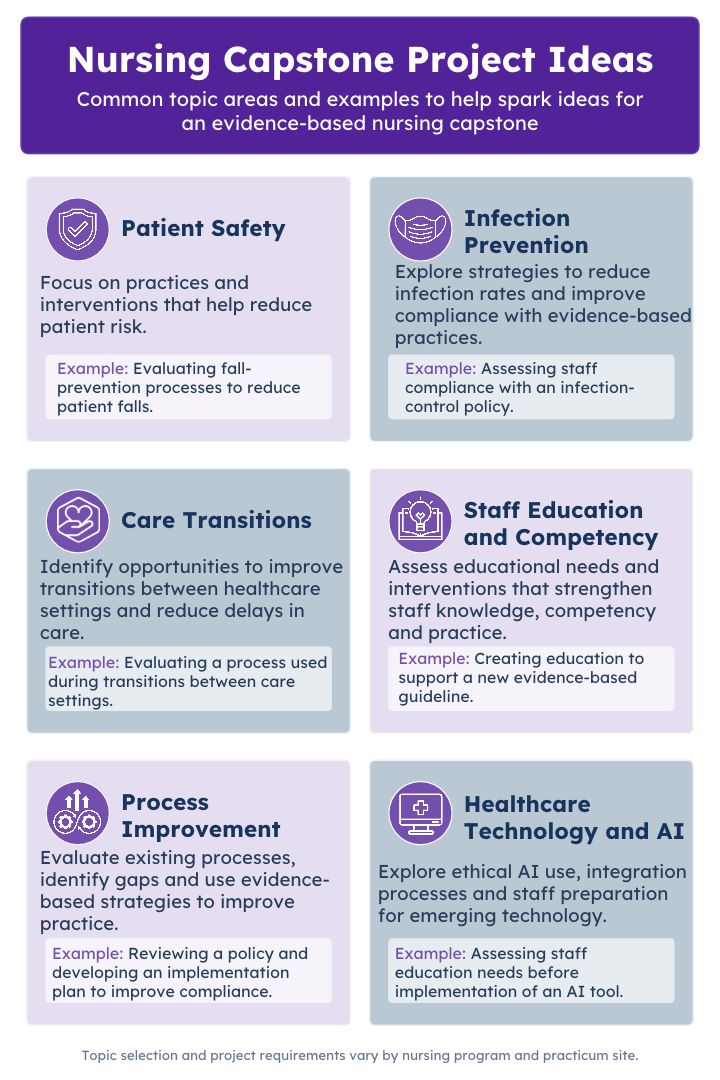
Nursing capstone project ideas can focus on patient safety, quality improvement, clinical processes, staff education, healthcare access or emerging technologies. The right topic will depend on your program requirements and the needs identified at your practicum site.
Potential areas to explore may include:
Dr. Torkildson emphasizes that evidence-based practice guidelines continue to evolve, creating opportunities for healthcare organizations to evaluate whether their current practices align with the latest evidence. This means a capstone idea does not necessarily need to involve an entirely new problem. Students may find meaningful opportunities by examining an existing practice and determining whether there is evidence to support an improvement.
"There are always rapidly evolving evidence-based practice guidelines that may need to be updated or implemented at the practicum site."
Nursing Capstone Project Examples
Nursing capstone projects can address a range of practice and organizational needs. Dr. Torkildson has seen nursing students complete capstone projects addressing issues such as healthcare-associated infections and gaps in staff competency or compliance. The following examples demonstrate that a nursing capstone does not necessarily begin with a predetermined solution. Instead, students can identify a need, examine the available evidence and use their findings to develop and evaluate an appropriate approach.
Example 1: Addressing Healthcare-Associated Infections
One nursing capstone project Dr. Torkildson has seen addresses increased healthcare-associated infections within a facility. The student may begin by reviewing existing policies and processes and assessing staff compliance. A literature review can then help determine whether current practices align with the latest evidence and whether changes may be appropriate.
Based on those findings, the student may develop and implement approved interventions, evaluate their impact, and determine whether additional revisions are needed. This type of project demonstrates how evidence can guide a quality improvement initiative from identifying a gap through evaluation.
Example 2: Addressing a Staff Competency or Process Gap
Dr. Torkildson has also seen capstone projects focused on gaps in staff competency or adherence to an established process or new policy. A student may begin by identifying the practice gap and assessing staff educational needs.
The project may then involve researching evidence-based interventions that could improve competency or compliance, developing and implementing an appropriate intervention and evaluating staff comprehension and competency. Follow-up can help determine whether the intervention resulted in changes to practice and whether revisions are needed.
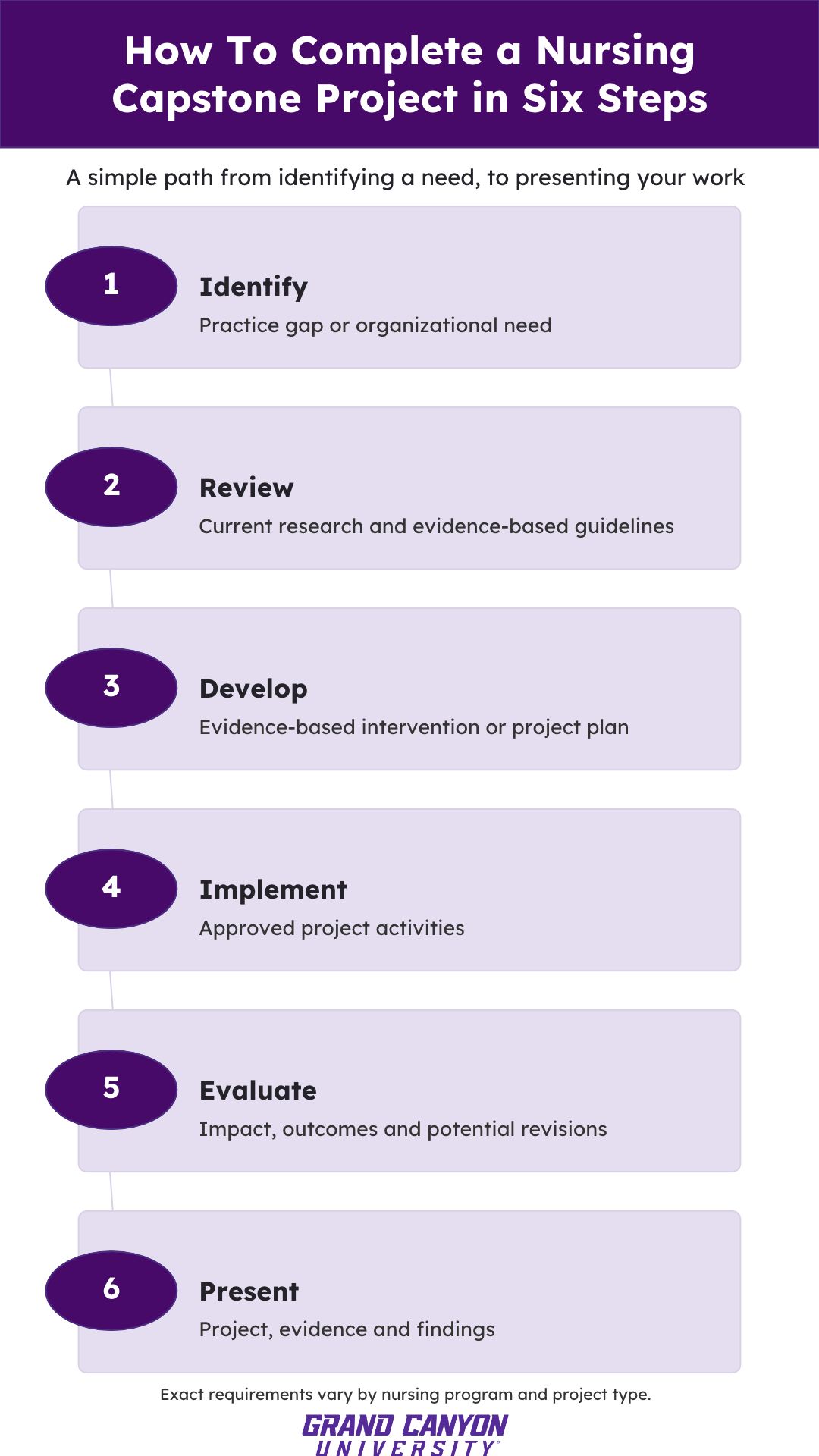
How To Complete a Nursing Capstone Project in Six Steps
The process for completing a nursing capstone varies by program and project type. In general, you can expect to move from identifying a practice or organizational need to reviewing evidence, developing your project and evaluating your work. Your faculty and preceptor can provide guidance throughout the process and help ensure your project meets program requirements.
1. Identify a Practice Gap or Need
Start by identifying an issue that could benefit from evaluation or improvement. Depending on your program, you may conduct a needs assessment, work with your preceptor to identify an organizational priority or contribute to an existing initiative at your practicum site.
2. Review the Current Evidence
Search for current scholarly literature and evidence-based guidelines related to the issue you identified. Evaluate the quality and relevance of your sources rather than relying solely on your own professional experience to determine what intervention may be appropriate.
"All capstone projects must be based on evidence-based practice or guidelines. The review of the literature to determine the evidence-based practice/guideline is essential in any capstone project."
3. Develop Your Project
Use your findings to determine an appropriate intervention, improvement strategy or other project activity. Your plan should reflect the available evidence while remaining within the scope and requirements of your nursing program.
4. Implement the Approved Plan
If implementation is part of your capstone requirements, carry out the approved activities at your practicum site. Continue communicating with your faculty and preceptor as you work through the project and address questions or challenges that arise.
5. Evaluate the Project
Determine whether the intervention or project activities addressed the identified need. Evaluation may also identify opportunities to revise the intervention or determine whether additional improvement is needed.
6. Present Your Work
Your final capstone presentation may summarize the practice gap, evidence you reviewed, project activities and evaluation. Dr. Torkildson notes that students may present their work to classmates and leadership at their practicum site. Depending on the project and opportunity, some students may also work with their preceptor to pursue a professional presentation or publication.
Common Challenges with Nursing Capstone Projects
Nursing capstone projects can require you to balance evidence, program expectations and the needs of your practicum site. Understanding some common challenges before you begin may help you approach your project more thoughtfully.
Common capstone challenges include:
"The most common mistake is assuming that they know the best intervention based on professional experience rather than a review of the literature. Actual practice does not always represent the evidence-based practices or guidelines for a variety of reasons. The mindset that ‘we have always done it this way’ is a challenge to overcome."
Tips for a Successful Nursing Capstone
Preparation, communication and organization can help you manage the different components of a nursing capstone.
As you work through your project, consider these tips:
Dr. Torkildson encourages students to be open about what they know and don't know while also recognizing the knowledge they have developed throughout their nursing coursework. “Be respectful, but don’t be afraid to offer suggestions or ask questions,” she advises. A capstone is an opportunity to bring those competencies together while continuing to seek guidance when needed.
Complete a Nursing Capstone at GCU
A nursing capstone can give you an opportunity to bring together the knowledge and competencies you have developed throughout your degree program. At GCU, Bachelor of Science in Nursing (BSN) students complete an evidence-based project capstone that incorporates evidence-based practice and PICOT principles and culminates in the development and presentation of a clinical change project.
If you are interested in preparing for a career in nursing, explore GCU's BSN programs and discover how nursing coursework and clinical experiences can help you develop foundational competencies for professional nursing practice.
Earn Your Nursing Degree at GCU
Prepare to pursue your nursing goals with a curriculum designed to build competencies in evidence-based practice, clinical care and nursing.