


How To Become a Math Teacher
What Is a Math Teacher?
Math teachers are educators who specialize in teaching mathematics concepts and skills. Typically, math teachers teach middle school and high school students, although some may serve as math interventionists who specialize in teaching this subject area to elementary school students.
Math teachers educate students on general mathematics concepts and principles, while also teaching critical thinking and analytical reasoning skills. They may teach general math to elementary students or specialized math to middle and high school students in areas such as geometry, algebra, statistics, trigonometry and calculus.
Percentage of US adults surveyed who state math skills are “very important” in their personal life(See disclaimer 1)
What Does a Math Teacher Do?
Math teachers are responsible for preparing students to succeed not only academically, but also vocationally and personally. Math skills are widely considered to be very important, both for work and everyday life.(See disclaimer 1) From navigating a car loan to planning an event to managing a household, math skills will play a significant role in each student’s life as they graduate and become active members of society. It’s a math teacher’s job to inspire and empower students to approach mathematical problems with confidence.
The specific tasks of a math teacher can include the following:(See disclaimer 2)
Lesson plans
Developing lesson plans and classroom activities
Assignments
Creating and grading assignments, quizzes and exams
Instruction
Instructing students in math concepts and problem-solving skills
Class environment
Fostering a supportive and welcoming learning community
Behavior management
Establishing and enforcing classroom rules, and managing student behavior
Meetings
Meeting with parents to discuss student progress, and meeting with other faculty and administrative staff
What Experience and Education Does a Math Teacher Need?
A math teacher needs postsecondary education in both mathematics and pedagogy, as well as student teaching experience, in order to obtain a teaching license or certification. The specific requirements to become a math teacher may vary from one state to the next. In addition, public school teachers must meet different requirements than private school teachers, as private schools establish their own requirements that are independent of state requirements.(See disclaimer 3 )Before beginning your pathway, research the requirements for your state and your desired work setting.
High School Diploma
College Degree
Student Teaching Experience
Licensure
Endorsements
Graduate Degrees
Best Degrees for Math Teachers
What is a math teacher’s best degree option? Ideally, a future math teacher will earn a degree in education that has a concentration in mathematics. It’s important to consider whether the degree will meet licensure requirements in the state, as well as whether it teaches critical topics in education, such as instructional methods and curriculum design.
The best degrees for those interested in how to become a math teacher will cover these competencies:(See disclaimer 3,6)
Curriculum design
Classroom management
Student assessments
Instructional design
Learning theories
Mathematics
GCU Recommends These Degree Programs for Math Teachers




What Skills Does a Math Teacher Need?
An aspiring math teacher needs hard skills to be able to teach their subject area effectively to students, assess student progress and plan the curriculum. Math teachers also need soft skills that can assist them in developing a good rapport with students and inspiring students to achieve their full potential.
Some of the top skills and qualities for math teachers include:(See disclaimer 2,3)
Communication skills
Patience
Resourcefulness
Math competencies
Organization skills
Problem-solving skills
Where Do Math Teachers Work?
Math teachers often teach in public schools. Although an aspiring teacher can generally expect to pursue employment in a school, there may be other settings in which education competencies are applicable.(See disclaimer 7) Transferable skills may open the door to a variety of teaching careers.
Some of the possible work settings for math teachers may include:(See disclaimer 7,9)
Public and Private High Schools
At the high school level, math teachers typically teach various types of math classes exclusively, rather than a variety of subjects.
Public and Private Elementary Schools
Although an elementary school teacher usually teaches a variety of subjects, math teachers in elementary schools may be mathematics specialists who focus on their content area.
Nonprofit Youth Organizations
In these settings, math teachers may work with students in after-school programs and community programs, giving them the extra help needed to succeed.
Government Agencies
An education degree and experience teaching math may lead to work opportunities within state and federal government agencies that focus on education policies and resources.
Median annual salary for high school teachers as of May 2024(See disclaimer 8)
Expected average number of job openings for high school teachers, each year, from 2024 to 2034(See disclaimer 10)

Advancement Opportunities For Math Teachers
After gaining experience as a mathematics teacher, you may advance to the position of lead math teacher. In this role, you would likely provide mentorship to new teachers and student teachers. With additional education and certification, some math teachers may advance to administrative roles in the school system. Others may become instructional coordinators.(See disclaimer 3)
Explore More on Math Teachers
It’s always a smart idea to take a closer look at the nuances of this career path before enrolling in an education degree program. These GCU blogs explore some top reasons to consider this career, why math is essential in all fields and how math teachers can engage their students.
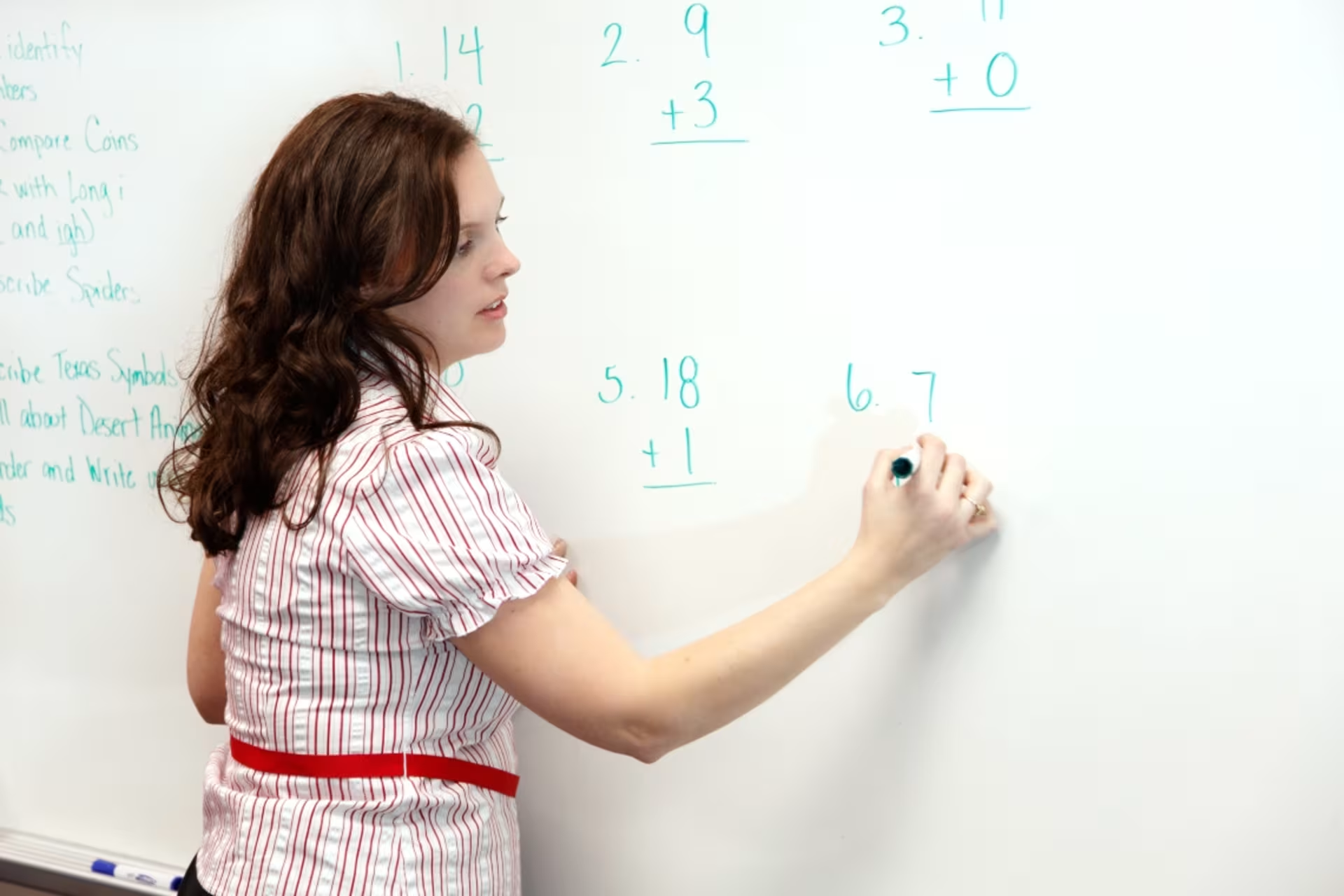
Looking for motivation to learn how to become a math teacher? Explore these top five reasons why this career might suit you well.

Math is essential for people in all types of professions. Learn more about how math teachers prepare students to excel for all sorts of future careers.

What does a math teacher do to engage students? It’s all about making math meaningful, such as by relating lesson plans to real-life concepts and telling a story for context.

If you’re passionate about mathematics and want to share your love of learning with students, start your journey to becoming a math teacher at GCU!
- Senseman, K. (2025, Aug. 14). Can’t Get By Without Math in Daily Life? Gallup. Retrieved February 2026.
- Indeed Employer Content Team. (2025, March 4). Match Teacher Job Description: Top Duties and Qualifications. Retrieved June 2026.
- U.S. Bureau of Labor Statistics. (2025, Aug. 28). How to Become a High School Teacher. Occupational Outlook Handbook. Retrieved February 2026.
- Learn.org. (n.d.). Become a High School Math Teacher in 5 Steps. Retrieved February 2026.
- Arizona Department of Education. (n.d.). Endorsement Requirements. Retrieved February 2026.
- Sallie. (n.d.). Your Guide to Majoring in Education. Retrieved February 2026.
- U.S. Bureau of Labor Statistics. (2025, Aug. 28). High School Teachers: Work Environment. Occupational Outlook Handbook. Retrieved February 2026.
- AllEducationSchools.com. (2026, Feb. 9). What Can I Do With a Teaching Degree (Besides Teach)? Retrieved February 2026.
- The earnings referenced were reported by the U.S. Bureau of Labor Statistics (BLS), High School Teachers, as of May 2024, retrieved February 2026. Due to COVID-19, data from 2020 to 2023 may be atypical compared to prior years. BLS calculates the median using salaries of workers nationwide with varying levels of education and experience. It does not reflect the earnings of GCU graduates as high school teachers, nor does it reflect the earnings of workers in one city or region of the country or a typical entry-level salary. Median income is the statistical midpoint for the range of salaries in a specific occupation. It is very unlikely that a median salary will reflect an entry-level salary. It represents what you would earn if you were paid more money than half the workers in an occupation, and less than half the workers in an occupation. It may give you a basis to estimate what you might earn at some point if you enter this career. Grand Canyon University can make no guarantees on individual graduates’ salaries. Your employability will be determined by numerous factors over which GCU has no control, such as the employer the graduate chooses to apply to, the graduate’s experience level, individual characteristics, skills, etc. against a pool of candidates.
- COVID-19 has adversely affected the global economy and data from 2020 to 2023 may be atypical compared to prior years. Accordingly, data shown is effective August 2025, which can be found here: U.S. Bureau of Labor Statistics, Occupational Outlook Handbook, High School Teachers, retrieved February 2026.