


Bachelor of Science in Information Technology Degree
Discover the Fundamentals of Core IT Disciplines
Earning a Bachelor of Science in Information Technology (BSIT) at Grand Canyon University allows you to explore IT disciplines such as networking, programming and data management. Through hands-on coursework and problem-solving projects, you’ll be taught how to design, implement and support technology systems.

Up to 90 credits, only 84 can be lower division
Credits: Fill out the Lopes Eval to find out what will transfer
Admission Requirements (Bachelor's)
- 16+ years old
- High School Graduate
- 2.8+ Unweighted GPA
OR 2.5+ Unweighted GPA and
- ACT: 19
- SAT: 1000*
Admission requirements may differ based on degree level, program and modality, or transfer status. Some programs of study may require a higher GPA and/or other qualifying criteria for admission. Please review full admission and program requirements in the University Policy Handbook.
*Math and reading only on a 1600 point scale (test date after 3/1/2016). SAT score of 1380 required for 2400 point scale (test date before 3/1/2016).

Develop IT Skills in Networking and Software Development
This bachelor’s in information technology can help you build progressive technical skills while growing as an ethical, forward-thinking IT professional. Guided by knowledgeable faculty, you can develop practical abilities in computer systems, architecture and data management, which are grounded in hands-on application.
Whether studying on campus with access to GCU’s vibrant Christian community, or online with flexible learning options, you’ll be supported as you prepare to innovate in the IT field.
Online Bachelor's in IT Coursework
As a BS in Information Technology student, you will be taught to use technology to solve problems within an organization. You will study how to deploy, configure and manage local technology and cloud-based applications. The coursework focuses on skills that involve analyzing existing tools and platforms to optimize their use and gain hands-on experience with scripting by writing and executing functions in multiple languages.
Recognizing the importance of soft skills in the IT field, the program also emphasizes communication, critical thinking and problem-solving to support effective decision-making. You will explore how to best advise clients on technology solutions that align with their goals and gain insights into IT project management and professional practices through interactive tech-driven coursework.
Students in the information technology degree program can gain hands-on experience in:
Windows and Windows server administration
Linux and Linux server administration
Corporate and enterprise networking
Database architecture and administration
Cloud-based computing and systems
Security-driven systems administration
Prepare for Industry Certifications
GCU’s Bachelor of Science in Information Technology is aligned with industry IT certifications. It can help students prepare for certification exams, with additional study and practice, by building a strong base of theoretical and hands-on knowledge. The program also emphasizes practical application, helping prepare graduates with the professional and technical capabilities needed to perform effectively in a broad spectrum of IT roles.

This undergraduate information technology degree can help you prepare for concepts and practices aligned with these industry certifications:(See disclaimer 1)

Focus Your Degree
The BS in IT offers you the opportunity to personalize your academic journey through an emphasis in cybersecurity that reflects specific interests and career paths. Whether you want to secure critical systems or combat cyber threats, this emphasis provides expertise in network security, ethical hacking and risk management, built on a foundation of core computer science skills. Choosing a cybersecurity track can help you delve into advanced topics that will demonstrate the skills necessary for roles in digital defense, security architecture and incident response.
Career Opportunities for BSIT Degree Graduates
IT professionals may work across a variety of settings, including computer systems design companies, the finance and insurance industries, software publishing companies and manufacturing.(See disclaimer 2 )Working in collaborative teams and independently, IT professionals may work in a variety of specialized areas.
With this degree, graduates may go on to pursue careers as:
Information security analyst
Software quality assurance analysts and tester
Data scientist
Software developer
Database architect
Median annual wage for computer and information technology occupations as of May 2024(See disclaimer 3)
Openings projected each year, on average, in computer and information technology occupations from 2024 to 2034(See disclaimer 4)
Earn Your BS in IT Degree From an Accredited University
As an institutionally accredited university, GCU is proud to prioritize the quality of our education. The Higher Learning Commission has continually accredited GCU since 1968. The College of Engineering and Technology shares the university’s commitment to upholding the principles and standards established by our accrediting bodies.
Frequently Asked Questions
Read through some of the most frequently asked questions to learn more about earning your degree in information technology and pursuing a career in IT.
What is an IT degree?
Is an IT degree worth it?
What degree is best for information technology?
What's the difference between an IT and a computer science degree?
Is a Bachelor of Science in Information Technology hard?
Where can I work with a degree in information technology?
Program Curriculum
General Education Requirements
Core Courses

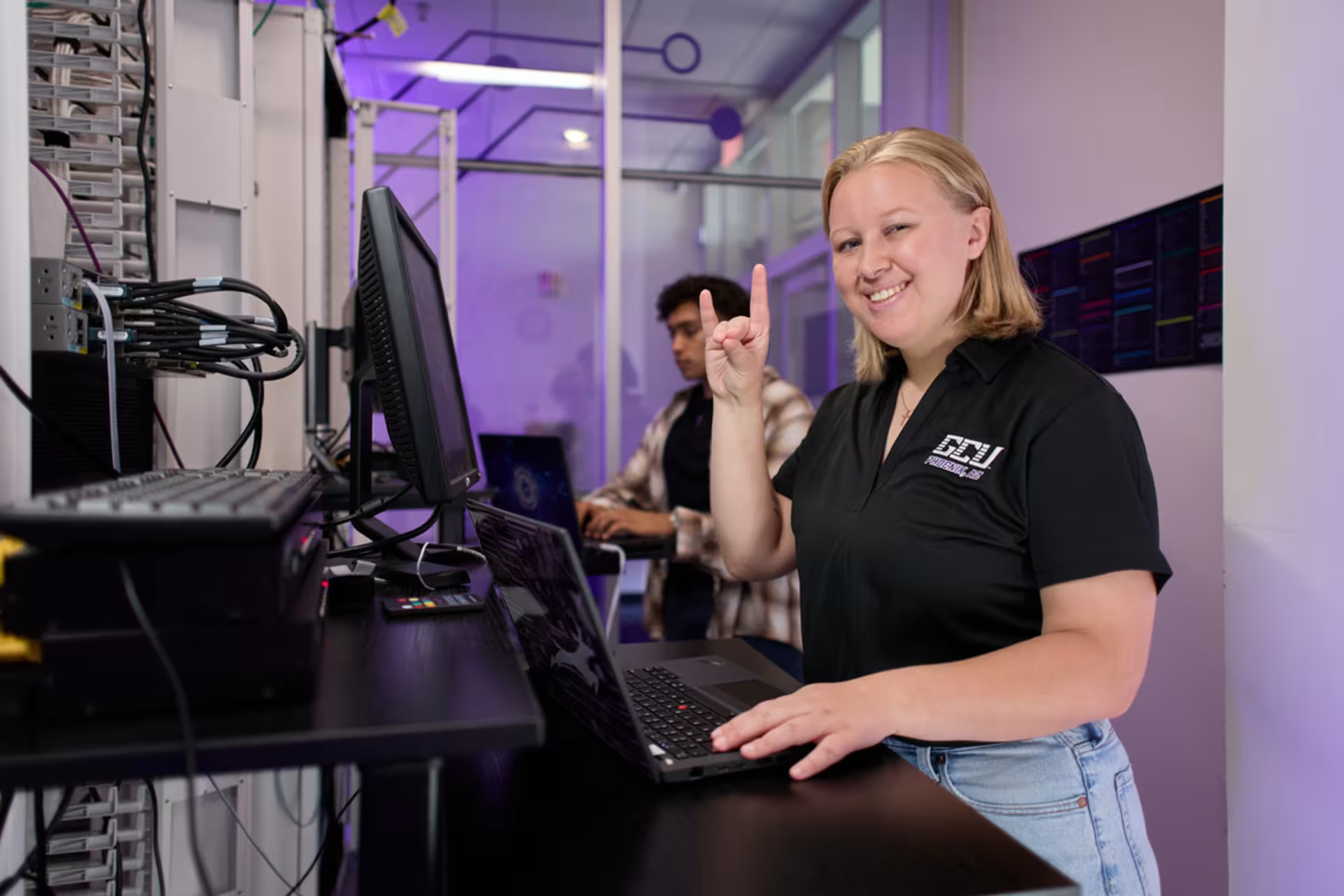
If you are passionate about building a future in technology, a degree in IT could be the right match for you. Apply to the College of Engineering and Technology and plan your career in IT.
- Grand Canyon University does not accept certification completion for credit or as a substitute for completing a course.
- U.S. Bureau of Labor Statistics. (2025, Aug. 28). Software Developers, Quality Assurance Analysts and Testers: Work Environment. Occupational Outlook Handbook. Retrieved October 2025.
- The earnings referenced were reported by the U.S. Bureau of Labor Statistics (BLS), Computer and Information Technology Occupations, as of May 2024, retrieved October 2025. Due to COVID-19, data from 2020 to 2023 may be atypical compared to prior years. BLS calculates the median using salaries of workers nationwide with varying levels of education and experience. It does not reflect the earnings of GCU graduates in computer and information technology occupations, nor does it reflect the earnings of workers in one city or region of the country or a typical entry-level salary. Median income is the statistical midpoint for the range of salaries in a specific occupation. It is very unlikely that a median salary will reflect an entry-level salary. It represents what you would earn if you were paid more money than half the workers in an occupation, and less than half the workers in an occupation. It may give you a basis to estimate what you might earn at some point if you enter this career. Grand Canyon University can make no guarantees on individual graduates’ salaries. Your employability will be determined by numerous factors over which GCU has no control, such as the employer the graduate chooses to apply to, the graduate’s experience level, individual characteristics, skills, etc. against a pool of candidates.
- COVID-19 has adversely affected the global economy and data from 2020 to 2023 may be atypical compared to prior years. Accordingly, data shown is effective August 2025, which can be found here: U.S. Bureau of Labor Statistics, Occupational Outlook Handbook, Computer and Information Technology Occupations, retrieved October 2025.
- Coursera Staff. (2025, June 24). Computer Science vs. Information Technology: Jobs, Degrees + More. Coursera. Retrieved October 2025.