


Artificial intelligence (AI) is transforming supply chain operations across industries, according to Forbes. From forecasting demand to optimizing delivery routes, AI-powered tools are helping organizations make faster, smarter and more data-driven decisions.(See disclaimer 1) As global supply chains become more complex, companies are increasingly turning to AI and automation to improve efficiency, reduce costs and respond to disruptions in real time.(See disclaimer 1)
The growing importance of AI in supply chain management is creating new career opportunities for professionals who understand both business operations and emerging technologies. Students interested in logistics, operations, analytics and technology may find themselves well positioned for careers in this rapidly evolving field.
We spoke with Ed Ramirez, supply chain instructor for the Colangelo College of Business at Grand Canyon University, to learn more about the influence of AI in supply chain management and how students can prepare for their future in this rapidly changing field.
The Expanding Role of AI in Supply Chain Decision-Making
Supply chain decision-making has evolved significantly in recent years. Traditional planning methods often relied heavily on historical reports, manual forecasting and slower planning cycles. Today, AI systems can analyze large amounts of real-time data and help organizations respond more quickly to changing conditions.
According to Ed Ramirez, this shift is changing how companies approach inventory planning and operational decision-making.

Ramirez shares, “In the past or traditionally, managers relied on past sales reports and manual forecasting to decide how much inventory to order. Today, companies like Walmart use AI systems that analyze real-time data such as weather, local buying trends, holidays and online shopping activity.”(See disclaimer 2 )
Ramirez explains that AI tools can help companies anticipate spikes in demand before they happen. “For example, before a hurricane, AI can predict increased demand for bottled water and batteries and automatically recommend sending extra inventory to affected stores. This allows Walmart to respond faster, avoid stock shortages and make better decisions than traditional planning methods,”(See disclaimer 2) he says.
AI is also accelerating the speed of supply chain decisions. Instead of waiting for weekly or monthly reporting cycles, organizations can now make adjustments much faster when disruptions occur.(See disclaimer 1)
"Another major change is the speed of decision making. Traditional planning cycles might occur weekly or monthly, now AI enables near real-time decision support. For example, AI can automatically recommend rerouting shipments, adjusting production schedules, or reallocating inventory when disruptions occur."
At the same time, Ramirez emphasizes the importance of understanding the differences between various forms of AI and maintaining human involvement in critical decisions.
“We also need to keep in mind that when it comes to decision making, we need to differentiate between different types of AI, for example the difference between generative AI and cognitive AI. Personally, I don’t think cognitive AI is ready to replace humans and should never replace humans. Critical high-risk decisions need to be made by humans, not AI.”
Why AI in Supply Chain Management Is Becoming Mission Critical
As customer expectations continue to increase, companies are under pressure to deliver products faster, improve accuracy and operate more efficiently. AI in supply chain management is helping organizations respond to those demands by improving forecasting, logistics and inventory management.
Ramirez points to Amazon as one example of how AI is becoming deeply integrated into modern supply chain operations.
He shares, “Amazon uses AI to predict customer demand, manage warehouse inventory and optimize delivery routes in real time. During peak shopping periods like Prime Day or the holidays, AI helps the company position products closer to customers before orders are even placed, allowing faster delivery and lower costs,” as validated by Amazon News.(See disclaimer 3)
Organizations that delay adopting AI technologies may struggle to remain competitive in industries where speed and operational efficiency are increasingly important.
“Companies that delay adopting AI may struggle to compete against Amazon’s speed and efficiency, leading to slower deliveries, higher operating costs and loss of customers to more technologically advanced competitors,” he says.
Research from Gartner found that 74% of supply chain practitioners identify AI as the primary driver of supply chain transformation over the next several years.(See disclaimer 4) Additionally, McKinsey reports that 88% of organizations now use AI in at least one business function.(See disclaimer 5)
How AI Enables Faster and Smarter Supply Chain Decisions
By combining real-time data from warehouses, suppliers, transportation systems and consumer behavior, AI can help supply chain professionals make more informed decisions across multiple stages of the supply chain.
Some common applications include:
Rather than relying solely on historical reports, organizations can use AI tools to continuously monitor operations and adapt more quickly when conditions change.
Core AI Capabilities Powering Modern Supply Chain Management
Several forms of AI are contributing to modern supply chain operations. These technologies help organizations improve efficiency, automate processes and gain deeper operational insights.
Machine Learning
Machine learning systems identify patterns in data and improve predictions over time. Companies often use machine learning to forecast demand, optimize inventory and identify potential operational disruptions.
Predictive Analytics
Predictive analytics combines historical and real-time data to help organizations anticipate future outcomes. These tools may help companies prepare for shifts in customer demand or supply chain disruptions.
Robotics and Automation
Automation technologies are increasingly used in warehouses and fulfillment centers to support order processing, package sorting and inventory movement.(See disclaimer 1)
Natural Language Processing
Natural language processing allows AI systems to interpret and respond to human language. This technology can support customer service tools, AI-generated reports and communication workflows.
Generative AI Use Cases in Supply Chain Operations
Generative AI use cases in supply chain operations are continuing to expand as organizations look for ways to improve communication, reporting and operational efficiency.
Ramirez describes how DHL is currently applying generative AI within its operations. He says, “One of my former employers, DHL, is presently using AI-powered systems in some of their warehouses and delivery operations. DHL uses generative AI tools to create shipment reports, analyze delivery performance and assist employees with customer service questions.”(See disclaimer 6)
In addition to generative AI, companies are also incorporating automation and intelligent systems throughout logistics operations. “In some DHL warehouses, AI-driven robots also assist with sorting and moving packages automatically, improving speed and reducing manual work.”(See disclaimer 6)
The Rise of Agentic AI in Supply Chain Decision Systems
Agentic AI in supply chain operations refers to systems that can autonomously respond to changing conditions, make recommendations and perform certain tasks with limited human intervention.
Ramirez explains that companies are already using these systems to improve logistics operations in real time. These capabilities may help organizations reduce delays, improve delivery accuracy and respond more quickly to disruptions across the supply chain.
AI and Automation Compared to Traditional Supply Chain Planning
Traditional supply chain planning methods often relied on static reports, spreadsheets and manual forecasting. AI and automation introduce faster data analysis, predictive insights and more dynamic operational planning.
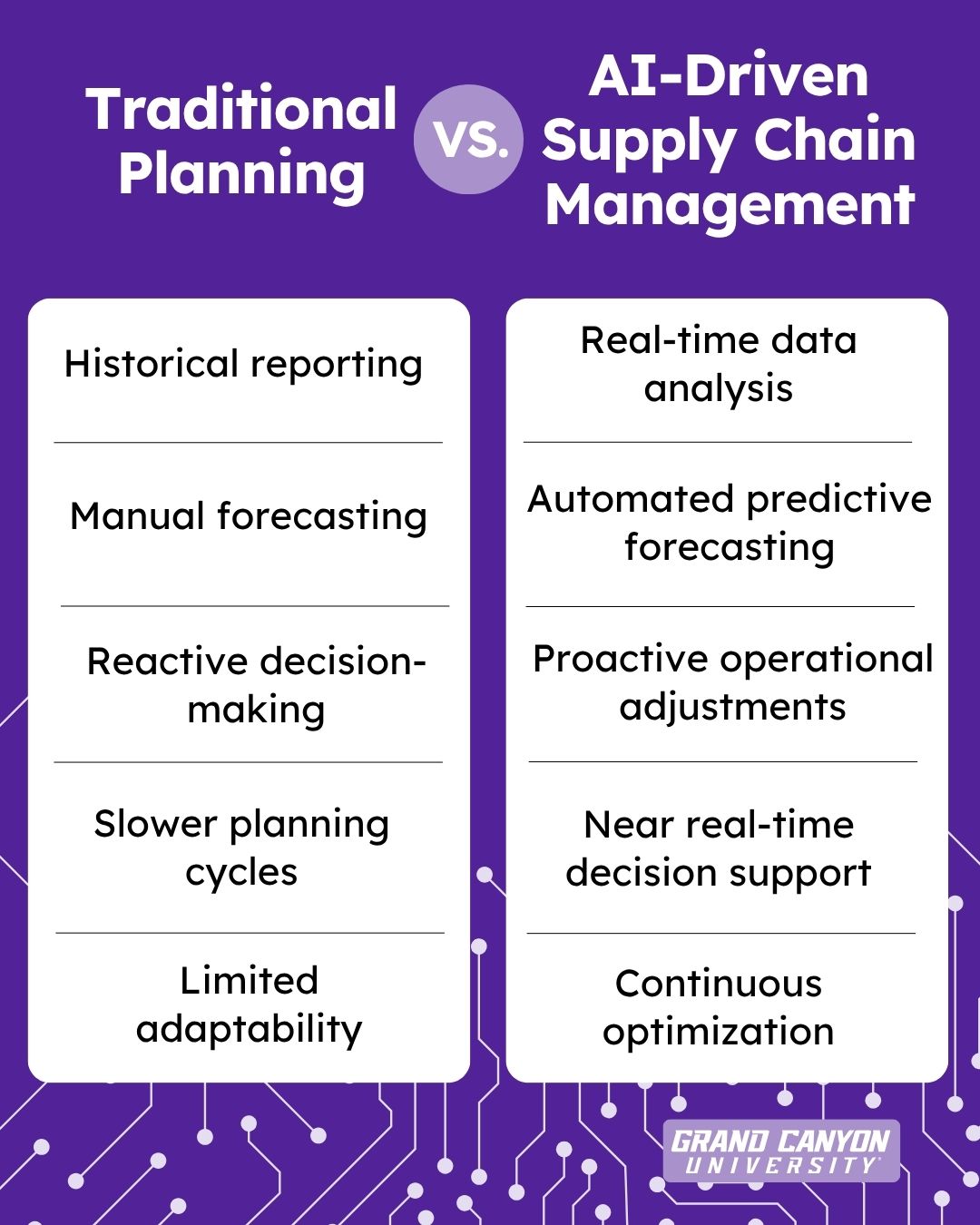
AI-driven systems may help organizations become more agile and responsive while improving operational efficiency.
Technology and Data Requirements for AI in Supply Chain
Successful AI implementation depends heavily on strong data management practices and integrated business systems. AI tools rely on accurate, current and connected data in order to generate reliable recommendations.
According to Ramirez, “Regardless of AI being used in supply chain and or any other industry, users should approach data, governance and trust carefully to make sure AI is both effective and responsible. Supply chain data often comes from multiple systems such as ERP platforms, warehouses, transportation providers and suppliers. If the data is incomplete, outdated or inconsistent, AI recommendations may be inaccurate.”
Ramirez also reinforces the importance of data accuracy when organizations implement AI systems. “As the old saying goes, ‘garbage in, garbage out.’”
Many organizations integrate AI tools with technologies such as ERP systems, CRM platforms, transportation management systems and warehouse management systems to support operational visibility and decision-making.
Governance, Trust and Responsible AI in Supply Chain Management
As AI adoption continues growing, organizations must also address issues related to governance, transparency and responsible AI usage. Ramirez explains that governance involves defining oversight responsibilities and establishing clear standards for AI implementation.
“When it comes to governance, this one involves defining who is responsible for AI oversight, how decisions are monitored and what rules guide AI usage,” he explains. “Companies should create guidelines for data privacy, cybersecurity, compliance and ethical use of AI.”
"Employees and managers are more likely to trust AI systems if they understand how recommendations are generated."
Ramirez adds, “Human oversight is also critical. AI should support decision-making rather than completely replace human judgment especially in high-risk situations. I always remind my students that we humans need to continue being the pilot, not the copilot.”
Ramirez also notes that AI technologies are still evolving and require continued monitoring and evaluation. “I also remind my students that presently AI still has lots of biases, errors or unintended outcomes. I try to use the analogy of Waymo here in Phoenix; those cars are still in the testing period (AI is in the same situation still going through trials and tribulations).”
Measurable Business Outcomes of AI in Supply Chain
Organizations adopting AI technologies are already seeing measurable operational improvements across supply chain functions. Companies using AI-enabled supply chain management have reported improvements in logistics efficiency, inventory management and supply chain sustainability, according to IBM.(See disclaimer 7 )
AI systems may help organizations:
As AI adoption continues expanding, companies may increasingly seek professionals who understand both supply chain operations and emerging technologies.
The Future of AI in Supply Chain Decision-Making
The future of AI in supply chain management will likely involve even greater integration between automation, predictive analytics and intelligent decision-support systems. As organizations continue investing in AI technologies, supply chains may become more responsive, data-driven and connected.
For students interested in entering this field, developing both technical and professional skills may be important. Ramirez explains that students should build foundational knowledge in both business systems and human-centered problem-solving skills.
“Students who want to work with AI-driven supply chain systems should focus on developing both technical and professional skills. On the technical side, they should build knowledge in data analysis, supply chain operations, business systems such as ERP (Enterprise Resource Management), CRM (Customer Relations Management), TMS/WMS (Transportation and Warehousing Management Systems) platforms, forecasting, and the use of AI tools for decision-making.”
He adds, “At the same time, employers also value soft skills such as communication, problem-solving, adaptability and critical thinking, since AI systems still require people who can interpret information and make informed business decisions.”
How GCU Supports Business Students
GCU helps students gain practical experience through hands-on learning opportunities and industry-connected experiences.
Ramirez explains that students participating in a pilot program worked with CRM technology designed to simulate realistic business interactions. “The AI simulation environment created an immersive experience where students interacted with what appeared to be real customers, allowing them to develop practical communication, problem-solving and customer service skills in a realistic setting.”
These experiences may help students bridge the gap between classroom learning and workforce readiness. “In fact, one of the students who completed this pilot program recently secured full-time employment with one of our partner organizations.”
Students interested in supply chain careers may also benefit from networking opportunities and industry engagement experiences offered through GCU.
Ramirez shares, “We have a student managed supply chain club, we have guest speakers from global corporations, we go out on tours to visit various local fortunate 500 companies such as Avnet, Amazon, etc.”
Earn Your Supply Chain Management Degree From GCU
As technology continues to reshape global supply chains, organizations are seeking professionals who can combine business strategy, logistics expertise and data-driven decision-making skills. GCU’s Bachelor of Science in Supply Chain and Logistics Management degree program is designed to help students build foundational knowledge in areas such as procurement, transportation, inventory management, operations and supply chain analytics. Students may also explore how emerging technologies, including AI and automation, are influencing modern logistics and business operations.
Students interested in expanding their leadership and business knowledge may also explore GCU’s business-focused degree programs, including the Bachelor of Science in Business Management and the MBA: Supply Chain Management program. Those interested in preparing for careers involving global commerce, international trade and multinational organizations may also explore the Bachelor of Science in International Business. These programs are designed to help students develop skills in organizational leadership, operations strategy, problem-solving and business decision-making while gaining insight into modern supply chain and logistics environments.
Learn more about business degree opportunities at GCU.
Explore AI-Driven Supply Chain Careers
Discover business and supply chain degree programs designed for today’s evolving logistics and operations environments.


