


If you are a teacher looking to deepen your expertise, an aspiring educator exploring a path to licensure or a professional interested in educational leadership, a Master of Education (MEd) may be worth considering. But what is an MEd degree, and how does it differ from other graduate education options?
An MEd is a graduate-level education degree that can help students develop advanced knowledge and skills in teaching, curriculum, leadership and other specialized areas of education. Depending on the program, an MEd may be intended for licensed educators, individuals seeking initial teacher licensure or professionals pursuing roles beyond the traditional classroom.
Understanding these differences can help you choose a graduate program that supports your professional goals.

We spoke with Julie Blair, director of academic programs at GCU, to learn more about the value of an MEd and what you can do with this degree. She explains, “For someone considering a graduate degree in education, I would encourage them to begin with their ‘why.’ Graduate school is an investment of time, energy and resources, so it is important to understand how an MEd connects to both their professional goals and the impact they hope to make.”
What Does MEd Stand For?
MEd stands for Master of Education. It is a master’s degree focused on education and can encompass a variety of concentrations or specializations.
There is no single type of MEd degree. Some programs emphasize classroom instruction and curriculum, while others focus on areas such as special education, educational leadership or administration. This variety makes it important to consider the purpose and requirements of an individual program rather than relying on the degree title alone.
How a Master of Education Degree Works
An MEd is completed after earning a bachelor’s degree and typically combines graduate coursework with opportunities to apply advanced educational concepts. Depending on the program, students may study teaching methods, curriculum development, assessment, research, leadership and strategies for supporting diverse learners.
One particularly important distinction is whether an MEd is an initial licensure or non-licensure program.
Initial licensure programs are intended for students seeking their first educator license or licensure in a new area. Non-licensure programs develop education knowledge and professional skills without directly leading to a teaching credential.
Because educator licensure requirements vary by state, prospective students should review the purpose of a program, its admission criteria and applicable state licensure disclosures before enrolling.
MEd Degree vs. MAT Degree
An MEd is not the only graduate degree available to education professionals. Another common option is the Master of Arts in Teaching (MAT).
Blair explains, “While both degrees can prepare graduates to make an impact in education, they often have different areas of emphasis. A Master of Arts in Teaching typically focuses more specifically on instructional practice, teaching methods and classroom preparation. A Master of Education may offer a broader range of pathways, including initial teacher preparation, advanced teaching practice, special education, curriculum and instruction, school counseling or educational leadership.”
Degree names and curricula vary among universities, so students should compare individual programs rather than assume all MEd or MAT degrees have identical purposes. Consider the role you ultimately want, whether it requires licensure or another credential and whether the curriculum and field experiences support that goal.
As Blair advises, “My advice is to begin with the destination and work backward: identify the role you hope to pursue, research its requirements and then select the degree pathway designed to help you get there.”
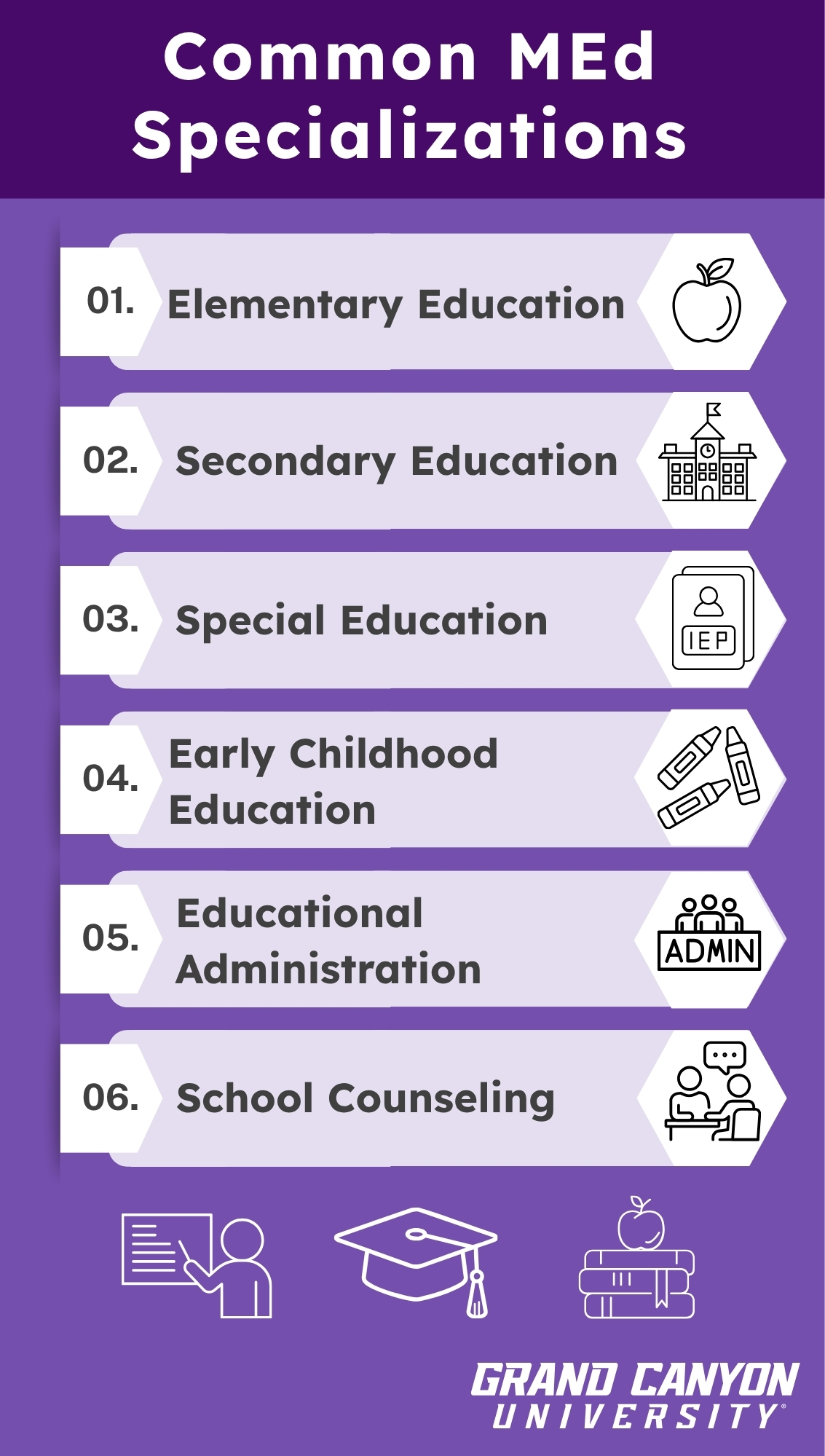
Common MEd Degree Specializations
MEd programs can allow students to develop expertise aligned with specific educational interests or career goals. Available specializations vary by institution, but areas may include:
Choosing a specialization should involve more than selecting an interesting subject. Consider the learners you want to serve, the setting in which you want to work and any licenses or credentials that may be required for your intended career.
What Do You Learn in an MEd Program?
Coursework varies considerably by specialization, but MEd students generally move beyond foundational concepts to examine education at an advanced level.
According to Blair, students may strengthen skills in:
These competencies can support both formal and informal leadership. An educator does not necessarily need an administrative title to lead. Teachers can demonstrate leadership by mentoring colleagues, supporting curriculum initiatives, facilitating professional development or advocating for students.
“Ultimately, the goal is not only to know more, but also to use that knowledge to learn, lead and serve in ways that positively impact students and educational communities,” Blair says.
MEd Degree Requirements
Requirements for an MEd vary by university and program. In general, applicants need to have earned a bachelor’s degree and satisfy the graduate admission requirements established by their institution.
Some programs may have additional prerequisites. An advanced educational leadership program, for example, may be intended for experienced or licensed educators, while an initial licensure program may be structured for someone who has a bachelor’s degree but has not yet earned a teaching license.
Program requirements can also include graduate coursework, field experiences, internships, student teaching or other practice-based components.
What Can You Do With an MEd Degree?
The career possibilities associated with an MEd depend on your specialization, prior experience, credentials and state requirements. Potential pathways may include:
Some graduates may also apply their education expertise outside traditional K–12 schools.
“One of the greatest strengths of an MEd is the transferability of the skills students develop,” Blair says.
An MEd may therefore support opportunities in settings such as higher education, nonprofits, community education, corporate learning and development, instructional design or education-related program coordination, depending on employer requirements and an individual’s qualifications.
"Communication, collaboration, research, program evaluation, problem-solving and leadership are valuable anywhere teaching and learning occur, and that reaches well beyond a classroom or school building."
Is an MEd Degree Only for Teachers?
Although many MEd programs serve practicing or aspiring teachers, the degree can also support professionals interested in other aspects of education.
Educational systems need people who can develop curriculum, evaluate programs, train professionals, support students and lead organizations. Depending on the degree concentration and applicable requirements, an MEd may be relevant to professionals pursuing these types of responsibilities.
As Blair notes, “An MEd can help graduates deepen their expertise while opening doors to new ways of teaching, leading, advocating and serving others. The key is selecting a program that aligns with the role and setting in which the student hopes to make an impact.”
Is an MEd Degree the Same as a Doctorate?
No, an MEd is a master’s degree, not a doctoral degree. Master’s programs are graduate-level programs completed after a bachelor’s degree, while doctoral programs represent a different level of graduate education. Doctoral programs are more time-intensive and advanced than an MEd.
Students interested in advanced research, scholarship or certain high-level leadership and postsecondary roles may eventually consider a doctorate, such as a Doctor of Education (EdD) or Doctor of Philosophy (PhD). However, whether a doctorate is necessary depends on the profession and employer.
An MEd can instead provide a graduate-level opportunity to build specialized knowledge and professional competencies without pursuing a doctorate.
Benefits of Earning an MEd Degree
The value of an MEd will depend on your goals, but earning one can provide opportunities to:
Graduate study can also encourage educators to evaluate evidence and examine their own professional practices more critically.
Blair emphasizes this aspect of graduate education: “Graduate school should stretch you. When students approach it simply by checking a box, they may miss the greatest value of the experience, and, quite honestly, that is often where I have seen students struggle. The degree matters, but the professional growth that happens along the way matters just as much.”
How To Decide Whether an MEd Degree Is Right for You
Before applying, identify what you want the degree to help you accomplish. Your answer can make it easier to compare programs based on substance rather than degree titles alone.
Blair encourages students to consider questions such as:
You do not necessarily need your entire career mapped out before starting graduate school. You should, however, understand what a particular program prepares graduates to do.
“My advice is to research carefully, ask questions and choose an MEd program with purpose,” Blair says. “The right graduate degree should not simply add another credential; it should deepen your knowledge, expand your opportunities and strengthen your ability to positively serve students, colleagues and educational communities.”
Frequently Confused MEd Terms and Abbreviations
As you research programs, you may encounter several similar abbreviations:
Always check the individual program description and applicable state requirements rather than using the abbreviation alone to determine what a degree prepares you to do.
"The combination of purposeful program design, practical preparation, innovation, high expectations and a heart for service is what makes the GCU experience so special. We want our graduates to be prepared to learn, lead, serve, and to positively impact students, schools and communities wherever their professional paths may take them."
Why GCU?
GCU’s College of Education offers a variety of graduate education pathways for aspiring educators, practicing professionals and those interested in leadership or specialized areas. Current options include licensure and non-licensure master’s degrees, and GCU offers flexible online(See disclaimer 1) learning opportunities for working professionals.
Blair highlights the intentionality behind the programs: “What I find especially meaningful about GCU is that our programs are designed to do more than help students earn another credential. We are intentional about what we include, from the overall program design to the coursework, learning experiences and assignments. We want each component to have a clear purpose and to help prepare candidates for the realities of an educational field that is continually evolving.”
GCU is institutionally accredited by the Higher Learning Commission (HLC) and has maintained HLC accreditation since 1968. Many of GCU’s master’s degrees in education have programmatic accreditation through the Association for Advancing Quality in Educator Preparation (AAQEP). Prospective students should review the accreditation information for the specific program they are considering.
If an MEd aligns with your professional goals, explore GCU’s Master of Education degree programs to compare available pathways, specializations and program requirements. Whether you are seeking to enter teaching, deepen your expertise or prepare for new responsibilities in education, reviewing each program’s purpose and requirements can help you identify the option that best supports your next step.
Explore MEd Degree Programs
Learn about GCU's available MEd specializations, licensure and non-licensure options and flexible online learning opportunities.


