


As learning environments continue to evolve, schools, universities, corporations and training organizations need professionals who can create meaningful learning experiences and effectively use technology to support them. If you're exploring graduate education in this field, you may find yourself comparing instructional design vs. instructional technology and wondering which path aligns best with your interests and career goals.
The short answer is that instructional design focuses primarily on how people learn and how educational experiences are structured, while instructional technology emphasizes the tools, systems and digital environments that support learning. Both areas work closely together, but they approach learning from different perspectives.
Understanding the distinction can help you choose a degree program that fits your strengths, interests and long-term aspirations.
What Is an Instructional Design Degree?
An instructional design degree typically explores how people learn, how instruction can be structured and how educational materials can be developed to support specific learning outcomes. Students often study learning theories, curriculum development, assessment strategies and learner engagement.
To understand what instructional design is, imagine being responsible for creating a learning experience from the ground up. Rather than simply presenting information, instructional designers strategically organize content so learners can absorb, apply and retain knowledge.
In practice, instructional designers may be responsible for:
For educators asking what is instructional design in education, the answer extends beyond lesson planning. Instructional design in education involves intentionally creating learning experiences that help students meet specific academic goals through effective content organization, assessment and instructional strategies.
An instructional design professional often begins by asking:
These questions guide the development process before technology tools are ever selected.
What Is an Instructional Technology Degree?
An instructional technology degree explores the implementation, management and evaluation of educational technologies. Students study learning management systems (LMS), digital media, emerging technologies, online learning environments and technology integration strategies.
While instructional designers frequently focus on the learning experience itself, instructional technology professionals often concentrate on how digital tools and learning systems support that experience.
In practice, instructional technology professionals may be responsible for:
Professionals in instructional technology often ask different questions than instructional designers:
Their work frequently bridges educational goals with technological capabilities.
Instructional Design vs. Instructional Technology: Key Differences
While the fields overlap, understanding instructional design vs. instructional technology becomes easier when comparing their primary focus areas.
Rather than viewing one discipline as superior to the other, it is often more accurate to view them as complementary specialties that contribute to the same learning goals.
Instructional Design vs. Instructional Technology Coursework
The coursework in each program typically reflects its distinct focus. While individual experiences may vary, these degree paths often introduce students to different concepts, frameworks and professional practices.
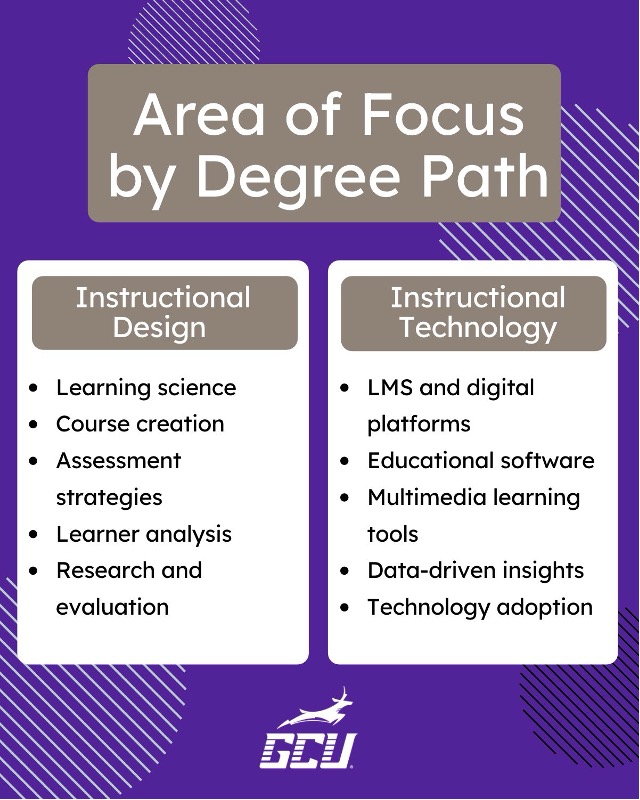
Instructional Design Areas of Study
Students in an instructional design program may encounter topics such as:
These areas of study often focus on how learning experiences can be intentionally designed to support specific educational objectives.
Instructional Technology Areas of Study
Programs focused on instructional technology may introduce students to subjects such as:
Coursework in these areas frequently examines how technology can be selected, implemented and evaluated to support learning goals.
What Do Instructional Designers and Instructional Technologists Do?
Instructional designers plan and build learning experiences, such as objectives, content and assessments, while instructional technologists select, implement and support the tools that deliver those experiences.
Both professionals share the goal of improving learning outcomes. However, instructional designers generally lead with pedagogy, while instructional technologists lead with technology implementation.

"One misconception is that instructional design is just creating online courses or that instructional technology is primarily providing technical support. Both fields are much broader. Instructional designers are thinking about the learner, outcomes, content, assessment, engagement, accessibility and overall learning experience. Instructional technologists consider how technology and digital systems can effectively support those goals. In practice, those responsibilities frequently intersect."
– Lindy Gaudiano, PhD - Assistant Dean, College of Education
Who May Benefit From Each Degree Path?
Both instructional design and instructional technology can apply to a variety of educational and organizational settings. While individual goals vary, each degree path may appeal to professionals seeking to support learning in different ways.
Who May Benefit From an Instructional Design Degree?
An instructional design degree may be worth exploring for individuals in positions that involve:
Who May Benefit From an Instructional Technology Degree?
An instructional technology degree may appeal to individuals in positions that involve:
Because instructional design and instructional technology often intersect, professionals may find value in either path depending on their responsibilities and interests. Those who are drawn to developing learning experiences may lean toward instructional design, while those interested in the systems and tools that support learning may find instructional technology particularly relevant.
"I believe employers increasingly value people who can collaborate across teams. Learning design and educational technology rarely happen in isolation. Professionals may work with faculty, teachers, subject matter experts, technology teams, administrators, data teams and organizational leaders."
Skills Instructional Designers and Instructional Technologists Need
AI literacy and data literacy are becoming core skills in both fields, according to Lindy Gaudiano, PhD. “AI is the most visible change. Organizations need professionals who understand how to use AI thoughtfully, not just to generate content. That includes evaluating AI tools, considering accuracy and bias, protecting privacy, maintaining academic integrity and determining where AI can genuinely improve learning or efficiency. Data literacy is also increasingly important. Professionals need to be able to look at learner data, identify patterns, evaluate whether an instructional approach is working and use that information to make improvements.”
How To Compare Instructional Design and Instructional Technology Programs
When comparing degree options, look beyond the program title and examine the curriculum carefully.
Consider questions such as:
Modern learners often benefit from programs that combine theoretical foundations with opportunities to solve authentic educational challenges.
As digital education continues to expand, employers frequently value graduates who can demonstrate both strategic thinking and practical application.
Benefits and Challenges of Each Degree Path
Both instructional design and instructional technology degree programs can offer distinctive opportunities and considerations depending on your interests, strengths and professional goals. Understanding the potential benefits and challenges of each path may help you determine which option aligns best with your academic and career aspirations.
Instructional Design Degree Benefits and Challenges
Benefits
Challenges
Instructional Technology Degree Benefits and Challenges
Benefits
Challenges
How To Choose Between Instructional Design and Instructional Technology
Choose instructional design if you're most interested in how people learn and how to create effective learning experiences. Consider instructional technology if you're more interested in selecting, implementing and evaluating the technologies that support learning.
When comparing instructional design vs. instructional technology, the best choice often depends on what excites you most. If you enjoy analyzing how people learn, organizing content, developing curriculum and creating meaningful educational experiences, instructional design may align closely with your interests. If you are energized by technology, digital innovation and helping organizations implement learning tools effectively, instructional technology may be the stronger fit.
Another helpful question is whether you naturally focus on the learner experience or the technology environment. Neither answer is wrong, but your preference may point toward the degree path that best supports your goals.
“I encourage students to think first about what part of the learning experience excites them most,” Dr. Gaudiano says. “Instructional design is often centered on how people learn and how we intentionally design effective learning experiences.”
As educational systems become increasingly digital, professionals who understand both instructional strategy and technology implementation can play an important role in shaping the future of learning.
Faculty Perspective on the Future of Learning Design and Educational Technology
“I believe instructional designers and instructional technologists will increasingly serve as the bridge between what technology makes possible and what research tells us is effective for learners. Their role will include helping organizations make thoughtful decisions about when technology enhances learning and when human interaction, feedback, relationships and expertise remain essential,” Dr. Gaudiano states.
Dr. Gaudiano points to AI as a major area to watch, particularly as it shapes personalized and adaptive learning and content development. She also encourages aspiring professionals to pay attention to learning analytics, immersive and simulation-based learning, accessibility, competency-based education and more flexible approaches to when and where learning takes place.
"What excites me most is the opportunity to make learning more accessible, personalized, engaging and responsive to individual needs. A tailored experience. For me, the most exciting future is not one where technology replaces educators or learning professionals. It is one where technology allows them to spend more time doing the things humans do best — building relationships, creating meaningful experiences, providing feedback, solving complex problems and helping others grow."
Frequently Asked Questions About Instructional Design vs. Instructional Technology
Still comparing the two fields? These quick answers can help clarify some of the most common questions.
Is instructional design the same as instructional technology?
No, instructional design focuses primarily on creating effective learning experiences, while instructional technology focuses on the tools and systems used to support learning.
Do instructional designers need technology skills?
Yes, instructional designers often work with digital learning tools and platforms, but technology typically supports the learning strategy rather than driving it.
Which degree should I choose: instructional design or instructional technology?
Consider instructional design if you're most interested in how people learn and how learning experiences are created. Instructional technology may be a better fit if you're more interested in implementing and evaluating digital tools and learning systems.
Explore Programs Focused on Instruction and Learning
Earning an education master's degree can be an opportunity to build on your experience, explore new areas of interest and prepare for the next stage of your academic or professional journey. As you consider your goals, GCU offers several programs that can help you further develop your knowledge of learning, instruction and educational leadership.
Students interested in related areas of educational leadership and learning development may also explore GCU's Master of Arts in Curriculum and Instruction, which focuses on curriculum planning, instructional strategies and educational improvement. Those seeking specialized training may also consider the Graduate Certificate of Completion in Instructional Design, which provides focused coursework in designing effective learning experiences for diverse audiences.
Shape the Future of Instruction and Learning
Explore graduate programs designed to help you create engaging learning experiences and support learners in a technology-driven world.


