

The Canyon Neuroscience Group is part of the Canyon Emerging Scholars (CES) Program, which is designed to foster faculty-led research while actively engaging undergraduate students in both classroom and extracurricular settings. Its mission is to mentor students in practical problem-solving across a range of disciplines and interdisciplinary topics. Guided by the Boyer model of scholarship, CES promotes diverse research approaches — such as applied, integrative and discovery-based methods — while emphasizing reflective practices that are collaborative, community-oriented and interdisciplinary.
The Canyon Neuroscience Group directly supports GCU’s commitment to hands-on, inquiry-driven research by immersing students in authentic laboratory experiences. In our group, students focus on projects investigating Alzheimer’s disease and oxidative stress, using in vitro human cell culture as the primary model system. This approach gives students access to biomedical techniques while engaging them in questions with real clinical relevance.

In the neuroscience center, projects are faculty-guided but student-driven. Dr. Hikmet Nural-Guvener explains, “Students design experiments, collect and analyze data, troubleshoot unexpected results and help interpret findings. Faculty offer mentorship, training and structure, but students take ownership of the scientific process. Those demonstrating strong commitment, professionalism and teamwork gain the most from the experience and often become leaders within the research community.”
Canyon Emerging Scholars: Hands-On Research for Students
Students interested in joining the Canyon Emerging Scholars program can participate in faculty-led undergraduate research projects, develop critical lab skills and contribute to real scientific studies. Students joining the research group will also complete online training from CES that provides guidelines in working in a research lab.
In the lab, students spend significant time learning how to culture and maintain human cell lines, and apply a wide range of laboratory methods to answer the research questions they develop. To design those questions, students read and analyze scientific literature, compare experimental findings from other labs, synthesize that information and apply it to the specific Alzheimer- or oxidative-stress–related mechanisms they want to investigate.
Students gain hands-on experience developing technical skills including:

Students also design their own experiments, troubleshoot unexpected results and interpret data, which are essential competencies for anyone pursuing graduate school, medical school or a research-oriented career. “Through this work, the Canyon Neuroscience Group provides a laboratory environment where students actively think, work and problem-solve like scientists, demonstrating GCU’s strong commitment to experiential undergraduate research,” adds Dr. Sherlin Moses.
Research at GCU helps provide students with a great deal of experience in both lab techniques as well as publishing opportunities. “This can help students stand out in their graduate school applications, especially when students can help in developing published manuscripts and presentations. As mentors, we work very closely with our students, helping guide them toward research skill development and manuscript preparation,” explains Dr. Maurice Jabbour.
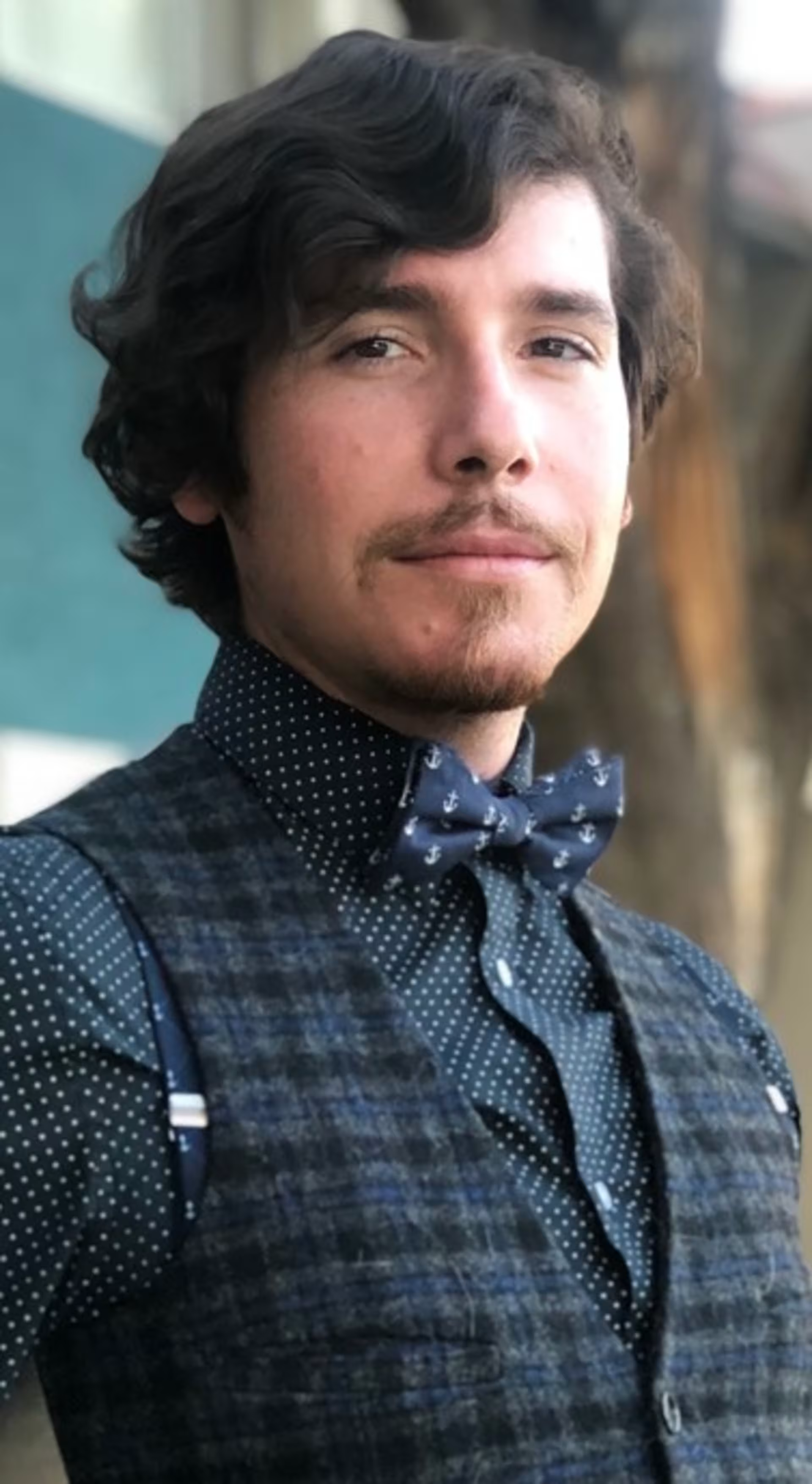
“We wouldn’t be able to do what we do without our dedicated and self-motivated team members. Our students and mentees play such an enormous part in everything that we do research-wise here at GCU,” says Dr. Randall Ordovich-Clarkson.
How To Get Involved in Neuroscience Research at GCU
The neuroscience research program is selective and designed for students who demonstrate strong academic performance, self-motivation and a genuine interest in scientific inquiry. Although most participants are juniors or seniors with substantial coursework completed, highly enthusiastic and dedicated sophomores are also encouraged to apply.
Here are some actionable steps to join the Canyon Neuroscience Group:
- Maintain strong academic performance.
Students should demonstrate good academic standing, with consistent performance in STEM coursework such as biology, chemistry and neuroscience fundamentals. A high GPA can help indicate readiness for the demands of research. - Reach out to faculty directly.
Students can email the neuroscience faculty members leading the group to express their interest. A brief introduction, resume, academic background and a short explanation of why you want to pursue research can help faculty evaluate fit. - Demonstrate readiness for a long-term commitment.
Research demands reliability. Students should be prepared to dedicate regular weekly hours to literature review, lab work and data analysis. - Provide evidence of key research qualities, such as:
The Parkinson’s Project
The Parkinson’s Project is led by Dr. Randall D. Ordovich-Clarkson and Dr. Maurice Jabbour and operates under the Canyon Emerging Scholars program. Their group looks at norpsilocin, a serotonergic compound, which has demonstrated neuroprotective effects. The goal of this compound and its derivatives would be to prophylactically prevent the development of neurodegenerative diseases such as Parkinson’s disease.
This lab work involves cell culturing of neuroblastoma cell lines which are subjected to stressors to mimic neurodegeneration. They examine the protective effects of compounds using MTT assays. In addition, they use biochemical techniques to investigate the cellular pathways involved in this neuroprotective process. Throughout this study, students are getting excellent hands-on experience on cell culturing, molecular and biochemical techniques and other areas of research.
Students who are interest in neurodegenerative diseases with a focus on Parkinson’s can reach out to either co-principal investigator at Randall.Clarkson@gcu.edu and Maurice.Jabbour@gcu.edu to inquire about joining the lab. This group is mostly looking for freshman or sophomores who can provide long-term commitment to the team throughout their academic journey at GCU. Most of these students are on a pre-med track, but they also accept students who are entering other biomedical disciplines, including pharmacy, biomedical engineering and related fields.
Faculty-Led Research Projects
Students can participate in faculty-led research projects in the Canyon Neuroscience Group by joining active studies that investigate how oxidative stress and altered glucose metabolism contribute to the molecular mechanisms underlying both Alzheimer’s disease and diabetes. These projects give students a direct role in understanding the biological “crossroads” between metabolic dysfunction and neurodegeneration, an emerging and highly relevant area of neuroscience research.
Participation begins with a guided literature analysis. Students read and evaluate scientific papers to understand what is already known about oxidative stress pathways, glucose-metabolism–related cellular stress, and how these processes may upregulate Alzheimer-related markers. This background work enables them to generate meaningful, testable research questions that align with the group’s overarching goal: understanding the molecular mechanisms linking diabetes and Alzheimer’s disease.
"Students are encouraged to share their findings through attending scientific meetings, both internally at GCU and externally. Students receive hands-on experience in developing manuscripts for publication, poster presentations and oral presentations."
Students help design and implement their experiments, so they contribute real data to ongoing research questions such as:
Students are generating data that directly supports research aimed at understanding the mechanistic relationships between metabolic disease and neurodegeneration.
Current study areas in the group include:
Through structured mentorship, scientific reading and extensive lab experience, students develop the technical and analytical skills required to contribute meaningfully to real scientific studies and prepare for advanced research, graduate training or clinical career paths.
Meet the Faculty Leaders Driving Neuroscience Research
Here are some of the faculty members driving neuroscience research initiatives at GCU. These leaders emphasize mentorship and collaboration as they guide students through research projects.
Randall D. Ordovich-Clarkson, MD
Dr. O. Clarkson, MD, brings clinical and research expertise in psychiatry, psychotherapy, neurology and microbiology. His interdisciplinary work integrates behavioral health and neuroscience to examine the mechanisms underlying neurodegeneration, social cohesion and pro-social behavior.
As co–principal investigator of the Parkinson’s Project with Dr. Maurice Jabbour, PhD, Dr. Clarkson investigates neuroprotective compounds with potential to slow the progression of Parkinson’s disease and related neurodegenerative conditions. His research bridges neurology and preventive medicine, advancing novel therapeutic strategies that target cellular resilience and neuroplasticity.
In the field of social psychology, Dr. Clarkson co-leads the Loyalty Project with Dr. Magen Branham, PhD, studying the biopsychosocial foundations of interpersonal and intrapersonal cohesion. This work explores behavioral systems across individual, familial, community and societal levels to illuminate how loyalty influences human motivation, group dynamics and moral reasoning.
Additionally, Dr. Clarkson serves as co-investigator in the Prosocial Animal Lab with Drs. Branham and Jabbour, where he contributes to studies on the neural and behavioral substrates of altruism, cooperation and social bonding using rodent models. This research informs a broader understanding of the evolutionary and neurobiological basis of pro-social behavior.
Dr. Maurice Jabbour
Dr. Jabbour has interdisciplinary research and academic career spanning engineering and biology. His academic credentials include a master’s thesis focused on designing portable biosensors combining immunoassay with photodetectors. Through doctoral and postdoctoral research experiences, Dr. Jabbour gained expertise and published peer-reviewed articles in molecular and cell biology, immunology as well as biochemistry. Dr Jabbour’s research interests center on investigating mechanisms within the immune system, with a particular focus on antigen presentation, regulation of inflammatory responses and autoimmunity.
Moreover, Dr. Jabbour has contributed to academia through teaching roles at community colleges and GCU (11 years as a GCU adjunct faculty), guiding students through various laboratory classes including biotechnology and biochemistry. These laboratories provided hands-on learning in DNA cloning, cell culture techniques, molecular and biochemical methodologies.
Dr. Hikmet Nural-Guvener
Dr. Nural-Guvener earned her PhD in 2006 from the University of Nevada, Reno, with expertise in developmental biology and neuroscience. Dr. Nural-Guvener started her first postdoctoral position in 2008 at Banner Sun Health Research Institute in a neuro-degeneration research laboratory.
The main objective of her research was to investigate putative biomarkers of Alzheimer’s disease (AD) and find possible drug therapy for the treatment of AD. Later, Dr. Nural-Guvener joined the Center for Cardiovascular Research team at the same institute. Her research focused on the effects of myocardial infarction (MI) on brain biochemistry and pathology. In addition, she investigated epigenetic mechanisms involved in cardiac fibrosis in heart failure.
Dr. Sherlin Moses
Dr. Moses’ background has been varied through both research and scientific industry experiences. Her profession in the field of regulatory toxicology has given her broad exposure to the different tiers of testing pesticide compounds, with a main focus on genetic toxicity tests in rodents through chromosomal analysis to determine the mutagenic properties. She was a postdoctoral fellow at the Banner Sun Health Research Institute, where the emphasis of the research was on neurodegenerative disorders, particularly Alzheimer’s disease.
Resources and Further Learning in Neuroscience
At GCU, students have access to a variety of resources that support both academic growth and practical experience in the field. Learn more about the College of Natural Sciences research opportunities, where you can find information on faculty-led projects, student research opportunities and the different labs within CES.
Start Your Journey at GCU
If you are interested in deepening your research knowledge, GCU offers undergraduate and graduate programs across many areas of science, including biology and health sciences, all designed to prepare students for careers in health and science fields. You can explore these programs through the College of Natural Sciences.
As a student at GCU, you can go beyond the classroom and join student organizations focused on science and research. These groups provide networking opportunities, workshops and peer support that can enhance your academic experience.
Whether you’re aiming for a career in neuroscience or simply want to expand your understanding of the brain, GCU’s resources make it possible to explore scientific theory and practical application. Dive into research, connect with mentors and take advantage of this opportunity to grow as a neuroscientist and researcher.
Gain Confidence in Your Research Skills
Learn more about GCU’s degree programs and how they can help you develop your research skills.


