
GCU Logo Mobile
Apply NowRequest Info
  • GCU Login
GCU LoginRequest Info
Grand Canyon University logo in bold purple uppercase text on a white background
  • Degree Programs
    • Areas of Study
      • Business
      • Teaching
      • Language
      • Counseling
      • Psychology
      • Healthcare
      • Nursing
      • Criminal Justice
      • Legal Studies
      • Engineering
      • Science
      • Technology
      • Theology
      • Ministry
      • Digital Arts
      • Digital Media
      • Fine Arts
    • Locations
      • Campus
      • Online
      • Evening
    • Degree Level
      • Bachelor's
      • Master's
      • Doctoral
      • Certificates
      • Bridge
      • Post-Master's
    • Other Course Options
      • Minors
      • Individual Courses
      • High School Dual Enrollment
      • Current Teacher Continuing Education
      All Majors & Programs
      All Majors & Programs
  • Academics
    • Colleges
      • Doctoral
      • Arts & Media
      • Business
      • Education
      • Engineering & Technology
      • Humanities & Social Sciences
      • Natural Sciences
      • Nursing & Health Care
      • Theology
      • Honors
    • More About GCU
      • Academic Catalog & Policies
      • University Accreditation & Regulation
      • Educational Alliances
      • Faculty Directory
      • Office of Assessment
      • Provost Message
      Academics
      Academics
  • Admissions
    • Admissions
      • Admission Requirements
      • Visit Campus
      • Undergraduate Admissions
      • College Transfer Center
      • Graduate & Doctoral Admissions
      • Campus Resources
      Admissions
      Admissions
  • Tuition & Financial Aid
    • Tuition
      • Online & Evening
      • On-Campus
      • Housing & Meal Costs
      • Other Fees
      • Cost of Attendance
    • Financial Aid
      • FAFSA
      • Scholarships & Grants
      • Student Loans
      Tuition & Financial Aid
      Tuition & Financial Aid
  • Why GCU
    • Student Journey
      • Online Learning
      • Campus Life
      • Evening Classes
      • Hybrid Learning
      • Military & Veteran
      • ROTC
      • International Students
      • Native American
    • Our Story
      • University Spirit & Traditions
      • Christian Identity & Mission
      • History & Campus Growth
      • Community Outreach
    • About
      • Leadership Team
      • Campus Locations
      • Blog
      • Offices
      • Contact
      • Media & Branding
      Why GCU
      Why GCU
Apply NowRequest Info

Read time 6 minutes

Published on Nov 25, 2024


In This Article
  • Overview
  • What Is a Music Teacher? 
  • What Does a Music Teacher Do? 
  • What Education and Experience Does a Music Teacher Need? 
  • Best Degrees for Music Teachers 
  • What Skills Does a Music Teacher Need? 
  • How Much Do Music Teachers Make?
  • Where Do Music Teachers Work? 
  • Advancement Opportunities for Music Teachers 
  • Start Your Musical Journey at GCU
In This Article
Overview
What Is a Music Teacher? 
What Does a Music Teacher Do? 
What Education and Experience Does a Music Teacher Need? 
Best Degrees for Music Teachers 
What Skills Does a Music Teacher Need? 
How Much Do Music Teachers Make?
Where Do Music Teachers Work? 
Advancement Opportunities for Music Teachers 
Start Your Musical Journey at GCU
Tags
Career Corner|Music|Teaching and Instruction
Related Articles In
Performing Arts & Digital Arts
Close-up of a person holding a camera with the lens in sharp focus, showing aperture blades and colorful light reflections.

What Is Digital Arts?

Trying to decide whether a digital arts degree is right for you? Here we share an overview of what the degree and what new skills you will gain.

10/28/2025

|

7 min read

Side-by-side image of a vintage typewriter and a modern laptop keyboard, symbolizing the contrast between traditional media and the digital innovations of new media.

Traditional vs. New Media: What’s the Difference?

Explore the key differences between traditional vs. new media, their impact on communication and how this can look in a modern media career.

09/16/2025

|

4 min read

A red-haired person works on a laptop at a desk with a notebook and cookies, set in a room with industrial-style decor.

How To Become a Screenwriter

What does a screenwriter do? Discover screenwriting careers and learn how to become a screenwriter. Earn a degree from GCU.

07/29/2025

|

5 min read

We're here to help.

I'm Ready to ApplyI Need More Information
GCU Logo White
1-855-GCU-LOPELive Chat
3300 West Camelback Road  - 
Phoenix, AZ 85017
Grand Canyon University © 2025
All Rights Reserved
  • Majors & Programs
  • Admission
  • Financial Resources
  • Academic Calendar
  • Academic Catalog & Policies
  • Online Learning
  • Why GCU
  • Contact Us
  • Careers
  • Title IX
  • Media & Licensing
  • Consumer Information
  • Financial Disclosures
  • Privacy Policy
  • Cost of Attendance
Find Your Purpose Logo
Video from GCU
FacebookTwitter/XLinkedInInstagramYouTube
  • Current Students
    |
  • Alumni
    |
  • Athletics
    |
  • Arena
    |
  • GCU News
    |
  • Lope Shops
    |
  • GCBC
    |
  • Canyon Promotions
    |
  • Lope House
    |
  • GCU Golf

Privacy / Cookie Disclaimer: Our site uses cookies to personalize content, to provide social media features/ads and to analyze site traffic. We share information about your use of this site with our social media, advertising and analytics teams who may combine it with other information that you’ve provided to them. By continuing to navigate this site you are consenting to the collection of information via our use of cookies. For more information on our cookie collection and use please visit our Privacy Policy.

Share This Story
FacebookTwitter/XLinkedInShare via Email

  1. Home/
  2. Blog/
  3. Performing Arts & Digital Arts/
  4. How To Become a Music Teacher

How To Become a Music Teacher

Student and Teacher making music together.
Start your GCU
journey today.
Step 1: Educational Interests
This helps us connect you with the right enrollment counselor to help you through the process.
Make a selection
Select One
Bachelor's
Master's
Doctoral
Bridge
Make a selection
First select a degree level
Make a selection
First select a degree level and how you would like to attend
Make a selection
First select degree level, modality, and area of interest
Make a selection
Select One
Yes
No
Make a selection
Select One
Yes
No
Make a selection
Select One
Yes
No
West Valley (Phoenix, AZ) ABSN
Select One
Albuquerque, NM ABSN
Boise (Meridian, ID) ABSN
Denver (Englewood, CO) ABSN
East Valley (Chandler, AZ) ABSN
Las Vegas (Henderson, NV) ABSN
Miramar (Miami, FL) ABSN
Orlando (Lake Mary, FL) ABSN
Salt Lake (Sandy, UT) ABSN
St. Louis, MO ABSN
Sun City, AZ ABSN
Tucson, AZ ABSN
West Valley (Phoenix, AZ) ABSN
Make a selection
Select One
Still in High School
High School Diploma or GED
Some College
Associate Degree or over 60 credits
Bachelor's Degree
Master's Degree or Higher
Bachelor's with Cert. & Experience
BS in Nursing
Make a selection
Select One
2029
2028
2027
2026
2025
2024
2023
2022
2021
2020
2019
2018
2017
2016
2015
2014
2013
2012
2011
2010
2009
2008
2007
2006
2005
2004
2003
2002
2001
2000
1999
1998
1997
1996
1995
1994
1993
1992
1991
1990
1989
1988
1987
1986
1985
1984
1983
1982
1981
1980
1979
1978
1977
1976
1975
1974
1973
1972
1971
1970
1969
1968
1967
1966
1965
1964
1963
1962
1961
1960
1959
1958
1957
1956
1955
1954
1953
1952
1951
1950
1949
1948
1947
1946
1945
1944
1943
1942
1941
1940
1939
1938
1937
1936
1935
U.S. Citizen
U.S. Citizen
Non-U.S. Citizen
No military affiliation
Make a selection
No military affiliation
Active
Spouse
Retired
Veteran
United States
United States
Afghanistan
Albania
Algeria
American Samoa
Andorra
Angola
Anguilla
Antarctica
Antigua And Barbuda
Argentina
Armenia
Aruba
Australia
Austria
Azerbaijan
Bahamas
Bahrain
Bangladesh
Barbados
Belarus
Belgium
Belize
Benin
Bermuda
Bhutan
Bolivia
Bosnia And Herzegovina
Botswana
Bouvet Island
Brazil
British Indian Ocean Territory
Brunei Darussalam
Bulgaria
Burkina Faso
Burundi
Cambodia
Cameroon
Canada
Cape Verde
Cayman Islands
Central African Republic
Chad
Chile
China
Christmas Island
Cocos (keeling) Islands
Colombia
Comoros
Congo
Congo, The Democratic Republic Of The
Cook Islands
Costa Rica
Cote D'ivoire
Croatia
Cuba
Cyprus
Czech Republic
Denmark
Djibouti
Dominica
Dominican Republic
East Timor
Ecuador
Egypt
El Salvador
Equatorial Guinea
Eritrea
Estonia
Ethiopia
Falkland Islands (malvinas)
Faroe Islands
Fiji
Finland
France
French Guiana
French Polynesia
French Southern Territories
Gabon
Gambia
Georgia
Germany
Ghana
Gibraltar
Greece
Greenland
Grenada
Guadeloupe
Guam
Guatemala
Guinea
Guinea-bissau
Guyana
Haiti
Heard Island And Mcdonald Islands
Holy See (vatican City State)
Honduras
Hong Kong
Hungary
Iceland
India
Indonesia
Iran, Islamic Republic Of
Iraq
Ireland
Israel
Italy
Jamaica
Japan
Jordan
Kazakstan
Kenya
Kiribati
Korea, Democratic People's Republic Of
Korea, Republic Of
Kosovo
Kuwait
Kyrgyzstan
Lao People's Democratic Republic
Latvia
Lebanon
Lesotho
Liberia
Libyan Arab Jamahiriya
Liechtenstein
Lithuania
Luxembourg
Macau
Macedonia, The Former Yugoslav Republic Of
Madagascar
Malawi
Malaysia
Maldives
Mali
Malta
Marshall Islands
Martinique
Mauritania
Mauritius
Mayotte
Mexico
Micronesia, Federated States Of
Moldova, Republic Of
Monaco
Mongolia
Montenegro
Montserrat
Morocco
Mozambique
Myanmar
Namibia
Nauru
Nepal
Netherlands
Netherlands Antilles
New Caledonia
New Zealand
Nicaragua
Niger
Nigeria
Niue
Norfolk Island
Northern Mariana Islands
Norway
Oman
Pakistan
Palau
Palestinian Territory, Occupied
Panama
Papua New Guinea
Paraguay
Peru
Philippines
Pitcairn
Poland
Portugal
Puerto Rico
Qatar
Reunion
Romania
Russian Federation
Rwanda
Saint Helena
Saint Kitts And Nevis
Saint Lucia
Saint Pierre And Miquelon
Saint Vincent And The Grenadines
Samoa
San Marino
Sao Tome And Principe
Saudi Arabia
Senegal
Serbia
Seychelles
Sierra Leone
Singapore
Slovakia
Slovenia
Solomon Islands
Somalia
South Africa
South Georgia And The South Sandwich Islands
Spain
Sri Lanka
Sudan
Suriname
Svalbard And Jan Mayen
Swaziland
Sweden
Switzerland
Syrian Arab Republic
Taiwan, Province Of China
Tajikistan
Tanzania, United Republic Of
Thailand
Togo
Tokelau
Tonga
Trinidad And Tobago
Tunisia
Turkey
Turkmenistan
Turks And Caicos Islands
Tuvalu
Uganda
Ukraine
United Arab Emirates
United Kingdom
United States
United States Minor Outlying Islands
Uruguay
Uzbekistan
Vanuatu
Venezuela
Viet Nam
Virgin Islands, British
Virgin Islands, U.s.
Wallis And Futuna
Western Sahara
Yemen
Zambia
Zimbabwe

By clicking submit, you give GCU consent to use automated technology to call and text you regarding educational services. Your consent is not required to receive educational services. GCU will never sell your information. By submitting this form, you agree to GCU's privacy policy.

Related Resources

Online Degrees
Admission
Scholarships & Grants
Transfer Center
Unlock Your Potential

Speak with a University Counselor today.

Apply Now
  1. NAMM Foundation. (2017, Feb. 9). Facts and Quotes about Music Education. Retrieved Sept. 19, 2024.
  2. Indeed Editorial Team. (2024, June 21). What Does a Music Teacher Do? (With Salary and Skills). Indeed. Retrieved Aug. 15, 2024.
  3. Thompson, H. (2023, Dec. 5). How to Become a Music Teacher (Plus Skills and Salary). Indeed. Retrieved Aug. 15, 2024.
  4. U.S. Bureau of Labor Statistics. (2024, Aug. 29). How to Become a High School Teacher. Occupational Outlook Handbook. Retrieved on Sept. 19, 2024. 
  5. U.S. Bureau of Labor Statistics. (2024, Aug. 29). How to Become a Postsecondary Teacher. Occupational Outlook Handbook. Retrieved on Sept. 19, 2024.
  6. The earnings referenced were reported by the U.S. Bureau of Labor Statistics (BLS) Postsecondary Art, Drama and Music Teachers, as of May 2023, retrieved on Sept. 19, 2024. Due to COVID-19, data from 2020 to 2023 may be atypical compared to prior years. BLS calculates the median using salaries of workers nationwide with varying levels of education and experience. It does not reflect the earnings of GCU graduates as postsecondary art, drama and music teachers, nor does it reflect the earnings of workers in one city or region of the country or a typical entry-level salary. Median income is the statistical midpoint for the range of salaries in a specific occupation. It represents what you would earn if you were paid more money than half the workers in an occupation, and less than half the workers in an occupation. It may give you a basis to estimate what you might earn at some point if you enter this career. Grand Canyon University can make no guarantees on individual graduates’ salaries. Your employability will be determined by numerous factors over which GCU has no control, such as the employer the graduate chooses to apply to, the graduate’s experience level, individual characteristics, skills, etc. against a pool of candidates. 
  7. The earnings referenced were reported by the U.S. Bureau of Labor Statistics (BLS) High School Teachers, as of May 2023, retrieved on Sept. 19, 2024. Due to COVID-19, data from 2020 to 2023 may be atypical compared to prior years. BLS calculates the median using salaries of workers nationwide with varying levels of education and experience. It does not reflect the earnings of GCU graduates as high school teachers, nor does it reflect the earnings of workers in one city or region of the country or a typical entry-level salary. Median income is the statistical midpoint for the range of salaries in a specific occupation. It represents what you would earn if you were paid more money than half the workers in an occupation, and less than half the workers in an occupation. It may give you a basis to estimate what you might earn at some point if you enter this career. Grand Canyon University can make no guarantees on individual graduates’ salaries. Your employability will be determined by numerous factors over which GCU has no control, such as the employer the graduate chooses to apply to, the graduate’s experience level, individual characteristics, skills, etc. against a pool of candidates. 
  8. BestAccreditedColleges. (n.d.). Music Teacher Advancement Opportunities. Retrieved Aug. 19, 2024.

Approved and verified accurate by the assistant dean of the College of Arts and Media on Nov. 7, 2024.

The views and opinions expressed in this article are those of the author’s and do not necessarily reflect the official policy or position of Grand Canyon University. Any sources cited were accurate as of the publish date.

In This Article: 

  • What Is a Music Teacher? 
  • What Does a Music Teacher Do? 
  • What Education and Experience Does a Music Teacher Need? 
  • Best Degrees for Music Teachers 
  • What Skills Does a Music Teacher Need? 
  • How Much Do Music Teachers Make? 
  • Where Do Music Teachers Work? 
  • Advancement Opportunities for Music Teachers 
  • Start Your Musical Journey at GCU

What Is a Music Teacher? 

Music is an art form that can transcend barriers, whether linguistic or cultural. It allows for a wide range of self-expression in a virtually limitless number of styles and types. Music teachers are professionals who are passionate about music and seek to inspire their students to learn about and love music, as well.

Music education has been proven to offer considerable benefits to students. For example, schools with music programs have an estimated 90.2% graduation rate and 93.9% attendance rate compared to schools without music education.1 Additionally, students who participate in music education programs are more likely to score higher on reading and spelling tests, demonstrate stronger attention spans, and later in life, report the lowest lifetime use of substances — among many other benefits.1 If you’re passionate about music education, take a look at how to become a music teacher and consider if this career path could be right for you. 

microscope & percentage icoin
90.2%
Estimated graduation rate when schools implement music education programs1

How Much Do Music Teachers Make?

gold dollar sign
 $80,360
Median annual wage for postsecondary art, drama and music teachers as of May 20236
money in hand.
$65,220
Median annual wage for all types of high school teachers as of May 20237

The salary for a music teacher can vary depending on many factors, including employer, years of experience and geographic location. According to the U.S. Bureau of Labor Statistics (BLS), the median annual wage for postsecondary art, drama and music teachers was $80,360 as of May 2023.6 While the BLS doesn't track data specifically for music teachers at the K-12 level, it does state that the median annual wage for all types of high school teachers was $65,220 as of May 2023.7

Advancement Opportunities for Music Teachers 

Music teachers may find their careers rewarding and decide to remain teachers until retirement. Music teachers who enjoy the performance aspect of music may decide to become professional musicians. Others might prefer to become music composers if they have a talent for writing and arranging music. Directing is another career advancement opportunity that may suit teachers who enjoy working on musical theater productions.7

What Education and Experience Does a Music Teacher Need? 

If you have a passion for music and wish to make it your life’s work, then review how to become a music teacher below. You’ll get the answers to questions like, What degree do you need to be a music teacher? and Are any professional certifications required? Although the specific career path may look a little different from teacher to teacher, an aspiring music teacher generally needs the following credentials:

High School Diploma 

Since high school music teachers are generally expected to hold a bachelor’s degree, a high school diploma is the first step toward pursuing this career.4 Naturally, you will want to build up as much music-related experience as possible. Take as many music classes as possible in high school, join the band and choral groups, get involved in musical performances and spend plenty of time practicing your techniques.

College Degree

While a bachelor’s degree and a state-issued teaching license may allow you to teach in high school, a master’s or PhD in your specific field is typically required to teach at the postsecondary level.4,5 When planning your college education, look for a music education program that combines advanced instruction and training in music, along with curriculum on pedagogy and musical instruction. You should also ensure that the degree program meets the teacher licensure or certification requirements for the state in which you plan to teach. While you are working toward earning your degree in music education, look for ways to get involved in musical productions, groups and similar opportunities.

Internships 

If you’ve chosen a degree that meets state licensure or certification requirements, it should include one or more student teaching experiences. While not an internship, a student teaching or practicum/field experience is similar in that it allows you to observe music teachers at work and participate in classroom instructional activities.3 Use this opportunity to learn as much as you can about effective classroom management and instructional techniques.

Entry-Level Roles 

Once you’ve obtained your teaching license, you may be able to start applying to music teacher positions.

Professional Certifications 

To teach in public schools, you'll need to obtain a state-issued teaching license or certification. Each state establishes its own requirements, so be sure to review those requirements and work toward meeting them. You should also determine whether you need to meet continuing education hours to maintain your licensure.3

No matter where your career path takes you, you may find personal fulfillment in inspiring students and nurturing their musical talents. Sharing your knowledge and passion can help create a lasting impact on the next generation of musicians.

Best Degrees for Music Teachers 

Arguably, the most important qualification an aspiring music teacher needs is a passion for music. However, music teachers are also expected to have a firm grasp of music theory and musical techniques, as well as instructional and student assessment methodologies. So, what degree do you need to be a music teacher?

It may be beneficial to pursue a degree that emphasizes music education and pedagogy rather than focusing solely on music. A music education degree can serve as a teacher preparation program while also teaching advanced music techniques.

A typical music education degree may cover topics such as: 

  • Piano, strings and brass 
  • Percussion and woodwinds 
  • Music theory 
  • Child development 
  • Music instruction methods 
  • Choral pedagogy

GCU Recommends These Degree Programs for Music Teachers 

Future music teachers can benefit from being able to play multiple instruments, as they must be able to teach different instruments to their students. They also need to know how to deliver effective lesson plans in an engaging way.2 Beyond musical knowledge and ability, music teachers also need a variety of soft skills, like organization, creativity and communication.3 To work toward this type of career, you may wish to consider the following degree programs:

Bachelor’s Programs 

  • Bachelor of Arts in Music Education-Choral: Voice 
  • Bachelor of Arts in Music Education-Instrumental: Brass, Woodwind, Percussion, or Strings

Other Programs 

  • Graduate Certificate of Completion Canyon L.E.A.P. to Teach, Elementary Education
  • Graduate Certificate of Completion Canyon L.E.A.P. to Teach, Secondary Education

Start Your Musical Journey at GCU

If you feel called to serve your community as a music teacher, you have the opportunity to build a strong foundation for your future at Grand Canyon University. Apply today for enrollment in the Bachelor of Arts in Music Education-Choral: Voice degree or the Bachelor of Arts in Music Education-Instrumental: Brass, Woodwind, Percussion, or Strings program. Embrace the chance to inspire the next generation of musicians and make a lasting impact.
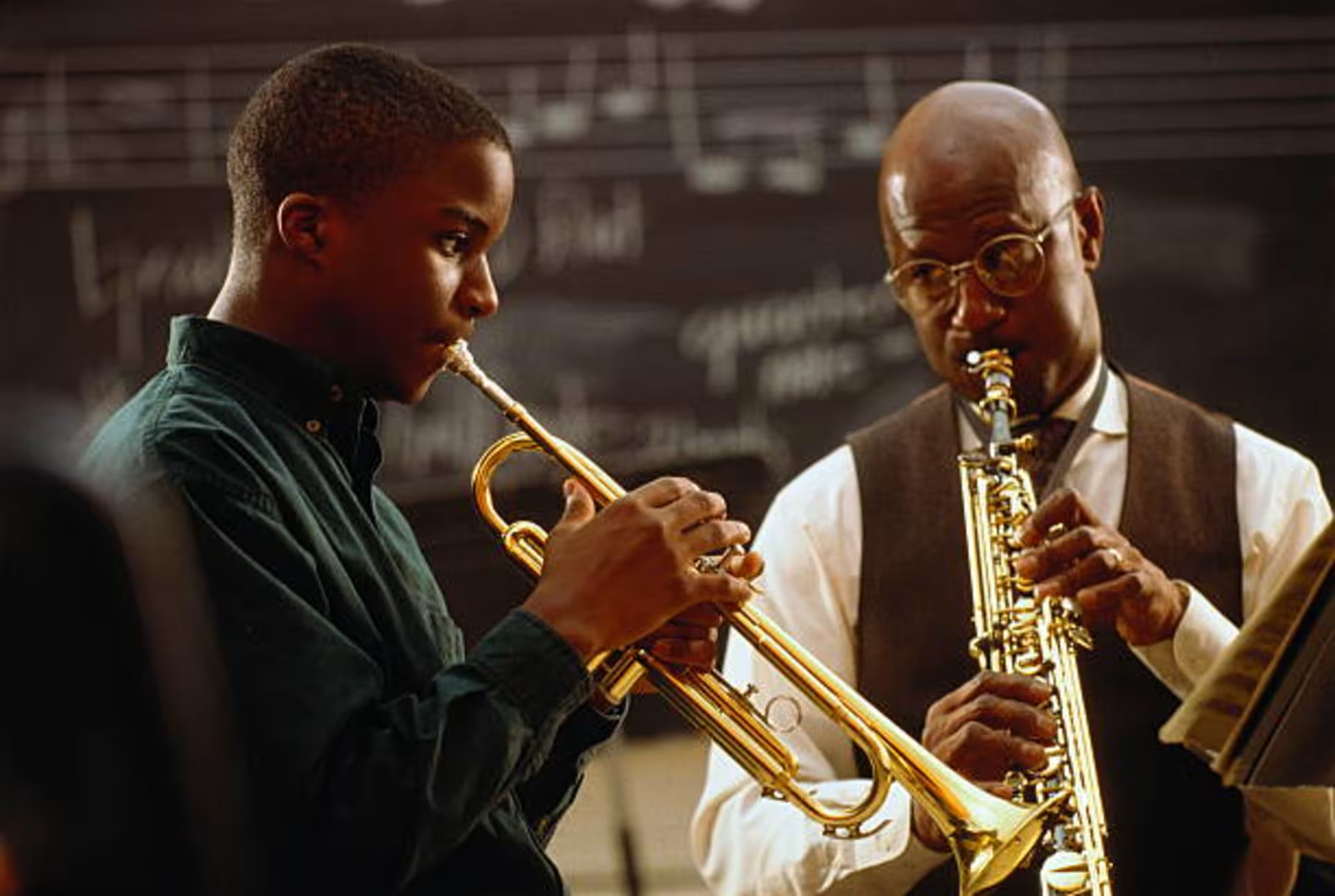

What Does a Music Teacher Do? 

Music teachers are responsible for instructing their students how to play instruments and/or sing. They teach students about music theory and musical techniques and may even give lessons on the historical context of various pieces of music. Above all, music teachers strive to instill a lifelong passion for music in their students. Tasks will generally include:2,3

Lesson Planning

Planning music curriculum and individual lessons is an important part of a music teacher’s job.

Assessments

Teachers must assess their students’ progress in performance and their understanding of music theory and techniques.

Performance Planning

Music teachers plan, coordinate and lead students through performances.

Music Instruction

Music teachers may deliver lessons to groups of students or just one student at a time.

Adjustments

If students are struggling to make progress, music teachers may adjust their teaching style to suit individual needs.

Field Trip Coordination

Sometimes music teachers may take their students on field trips to professional musical performances or related venues.

Music education enables students to both express themselves and develop musical abilities that may give them a sense of self-confidence and accomplishment. Music teachers are instrumental in guiding and nurturing their students' musical skills.

What Skills Does a Music Teacher Need? 

To be effective in the classroom, music teachers need to be able to draw upon a variety of hard and soft skills. Putting these skills to work may allow teachers to have a positive and lasting impact on their students, some of whom may themselves go on to pursue music-related careers. Some of the most important skills for music teachers include the following:2,3

  • Musical ability 
  • Communication 
  • Patience 
  • Time management 
  • Organization 
  • Leadership 
  • Creativity 
  • Decision-making

Where Do Music Teachers Work? 

Music teachers may pursue employment across several settings, including the following:2,3

Public Schools

Music teachers have the opportunity to work with students across all grade levels in public schools, from kindergarten through grade 12.

Music Conservatory

At music conservatories, teachers often focus on training students to pursue careers as professional musicians.

Community Centers

Some community centers may hire music teachers to implement programs for students.

Independent Studio

Some music teachers may set up their own business, serving as private music tutors who teach classes or individual lessons.

Private Schools

Private K-12 schools also employ music teachers to teach group classes and sometimes individual lessons.

Music Schools

Compared to conservatories, music schools typically focus on a broad range of academics, as well as musical instruction.

Afterschool Programs

Teaching music in an afterschool program can offer enrichment opportunities to children.