

A post-baccalaureate teaching certificate is a graduate-level credential designed for individuals who already hold a bachelor’s degree and want to become licensed teachers. These programs focus on essential teaching methods, classroom practices and field experience needed to pursue teacher certification.
Definition of a Post-Baccalaureate Teaching Certificate
Unlike traditional undergraduate teacher preparation programs, post-baccalaureate options allow degree holders from other fields to transition into teaching without completing another full degree. Many programs emphasize practical classroom preparation alongside coursework so candidates can build teaching skills while working toward certification.
Some programs, such as alternative licensure pathways, are intentionally streamlined to help meet the need for qualified teachers.(See disclaimer 1)

“Across the country, there’s a need for teachers,”(See disclaimer 2) explains Dr. Lindy Gaudiano. “Many states have created alternative pathways to licensure so that individuals who want to teach can move into the profession while still completing the required preparation.”
Programs like GCU’s Canyon L.E.A.P. to Teach certificates offer a structured pathway for individuals in Arizona who want to pursue certification through a focused graduate certificate rather than a full degree program.
How Does a Post-Baccalaureate Certificate Differ From a Master’s in Education?
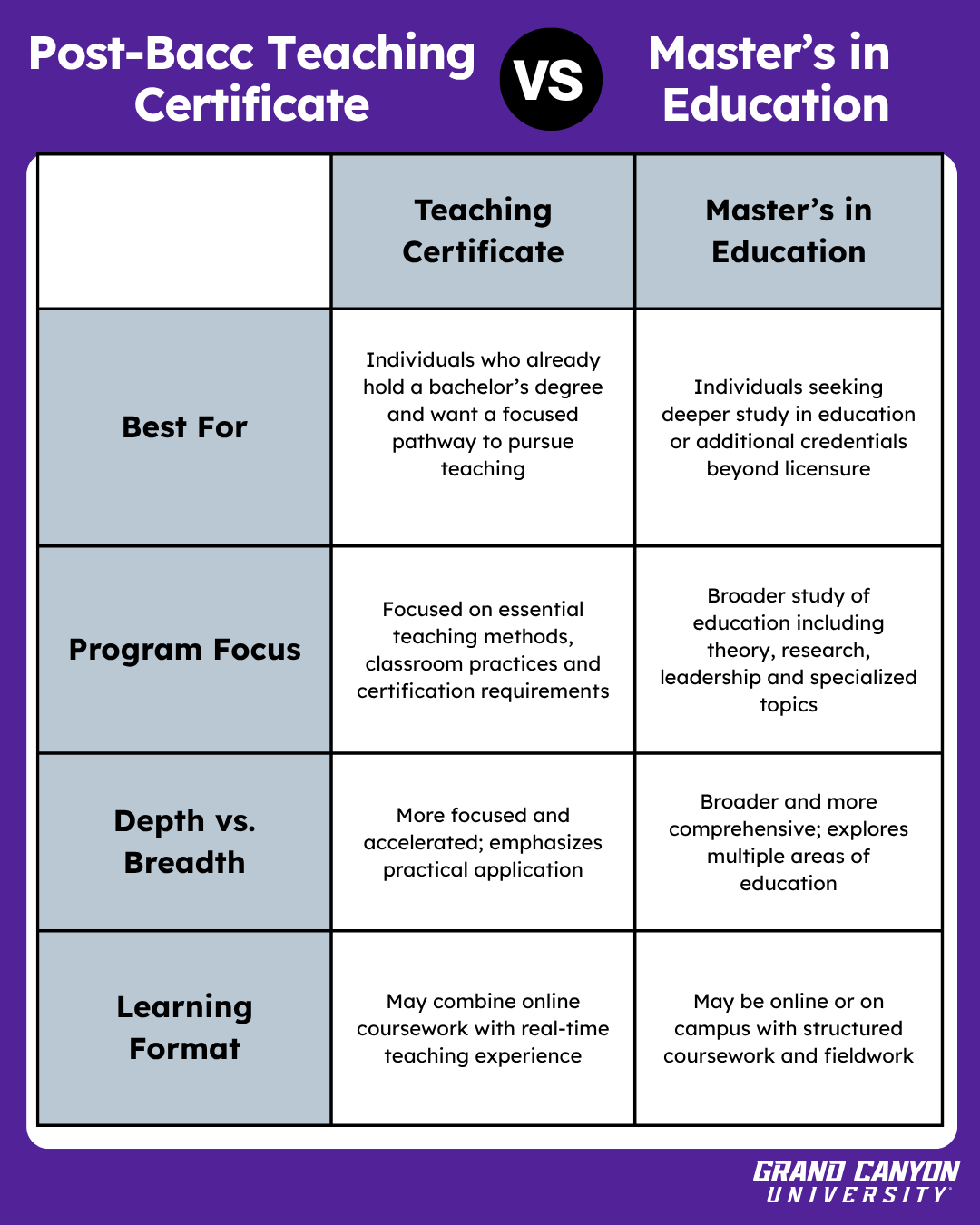
A post-baccalaureate teaching certificate differs from a master’s in education primarily in length, scope and credential outcome.
A master’s in education typically includes broader coursework over a longer period of time. These programs often span two or more years and may explore topics such as educational leadership, curriculum development, research methods or specialized instructional strategies.
Post-baccalaureate teaching certificates, by contrast, focus specifically on preparing candidates for teacher certification.
“With a traditional degree program, you often see a wider scope because the program is stretched out over a longer period of time,” Dr. Gaudiano explains. “With alternative licensure programs, you tend to go deeper faster. You’re in the classroom right away and applying what you’re learning almost immediately.”
This condensed format can appeal to individuals who want to pursue teaching without committing to a full graduate degree program.
Who Is a Post-Bacc Teaching Certification For?
Post-baccalaureate teaching certification programs often attract individuals who already have a bachelor’s degree but did not originally major in education. These programs provide a pathway for people who discover an interest in teaching later in their academic or professional journey.
“Many of the students who pursue alternative licensure programs are working professionals,” Dr. Gaudiano says. “They may have experience in another field and have decided that teaching is the direction they want to pursue.”
College Graduates Seeking an Alternative Route to Teacher Licensure
Some college graduates realize after completing their degree that they want to work in education. Instead of returning to complete a second bachelor’s degree in teaching, a post-baccalaureate certificate may offer a more direct pathway.
These programs allow graduates to focus on the teaching knowledge and field experience required for certification while building on the academic foundation they already have. In many cases, candidates can apply the subject-area knowledge from their original degree toward teaching in a specific content area.
Career Changers Transitioning Into Teaching
Career changers are another group frequently drawn to post-baccalaureate certification pathways. These individuals may have spent years working in another industry before discovering a passion for working with students.
According to Dr. Gaudiano, these candidates often bring valuable perspectives to the classroom. “Career changers often bring important professional experience with them,” she explains. “They’ve worked in another field, they’ve developed skills and they’ve intentionally chosen education as their next step.”
These experiences can contribute to qualities such as resilience, professionalism and commitment, which can be valuable when working with students.
"I would recommend this program to anyone who’s passionate about children and wanting to go into the teaching field and have a solid education and a solid foundation."
How Post-Baccalaureate Teacher Certification Online Programs Work
Many post-baccalaureate certification programs incorporate a mix of coursework and field experience. The exact structure varies depending on the program and state licensure requirements.
Some programs are delivered fully online, while others combine online(See disclaimer 3) coursework with in-person classroom experience. Alternative licensure pathways may also allow candidates to complete coursework while working in a school setting.
Candidates interested in GCU’s Canyon L.E.A.P. to Teach certificates in Arizona must already be a teacher of record, meaning they are working either as a long-term substitute, an apprenticeship teacher, a paraprofessional or some form of certified staff.
Online Course Delivery and Pacing
Online(See disclaimer 3) coursework can provide flexibility for working professionals who are balancing their studies with teaching responsibilities.
Programs such as GCU’s Canyon L.E.A.P. to Teach certificates in Arizona follow a condensed structure. “These programs are intentionally short and focused,” Dr. Gaudiano explains. “Students complete a set number of courses during the same academic year that they are working in a classroom.”
Because students are actively teaching while completing their coursework, they often have the opportunity to immediately apply new concepts in their daily classroom experiences. “If you’re learning about a strategy or instructional method in your coursework, you may be able to try it with your students the very next day,” Dr. Gaudiano adds.
Field Experience and Student Teaching Requirements
Traditional teacher preparation programs often include a dedicated student teaching experience near the end of the program. Alternative certification pathways take a different approach.
“They are already working in the classroom while completing the program,” Dr. Gaudiano explains. “The state has reviewed the program and approved that combination of coursework and classroom experience as preparation for certification.”
Because candidates spend the entire academic year teaching, their daily classroom experience becomes a key component of their professional preparation.
Many schools also provide mentorship or support from experienced educators. “Our expectation is that candidates receive support from their school while they’re teaching,” Dr. Gaudiano says. “They’re getting coursework from the university while also gaining guidance and mentorship from the school system.”
Admission Requirements and Program Expectations
Admission requirements for post-baccalaureate teacher certification programs vary by institution and state licensing guidelines. However, most programs share several common expectations.
Candidates typically must hold a bachelor’s degree from an accredited institution and meet minimum academic requirements. Some programs may also require candidates to already be employed in a school setting.
Academic Prerequisites and Required Documentation
Programs that incorporate a teacher-of-record model may require verification that candidates are actively working in a classroom role.
Common admission requirements may include:
State Specific Requirements for Teacher Certification
Teacher certification requirements are determined at the state level. As a result, preparation programs must align with state education department standards.
Dr. Gaudiano notes that some certificate programs are reviewed and approved by state education agencies to ensure that coursework and field experience meet certification expectations.
Because licensure rules vary from state to state, prospective teachers should review their state’s certification requirements before selecting a program.
"I loved how I was able to teach – I loved the pace of it. It was just really helpful being in the classroom while also earning my degree."
What Do You Learn in a Post-Baccalaureate Teaching Certificate?
Post-baccalaureate teaching certificate programs focus on foundational teaching knowledge and practical classroom skills. Coursework typically addresses both instructional strategies and student engagement.
These programs aim to help candidates develop the confidence and knowledge needed to manage classrooms and support student learning.
Core Teaching Methods and Classroom Management
Many programs introduce candidates to essential instructional methods, lesson planning strategies and classroom management approaches.
Students may explore topics such as:
Because candidates in alternative licensure pathways often teach while completing coursework, they may be able to practice these strategies in real time.
“You’re learning something in your coursework and then applying it immediately,” Dr. Gaudiano explains. “You’re in the classroom every day, so you can see how those ideas work with your students.”
Working With Diverse and Welcoming Classrooms
Teacher preparation programs also often explore strategies for creating welcoming classroom environments that support students with different learning styles, backgrounds and needs.
Candidates may study:
These skills can help future educators develop classrooms where students feel supported and encouraged to participate in learning.
Frequently Asked Questions about Post-Baccalaureate Teaching Certificates
Read through these frequently asked questions to help you decide if a post-baccalaureate teaching certificate is the right choice for you.
Is a Post-Baccalaureate Certificate Worth It?
Whether a post-baccalaureate certificate is worthwhile depends on your career goals and circumstances. For individuals who already hold a bachelor’s degree and want to become teachers, these programs may offer a focused pathway toward certification without committing to a full graduate degree. The condensed timeline can also appeal to candidates who want to move into teaching sooner.
However, accelerated programs require strong time management and commitment. Prospective students should consider their schedule, professional responsibilities and readiness to balance coursework with classroom experience.
What Are the Benefits of a Post-Baccalaureate Teaching Certification?
Post-baccalaureate teaching certification programs may offer several benefits for individuals who already hold a bachelor’s degree and want to pursue teacher licensure. One advantage is the shorter program timeline compared to a master’s degree. These programs also often emphasize practical classroom experience, allowing candidates to gain hands-on teaching practice while completing coursework.
For professionals in other industries, a post-baccalaureate certificate may provide an opportunity to transition into education without pursuing a full graduate degree. In addition, the curriculum is typically focused on core teaching methods and classroom practices needed for certification.
These programs follow a condensed structure, so they often require a strong time commitment, so prospective students should consider their schedule and career goals when deciding whether this pathway aligns with their plans.
How Do I Choose a Post-Baccalaureate Teacher Certification Program?
Choosing the right program involves evaluating several factors related to quality, format and career goals.
Prospective teachers should look for programs offered by accredited universities that align with state teacher certification requirements. Programs approved or recognized by state education agencies may help ensure that coursework and field experiences meet certification standards.
Candidates may also want to research how the program can prepare graduates for licensure within their state.
Both online(See disclaimer 3 )and on-campus programs can offer valuable preparation, but the best choice often depends on personal circumstances. Online(See disclaimer 3) programs may provide flexibility for working professionals or individuals already employed in schools. On-campus programs may offer more in-person interaction and structured schedules. Prospective students should consider how each format aligns with their learning preferences and professional commitments.
Take the Next Step Toward Teacher Certification
If you already hold a bachelor’s degree and are interested in becoming a teacher, a post-baccalaureate certification program may offer a focused pathway to pursue teacher licensure in Arizona.
GCU offers the Canyon L.E.A.P. to Teach graduate certificates for individuals in Arizona seeking certification in elementary or secondary education. These programs provide a condensed route that allows candidates to complete coursework while gaining classroom experience during the academic year.
Learn more about GCU’s programs:
Exploring program structure, certification requirements and career goals can help you determine whether this pathway aligns with your plans to pursue a teaching career.
Start Your Teaching Journey at GCU
Explore GCU’s teaching certificates and learn how you can pursue teacher licensure opportunities.