

A master’s degree is a type of graduate degree — an advanced academic qualification that allows for concentrated study in a field or a specific area of specialization. Many learners decide to earn this postgraduate degree because they wish to enhance their competitiveness in the job marketplace or seek new career opportunities. Earning this type of degree can also allow graduates to prepare for further studies or research opportunities.
At Grand Canyon University, we welcome learners who are interested in nurturing their love of lifelong learning by earning a master’s degree. Our institutionally accredited university offers a variety of flexible master’s programs online and on campus across a range of fields to help learners achieve their goals.
Key Takeaways
You may be qualified to pursue a master’s degree after earning a bachelor’s degree. While a bachelor’s degree is generally the minimum requirement to apply, some master’s degree programs in certain professional fields may also require relevant work experience before applying.
What is a master’s degree’s schedule like? The credit hours required for a master’s degree will vary from one school and specific program to the next. In general, however, you can expect a master’s degree to require fewer credit hours than a bachelor’s degree.
Because of this, it may take less time to complete a master’s. However, this depends on course load and scheduling preferences. Many students enrolled in a master’s degree take classes on a part-time basis while continuing to work, and can therefore expect to take longer to graduate than master’s students who are enrolled on a full-time basis.
At GCU, you’ll find that you can adapt your school schedule to suit your work needs. If you need to work while earning your degree, GCU offers scheduling options that may help you balance your work and academic commitments.
Understanding What a Master’s Degree Is
What master’s degree should I get? Before figuring out which master’s degree program is right for your goals, you should take a closer look at the specifics of postgraduate education.
What Is a Master’s Degree? Definition and Purpose
A master’s degree will generally build upon your undergraduate education. For example, if you earned a Bachelor of Science in Applied Human Resources Management degree, then you might consider applying to the Master of Business Administration with an Emphasis in Strategic Human Resource Management degree to build on your academic foundation in human resources.
A typical bachelor’s degree provides a broad framework of academic competencies in both the chosen major and in general education classes. In contrast, the master’s degree provides a more focused look at your chosen field, often in a specific area of specialization within that field.
For example, you could earn a general MBA degree without an emphasis to examine a number of versatile and transferable business-related skills. Or, you could choose an emphasis on a focus area like strategic human resource management to take a deeper dive into relevant competencies.
By examining advanced knowledge in your chosen area, a master’s degree can allow you to transition from generalist to specialist. It offers career-focused skill development, often with research experience.
While many students plan to use a master’s degree to pursue growth in their field, others may use it to transition to a new field altogether. The master’s degree can also serve as a tool for career switching, as it’s not always necessary for the student to have a bachelor’s degree in the same field as the master’s degree. For example, if you have a background in business but would like to pursue a teaching career, consider looking for a master’s degree in education that leads to initial teacher licensure. However, it is important to note that there may be prerequisite courses that may need to be taken if you are pursuing a master’s degree not relevant to your bachelor’s degree.
The Postgraduate Education Pathway
A master’s degree can be a good option for individuals who pride themselves on being lifelong learners who continuously nurture an inquisitive nature. After earning a bachelor’s degree, enrolling in a master’s degree program can allow you to prepare for future doctoral studies. Postgraduate education can be part of your lifelong journey of learning.
Is a Master’s Degree Worth It?
While you’re the only one who can answer this question for yourself, a master’s degree can indeed be worth it for many people. Certain careers require at least a master’s degree to enter the field. These include jobs such as:(See disclaimer 1)
In other careers, a master’s degree may be a preference for pursuing specialization. These include urban planner, statistician, data scientist and economist.(See disclaimer 1 )
There are plenty of fields in which a master’s degree is a popular choice. Some of the most popular master’s degrees are those in fields like computer science, data science and analytics, business administration, healthcare administration, nursing and cybersecurity.(See disclaimer 1)
"There are 120 students that are looking to me to help them find their own purpose. GCU was able to give me all the help and support I needed to graduate and reach my professional goals."
Various Types of Master’s Degrees
What master’s degree should I get? While you’re working on answering this question with an eye toward your career goals, consider the following types of master’s degrees:
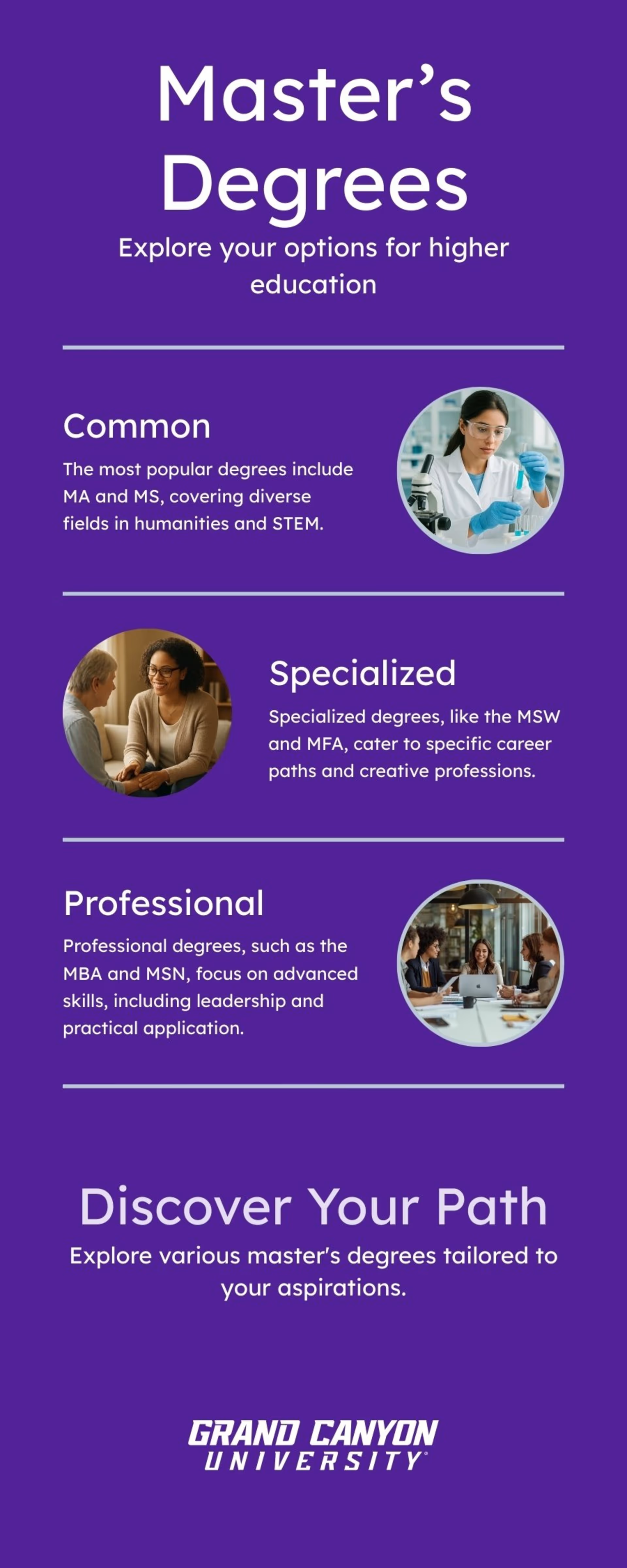
Common Master’s Degrees
There are many different types of master’s degrees across a broad range of professional fields. Two of the most common types are the Master of Arts (MA) and Master of Science (MS).
The MA degree is typically offered in a humanities or social sciences field. For example, you might earn an MA in history or English. There are also MA degrees in creative and visual arts, as well as in fields such as marketing and advertising.
The MS degree is typically offered in fields that demand technical competencies, such as STEM, healthcare, data analytics and business. For example, you might earn an MS in Accounting or an MS in Computer Science.
Other common master’s degrees are professional degrees, such as those that focus on leadership and applied expertise needed to solve everyday problems.
Examples of these professional degrees include the following:
Specialized and International Master’s Degrees
Along with the common master’s degrees, there are some specialized degrees you might not be familiar with. It’s worth taking a look at them to see if any might help you achieve your professional and personal goals. They include:
What You Can Expect in a Master’s Program
Before deciding to devote your time and energy to a master's degree, it's helpful to get a general idea of what to expect. Every degree will have its own requirements, of course, so you should thoroughly research the curriculum, coursework and other requirements for the degree program you’re thinking of enrolling in.
Coursework
You can expect to take courses that are heavily focused on your chosen area of specialization. For example, if you’re earning a Master of Science in Cybersecurity Management degree, then your coursework will cover topics such as cyberattacks and countermeasures, information security, cyber law and policies on cybersecurity. You might also take a course in general management and leadership for the information technology field.
Other master’s degrees may provide a broader education in your field, such as the MBA. If you earn an MBA with a concentration in a specific area, you can expect to take general classes in areas like organizational leadership and management, along with specialized classes in your area of concentration.
Research Project, Thesis or Capstone
Both main types of postgraduate degrees — the master’s degree and the doctoral degree — typically include some sort of major project designed to demonstrate your mastery of the important competencies in your field. Notably, while most doctorates will require original research, most master’s degrees will not.
You may still conduct a research project or write a master’s thesis, but you won’t necessarily conduct original research for it. Some master’s degrees require a capstone course. This is both a course and a project that typically requires hands-on work, such as developing a proposal.
Not all master’s degrees include this type of learning component, however. Some may consist entirely of coursework, although the individual courses may require their own, smaller research projects or papers.
Benefits of Earning a Master’s Degree
Is a master’s degree worth it? Consider the potential benefits of advancing your education and decide for yourself:
"Getting my master's through GCU in public health is helpful for me and invaluable in so many ways. What I learned from it was truly how to serve my community well, not only if I am working in this specific field, but where I minister to."
Choosing the Right Master’s Degree Program
Many colleges offer similar master’s degree programs, but not all are necessarily right for you. Spend some time thinking about how to choose the right master’s degree for your needs.
Alignment With Career Goals
Do you want to continue to climb the ladder within your current industry and area of specialization, or would you like to shift to a new specialty or a different field altogether? Look for a master's degree that will align with your career goals. Consider whether the career you want requires a specific type of master's degree for professional licensure or certification.
Accreditation and Institutional Reputation
You don’t want to spend time and effort earning a master’s degree only to discover later that the school has a poor academic reputation and perhaps isn’t even accredited. Instead, research your options carefully to find a college that is properly accredited. Some master’s degrees have also received programmatic accreditation. Both of these types of accreditation are indicators of academic quality.
GCU has been institutionally accredited continuously by the Higher Learning Commission since 1968. Some of our master’s degree programs have also received programmatic accreditation.
Evaluating Cost, Support and Flexibility
Other factors to consider when choosing a master’s program include the expected tuition costs and other fees, along with the available student support resources. You should also determine whether the degree program offers scheduling flexibility. Many master’s degree programs at GCU, for example, are available via on-campus evening cohorts or online classes.
Are online master’s degrees respected? Absolutely, online degrees are becoming increasingly respected by employers.(See disclaimer 4) In one survey, the vast majority of employers (83%) stated that they viewed online master’s degrees as just as respectable as on-campus master’s degrees. Of course, perceptions can vary based on factors like accreditation and institutional reputation — another reason to choose an accredited school with a strong reputation.(See disclaimer 4)
Why Earn Your Master’s Degree at Grand Canyon University?
GCU offers a wide range of on-campus and online master’s degrees across a range of fields — from business to technology to healthcare and beyond. It’s flexible, accredited education that fits your life.
At GCU, you’ll take faith-integrated courses that emphasize professional integrity and servant leadership from the Christian worldview. You can also benefit from our supportive learning community, career-focused curriculum and the commitment of our instructors to nurture student growth.
Bring Your Passion and Find Purpose
Earn your master’s degree online at GCU and benefit from a supportive learning community.